
About
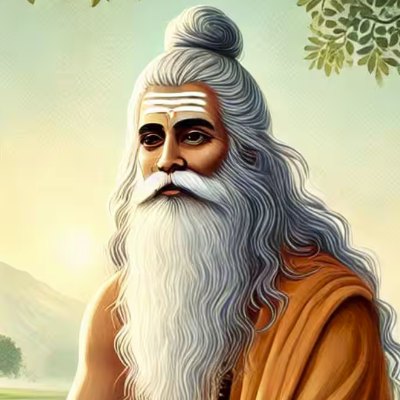
Galava — Sage, Son of Vishwamitra, and Protagonist of the Madhavi Episode
Galava · Kaushika (by gotra) · Son of Vishwamitra and Renumati
Galava is a sage of the Kaushika lineage, the son of the Brahmarshi Vishwamitra — also known as Kaushika, the great-grandson of King Kusha and the celebrated author of much of Mandala 3 of the Rigveda — and his wife Renumati. Galava is attested in multiple sections of the Mahabharata and in the Harivansha, and his name was given to him in childhood owing to a rope of darbha grass tied around his throat. He is most celebrated in the tradition for his protracted and morally complex effort to fulfil a guru-dakshina — a disciple's gift to his teacher — by procuring eight hundred horses of a specified rare description, an endeavour that became the subject of the Galavacharita embedded in the Udyogaparva of the Mahabharata. His narrative is also employed in the epic as a cautionary tale about the dangers of obstinacy.
✦ The Name
The name Galava is derived from the Sanskrit gala, meaning throat or neck. The Harivansha (Chapter 12) records that when his mother, reduced to poverty during a prolonged famine, tied a rope of darbha grass around the boy's neck to lead him to market for sale, the exiled prince Satyavrata intervened and freed him. From the binding at the neck, the child came to be known as Galava. The Devibhagavata Purana's Saptamaskanda preserves the same etymology. The name thus encodes within it the story of the child's early hardship and rescue.
✦ Lineage
- Father: Vishwamitra (Kaushika), the Brahmarshi, descended from King Gadhi of the Chandravamsha, celebrated author of the Gayatri Mantra and much of Rigveda Mandala 3.
- Mother: Renumati (also called Renu), one of several wives of Vishwamitra, named in the Harivamsa Chapter 27 as the mother of Galava along with Renuman, Samkriti, Mudgala, Madhuchhanda, Jaya, and Devala.
- Brothers (through Renumati): Renuman, Samkriti, Mudgala, Madhuchhanda, Jaya, and Devala, as listed in Harivamsa 1.27.46–47.
- Son: Shringavan, who married a woman called Vriddha-kanya, as recorded in the Mahabharata Shalyaparva, Chapter 52, verse 14.
✦ The Childhood Rescue and Education
The account preserved in the Harivansha Chapter 12 describes the circumstances of Galava's naming. Vishwamitra had left his family to perform penance on the banks of the Kaushiki river. During his absence a twelve-year drought struck the kingdom as a consequence of the sins of Satyavrata, the prince who had abducted a Brahmin's bride and been exiled by his father. In this period of famine, Renumati, Vishwamitra's wife, found herself without food or means of support. Driven to desperation, she resolved to sell one of her sons in order to sustain the others, and she tied a rope around the neck of a young child and led him toward the market. The exiled Satyavrata encountered the two on the road, learned who they were, intervened, untied the rope, and undertook to protect the family by leaving food for them at a tree near their hermitage each day until Vishwamitra returned. The child thus freed from the neck-rope was thereafter called Galava.
Following his rescue and the return of Vishwamitra, Galava pursued his education under his father's guidance. The Harivansha also records an episode in which Dharma took the form of Vasishtha and appeared at Vishwamitra's hermitage requesting food. Vishwamitra prepared a ritual rice offering, but the guest departed before eating, saying he would return. Vishwamitra stood waiting with the offering for a hundred years, and throughout this entire period Galava remained by his father's side in devoted attendance. After a hundred years Dharma returned, the meal was accepted, and Vishwamitra blessed Galava for his patience and service.
✦ The Guru-Dakshina and the Madhavi Episode
The central narrative of Galava's life as recorded in the Mahabharata Udyogaparva (Galavacharita, Chapters 104–121) concerns his determination to offer a guru-dakshina to Vishwamitra upon completing his studies. The custom required a student to present a parting gift to his teacher. Vishwamitra initially declined, stating he was satisfied with Galava's years of devoted service and needed nothing. But Galava insisted repeatedly, pressing his teacher to name a gift. Exasperated, Vishwamitra in anger named a gift he believed impossible to obtain: eight hundred white horses, each of which bore a single black ear.
Galava was dismayed, but his divine companion, the celestial eagle Garuda, offered to assist him. Garuda conveyed Galava to the court of King Yayati, once the most powerful monarch of his age. Yayati, now aged and no longer possessing such wealth, was unable to furnish the horses but offered instead his daughter Madhavi, a princess endowed with a remarkable boon: she would conceive sons who would be great kings, and she would regain her virginity after each birth. Yayati proposed that Galava use Madhavi to acquire horses from various kings, exchanging her temporary company for two hundred horses at a time from each king, collecting enough across four kings to total the eight hundred demanded.
Acting on Madhavi's own suggestion and Garuda's guidance, Galava first brought Madhavi to Haryashwa, king of Ayodhya, who had two hundred such horses. A son named Vasumanas was born to them. Galava then brought her to Divodasa, king of Kashi, who also had two hundred horses, and a son named Pratardana was born. He then brought her to Usinara, king of Bhoja, and a son named Shibi was born, with another two hundred horses received. With six hundred horses in hand but still two hundred short, Garuda advised Galava to offer Madhavi herself to Vishwamitra in lieu of the remaining two hundred. Galava did so. Vishwamitra accepted Madhavi and fathered upon her a fourth son, Ashtaka. After this, Galava returned Madhavi to her father Yayati, who arranged a swayamvara for her. At that assembly Madhavi chose to reject all suitors and entered the forest to live as an ascetic.
This narrative was recounted by the sage Narada to Duryodhana in the period before the Kurukshetra war as a moral lesson on the folly of obstinacy, with Galava presented as an example of how stubborn insistence on a course of action, even one undertaken from good motives, can lead to morally troubling outcomes.
✦ Other Appearances in the Mahabharata
The Mahabharata records Galava's presence in several other contexts across its books. He is mentioned as frequenting the court of Yudhishthira in the Sabhaparva (Chapter 4, verse 15) and as shining in the court of Indra in the same book (Chapter 7, verse 10). He is recorded as a friend of King Pratipa in the Harivansha (Chapter 20, verse 13). He once discussed virtue and the nature of prestige with the sage Narada in the Shantiparva (Chapter 286, verse 5), and he addressed Yudhishthira on the subject of fame in the Anushasanaparva (Chapter 18, verse 52). He also swore to vindicate himself in an episode involving lotus flowers associated with the sage Agastya, recorded in the Anushasanaparva (Chapter 94, verse 37). Additionally, the Mahabharata records an episode in which Galava was insulted by the Gandharva king Chitrasena, whose chariot passed overhead and whose spittle fell into Galava's ritual vessel during his evening rites; Krishna was invoked to resolve the matter.
✦ Textual Variants and Inconsistencies
The Mahabharata's Anushasanaparva (Chapter 4, verse 52) identifies Galava as a son of Vishwamitra, and the Harivansha genealogy confirms this. The Galavacharita in the Udyogaparva presents him both as the son of Vishwamitra and as a devoted student of the same sage, roles that are treated as compatible in the text. One source notes that his original name prior to the neck-rope incident is not specified anywhere in the primary texts; the name Galava as it stands is entirely derived from that single incident. The manuscripts.com compilation, drawing on the Devibhagavata and Harivansha, makes this explicit.
✦ Connection to the Wider Genealogy
Galava belongs to the Kaushika gotra through his father Vishwamitra. The Harivamsa Chapter 27 records that Galava's descendants form one of the named sub-lineages of that gotra, referred to as the Galavah. His son Shringavan, who married Vriddha-kanya, is the only descendant named in the primary sources. Through the Madhavi episode, Galava also participates indirectly in the genealogy of several ruling dynasties: the four sons born of Madhavi during his quest — Vasumanas, Pratardana, Shibi, and Ashtaka — became kings of Ayodhya, Kashi, Bhoja, and the Kaushika line respectively, and their descendants form significant genealogical branches in the Mahabharata tradition.
✦ References
- Primary Sources
- Mahabharata, Udyogaparva, Chapters 104–121 (Galavacharita): The principal extended narrative of Galava's guru-dakshina quest and the Madhavi episode, narrated by Narada to Duryodhana.
- Mahabharata, Anushasanaparva, Chapter 4, verse 52: Identifies Galava as a son of Vishwamitra in the Kaushika genealogical list.
- Mahabharata, Anushasanaparva, Chapter 18, verse 52: Records Galava addressing Yudhishthira on fame.
- Mahabharata, Anushasanaparva, Chapter 94, verse 37: Records Galava swearing to vindicate himself in the Agastya lotus episode.
- Mahabharata, Sabhaparva, Chapter 4, verse 15 and Chapter 7, verse 10: Records Galava's presence in Yudhishthira's court and in Indra's court.
- Mahabharata, Shalyaparva, Chapter 52, verse 14: Names Shringavan as Galava's son.
- Mahabharata, Shantiparva, Chapter 286, verse 5: Records Galava's discussion with Narada on virtue and prestige.
- Harivansha (Harivamsa Parva), Chapter 12: The famine and neck-rope episode; the etymology of the name Galava.
- Harivamsa Parva, Chapter 27, verses 46–47: Lists Galava among the sons of Vishwamitra through his wife Renumati.
- Harivansha, Chapter 20, verse 13: Records Galava's friendship with King Pratipa.
- Devibhagavata Purana, Saptamaskanda: Parallel account of the neck-rope episode and etymology of Galava's name.
- Secondary Sources
- Vettam Mani, Puranic Encyclopaedia (1975): Entry on Galava consolidates primary source references to his lineage, name etymology, and major narrative episodes.
- Manuscrypts.com, Galava entry (compiled from primary sources): Synthesises the Harivansha, Devibhagavata, and Mahabharata accounts of Galava's life.
- Wikipedia, Madhavi (princess): Provides a scholarly summary of the Galavacharita, noting the Mahabharata's framing of the narrative as a lesson on obstinacy, and references Indologist Pradip Bhattacharya's analysis of Madhavi's agency within the episode.