
About
Vriddhakanya — The Aged Maiden of the Garga Line, Ascetic and Celestial
Vriddhakanya · Vriddha-Kanya · The Old Maid · Kunigarga's Daughter
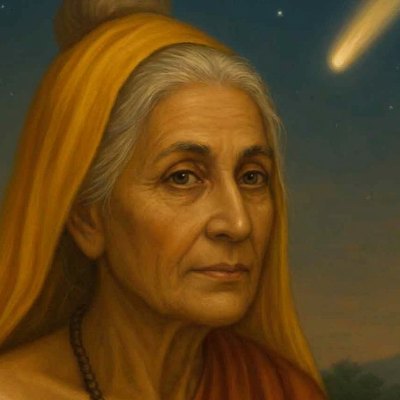
Vriddhakanya, whose name means the aged maiden or the elderly virgin, is a figure from the Mahabharata whose entire narrative appears within a single chapter — the fifty-second section of the Shalya Parva, the ninth book of the epic. She is the daughter of the sage Kunigarga, a rishi of the Garga lineage who brought her into existence not through ordinary birth but through the sole power of his accumulated austerities, and who departed for heaven immediately upon beholding her. Having been raised in no household and guided by no living parent, she devoted her life entirely to ascetic practice in a solitary forest. As the years passed without marriage, she acquired the name by which the tradition remembers her: Vriddhakanya, the old maid. Her story, narrated by Vaishampayana to the king Janamejaya in the context of Balarama's pilgrimage along the Sarasvati river, is one of the most compact and philosophically charged embedded narratives in the Shalya Parva, placed deliberately in juxtaposition with a contrary tale in Chapter 54 — that of Shandilya's daughter, who attained the same celestial regions by remaining celibate. Vriddhakanya is the sole named female figure in her chapter and the protagonist of its entirety. She appears in no other primary text.
✦ The Name
The name Vriddhakanya is a Sanskrit compound formed from vriddha, meaning old or aged, and kanya, meaning maiden, girl, or virgin. It is not a birth name but an appellation acquired through circumstance — the condition of having grown old without having married. The tradition does not preserve a personal name given to her at her creation; she is known entirely by this descriptive epithet, which itself encapsulates the central tension of her story. In the Ganguli translation of the Mahabharata she is referred to as the old maid. The epithet Kunigarga's daughter serves as a secondary identifier linking her to her father's lineage.
✦ Lineage
- Father: Kunigarga — a rishi of the Garga lineage, described in the Mahabharata as a sage of abundant energy and great fame. He created Vriddhakanya through the power of his ascetic concentration alone, without a mother, and immediately after beholding her, abandoned his own body and ascended to heaven. He was a son or descendant of Garga, the sage who founded the Garga gotra, who was himself the son of the Saptarshi Bharadvaja and his Kshatriya wife Susheela.
- Husband: Shringavan — a rishi, son of the sage Galava. Galava was a sage of great antiquity, regarded in the tradition as a son of the sage Vishvamitra, a royal sage who attained brahminhood through extraordinary tapas. Shringavan accepted Vriddhakanya's hand in a formal marriage conducted with fire-ritual observances, under the agreed compact that he would live with her for one night only, receiving half of her accumulated penances in exchange.
✦ Origin: Creation Without a Mother
The circumstances of Vriddhakanya's coming into existence are unusual even within the broad range of extraordinary births attested in Puranic and epic literature. Her father Kunigarga, having practised the most severe austerities, generated her by the directed force of his will — a form of creation the tradition associates with sages of the highest ascetic standing, sometimes called manasa-sristi, creation through the mind or concentrated intention. The text describes her at the moment of her appearance as fair-browed, faultless, amiable, and with eyes like lotus petals. She had no mother, no household, and no guardian except the forest itself. Her father, content with his creative act and its result, departed the mortal world at once. From the first moment of her existence, she was alone and entirely self-determining.
✦ The Life of Penance
Left in a solitary forest, Vriddhakanya devoted herself wholly to ascetic practice. The text specifies that she worshipped the pitris — the ancestral spirits — and the gods through fasting, and that she maintained severe and rigid penances continuously over a long span of time. This pattern of worship combining fasting, propitiation of ancestors, and honour of the divine is the canonical form of forest austerity as represented in the Mahabharata's embedded narrative tradition. Her father had apparently intended before his departure that she be given in marriage; the text notes that although he had desired this for her, she did not herself wish for it, because she found no husband she considered worthy of her. This quiet detail — that she refused marriage not from ignorance of its significance but from discernment — distinguishes her from the passive sufferer and establishes her as a woman who exercised judgment. She continued to emaciate her body with penances, worshipping the pitris and the gods in that solitary forest as the years passed into old age.
✦ Narada's Instruction and the Celestial Barrier
The turning point of Vriddhakanya's story arrives through the intervention of the celestial sage Narada — the peripatetic divine minstrel and messenger who appears throughout the Mahabharata as the bearer of revelation, instruction, and disruption in equal measure. The text records that it was Narada who communicated to her the dharmic doctrine that an unmarried woman, however great her accumulated merit through austerity, could not attain the highest celestial regions. The condition of having been a wife — of having formally entered the institution of marriage and borne its ritual standing — was understood in the tradition of the text to be a necessary precondition for a woman's full ceremonial completion and her consequent access to the highest heaven. This was not a punishment for her long years of genuine asceticism; it was a structural dharmic constraint as the text presents it. No amount of tapas, fasting, or worship of the pitris could substitute, in this understanding, for the ritual station of wifehood.
This revelation transformed the meaning of her entire life of practice. Everything she had accumulated was real and formidable — but it could not carry her to the destination she had earned in every other dimension of her being. The only path forward required that she find a husband willing to marry her despite her advanced age. Armed with Narada's instruction, she went to an assembly of rishis and made a public announcement: she would give half of her entire accumulation of ascetic merit to whoever would accept her hand in marriage.
✦ The Marriage with Shringavan
At this assembly of sages, Shringavan — the son of the sage Galava — came forward and accepted her offer, but with a condition of his own. He proposed a compact: he would take her hand in marriage, but their life together would last only a single night. Vriddhakanya agreed to this compact. The marriage was then conducted according to full Vedic ordinance — Shringavan poured libations on the sacred fire and accepted her hand in the proper manner prescribed by the scriptural tradition, with all the rites duly observed. The text is careful to emphasise that this was a lawful marriage in every formal sense, not a mere arrangement or convenience.
What happened on that wedding night constitutes the climax of the narrative. During the night she spent with Shringavan, Vriddhakanya was transformed. The aged body in which she had lived her entire life of austerity fell away, and she emerged as a young woman of the fairest complexion, clothed in celestial attire, adorned with celestial ornaments and garlands, and anointed with celestial unguents and perfumes. The text conveys that her beauty in this transformed state was so extraordinary that Shringavan, beholding her, was filled with great joy and passed the night in her company. This transformation is presented not as a miraculous reversal of time but as the fulfilment of what her tapas had truly earned her — the radiant form appropriate to her actual spiritual station, now made available by the ritual completion of her status as a wife.
✦ Ascent to Heaven and Shringavan's Grief
When morning came, Vriddhakanya — now transformed and ritually fulfilled as both ascetic and wife — departed the earthly realm and ascended to the celestial regions. The text calls this her auspicious departure for heaven, describing her brahmacaryya — her life of chaste self-discipline — as the foundation on which her entire narrative rested, and calling her story glorious. The account brings her journey to its proper end: years of solitary penance, a single night of lawful union, and then the heaven she had earned.
What the text does not conclude so neatly is the fate of the man left behind. Shringavan, her husband for one night, became very cheerless in her absence, dwelling continuously on the memory of the beauty he had witnessed. The compact he had made — by which he received half her penances as his share — he accepted only with difficulty, the weight of grief making even that extraordinary gain feel insufficient against his loss. Unable to endure the world after what he had seen and experienced, he eventually cast off his own body, following her from the mortal realm, driven by sorrow and compelled — in the precise language of the text — by her beauty. The narrative thus ends with both figures having departed the world, though by different routes and for different reasons: she through the completion of a lifelong ascetic and ritual journey, he through the devastating brevity of a love he had agreed to contain in a single night.
✦ The Tirtha Associated with Her Story
The episode is embedded within the account of Balarama's pilgrimage along the Sarasvati river, which forms the Sarasvata Parva within the Shalya Parva. Balarama visited a tirtha — a sacred ford or bathing place — near the region of Samantapanchaka on the banks of the Sarasvati, where the events involving Vriddhakanya and Shringavan were remembered. It was at this tirtha that Janamejaya, hearing Vaishampayana's account of Balarama's pilgrimage, asked specifically about the origin and history of the aged maiden whose story was associated with the place. The tirtha thus served not merely as a geographical point on the pilgrimage route but as a site of preserved narrative memory, a location sanctified by the completion of a remarkable human story.
✦ Theological and Ethical Significance
The story of Vriddhakanya is one of the Mahabharata's most concentrated explorations of the relationship between personal ascetic merit and social-ritual standing as competing or complementary conditions for liberation. The text presents a woman who is genuine in every dimension of her spiritual practice — she worships faithfully, fasts rigorously, maintains chastity throughout a long life, and accumulates real merit. She is in no sense deficient in virtue. Yet the tradition as the text articulates it holds that this is not enough: the ritual station of wife must also be achieved. The narrative does not interrogate this doctrine; it presents it as the condition of her existence and allows the story to speak through its outcome.
The deliberate placement of this chapter alongside Chapter 54, which presents the opposite conclusion — Shandilya's daughter ascending to heaven precisely through lifelong celibacy — signals that the Mahabharata's compilers were aware of the theological tension between the two accounts. Rather than resolving it, the text preserves both, embedding within the same pilgrimage itinerary two sacred sites that memorialise contradictory verdicts on the same question. This is characteristic of the epic's broader ethical method, which tends to accumulate perspectives rather than adjudicate between them. Vriddhakanya's story is not a defeat of asceticism by institutional requirement; it is one position within the tradition's ongoing and unresolved conversation about what women owe the world and what the world owes them.
Within the category of women in the Mahabharata who are called or described as kanya despite having entered into unions with men, Vriddhakanya occupies a distinct position: she is a maiden whose very name encodes both her purity and the condition that obstructed her ascent, and whose transformation on the night of her marriage represents the reconciliation of a lifetime's spiritual accumulation with a single night's ritual fulfilment.
✦ Connection to the Wider Genealogy
Vriddhakanya is a figure of the Garga lineage through her father Kunigarga, who was a son or descendant of the sage Garga, founder of the Garga gotra. Garga was the son of the Saptarshi Bharadvaja and his Kshatriya wife Susheela, placing Vriddhakanya within a lineage that traced back through Bharadvaja to Brihaspati, preceptor of the gods, and ultimately to Angirasa, one of the founding sages of Vedic tradition. Through her marriage to Shringavan, she entered into a single-night connection with the lineage of Vishvamitra — a royal sage of the Kaushika clan who attained brahminhood and whose son Galava fathered Shringavan. The tirtha on the Sarasvati bank associated with her story thus marks a point of convergence between two of the tradition's great sage-lineages: the Angirasa-Bharadvaja-Garga line and the Vishvamitra-Galava line.
✦ References
Primary Sources
- Mahabharata, Shalya Parva, Chapter 52 (Ganguli translation, 1883–1896): The sole primary source for the entire narrative of Vriddhakanya. Contains the full account from Kunigarga's creation of his daughter through her ascetic life, Narada's instruction, her public offer of half her penances, her marriage to Shringavan, her transformation and celestial ascent, and Shringavan's subsequent grief and self-dissolution. Narrated by Vaishampayana to Janamejaya as an explanation for the tirtha visited by Balarama on the Sarasvati.
Modern and Secondary Reference Works
- Pradip Bhattacharya, "The Complete Shalya Parva" (pradipbhattacharya.com, 2019): Scholarly analysis confirming the deliberate pairing of Chapter 52 (Vriddhakanya, who requires marriage for heaven) with Chapter 54 (Shandilya's celibate daughter, who attains heaven without it), and noting the theological plurality this juxtaposition represents within the Mahabharata's ethical framework.
- Pradip Bhattacharya, "Indraprastha Revisited" (pradipbhattacharya.com, 2017): Confirms the existence of a named tirtha associated with Vriddhakanya along the Sarasvati pilgrim route and notes its omission from certain modern scholarship on Balarama's pilgrimage geography.
- Indica Today, "Yamuna Part II: A Study of Its Links from the Sarasvati Findings": Cross-references the Kuni-Garga daughter episode to Mahabharata 9.50 within the geographic itinerary of Balarama's Sarasvati pilgrimage, situating the tirtha physically near the region of Dadhica and Kurukshetra.
- Manuscrypts.com, "Galava": Confirms with specific verse reference (Mahabharata Shalyaparva Chapter 52, verse 14) that Shringavan, who married Vriddhakanya, was the son of the sage Galava.