
About
Ganesha — Elephant-Headed Son of Shiva, Lord of Beginnings and Remover of Obstacles
Ganapati · Vinayaka · Vighnesha · Vighnaraja · Vighneshvara · Ekadanta · Lambodara · Heramba · Gajanana · Gajamukha · Vakratunda · Dvaimatura · Siddhidata · Mangalamurti · Prathameshvara · Kapila · Dhoomravarna · Siddhi Vinayaka · Ucchishta Ganapati · Mahaganapatih
Ganesha is one of the most widely recognised and extensively documented deities in the Hindu canonical tradition. He is the elephant-headed son of the god Shiva — the supreme ascetic and destroyer among the Trimurti — and the goddess Parvati, daughter of the mountain king Himavat and his consort Mena. Ganesha is the lord of the ganas, the attendant hosts of Shiva, and he presides over beginnings, thresholds, intellect, and the removal or placement of obstacles. He is the deity invoked at the start of any significant undertaking — ritual, literary, military, commercial, or domestic — and his worship is attested across virtually every major sectarian stream of Hinduism. The primary textual sources for his mythology are the Shiva Purana, the Skanda Purana, the Ganesha Purana, the Mudgala Purana, the Brahma Vaivarta Purana, the Linga Purana, the Vamana Purana, the Matsya Purana, the Agni Purana, and the Mahabharata. Ganesha occupies a unique theological position: he is simultaneously a son of the supreme deity and himself the object of an independent sectarian tradition, Ganapatya, in which he is worshipped as the supreme principle underlying all existence.
✦ The Names
The name Ganesha is a compound of the Sanskrit roots gana (a host, group, or assembly) and isha (lord or master), giving the meaning "lord of the ganas." The parallel name Ganapati substitutes pati (lord, husband, master) for isha, yielding the same essential meaning. These two names reflect his primary function as the appointed head of Shiva's divine retinue.
Vinayaka carries the sense of one who leads, removes, or guides without a superior — some interpretations render it as "the one without a master" or "the foremost guide." In the Manava Dharmashastra and certain Vedic contexts, the term vinayaka was earlier applied to a class of malevolent spirits causing obstacles; the application of the name to Ganesha represents a soteriological inversion, wherein the former source of obstacles becomes their remover.
Vighnesha and Vighneshvara both mean "lord of obstacles," identifying him as the deity who both creates and resolves impediments. Ekadanta means "he of the single tusk," a name derived from the episode in which one of his tusks was broken. Lambodara means "he of the pendulous belly," describing his characteristic rotund form. Gajanana and Gajamukha both mean "elephant-faced" or "elephant-headed," the most immediately recognisable of his physical attributes. Vakratunda means "he of the curved trunk." Heramba is interpreted in the Mudgala Purana as meaning "the protector of the weak" and is associated with a five-headed form of Ganesha mounted on a lion. Dhoomravarna means "smoke-coloured," designating one of his avatara forms. Kapila designates another avatara form of reddish-brown colour. Dvaimatura means "he who has two mothers," a name arising from a variant birth narrative in which Ganesha receives a second mother in addition to Parvati. Prathameshvara means "the first lord," expressing his precedence among all deities in the order of worship.
✦ Lineage
- Father: Shiva — the supreme ascetic god, one of the principal deities of the Trimurti alongside Brahma and Vishnu, lord of Mount Kailasha, destroyer and transformer of the cosmos. He is Ganesha's father in the majority of textual accounts, though some accounts describe Ganesha as born from Parvati alone without Shiva's participation.
- Mother: Parvati — goddess, daughter of Himavat (the divine personification of the Himalaya mountains) and his consort Mena. Parvati is the primary mother of Ganesha across virtually all accounts. The Shiva Purana describes Ganesha as created entirely from Parvati's own bodily substance. The Linga Purana and certain other texts describe Shiva as directly creating the child, with Parvati then accepting him as a son.
- Second mother (textual variant): In the Brahma Vaivarta Purana, the goddess Shani (the planetary deity Saturn, here personified as male, casting an inauspicious gaze) destroys the child's original head. The substitute head comes from a celestial being. In some retellings arising from this account, the goddess is given a secondary maternal role. More specifically, in some regional traditions and the Mudgala Purana's conceptual framework, the goddess Riddhi or the collective creative power of the divine is treated as a second generative source, giving rise to the epithet Dvaimatura.
- Brother: Kartikeya (also known as Skanda, Murugan, Kumara, and Shanmukha) — the six-headed god of war and commander of the divine armies, born from Shiva's seed cast into fire or water depending on the textual account. Kartikeya is Ganesha's elder or younger brother depending on which Purana is consulted; the relationship and birth-order is itself a subject of textual variance and of the famous contest episode described below.
- Spouse(s): The Shiva Purana in its Rudra Samhita declares Ganesha to be a lifelong celibate (brahmacharya). However, the Mudgala Purana, the Ganesha Purana, and many other Puranic and iconographic traditions assign him two consorts: Riddhi (Prosperity, or Perfection) and Siddhi (Supernatural Accomplishment). Some texts give him a single consort named Buddhi (Intellect). In Tantric and certain regional traditions, a consort named Shakti or Vinayaki is mentioned. The Brahma Vaivarta Purana gives his consort as Pushti (Nourishment).
- Sons (textual variant): Where consorts Riddhi and Siddhi are recognised, two sons are recorded: Kshema (Safety or Welfare) born of Riddhi, and Labha (Gain or Profit) born of Siddhi. In some texts these names are reversed or the sons are called Subha and Labha.
✦ Birth Narratives
The birth of Ganesha is narrated differently across the major Puranic texts, and no single account is universally canonical. The principal versions are as follows.
The Shiva Purana account (Rudra Samhita, Kumara Khanda): Parvati, wishing to bathe without interruption and finding that Shiva's own attendants would not refuse him entry to her private chambers, fashioned a figure of a boy from the turmeric paste or sandalwood unguent used to cleanse her own body. She breathed life into this figure and appointed him as her doorkeeper, instructing him to admit no one. Shiva arrived and was refused entry by the boy, whose identity he did not recognise. After various of Shiva's ganas failed to overpower the boy in battle, Shiva himself engaged him and, through a deception in which Vishnu or the goddess Parvati distracted the boy's attention, severed his head. Upon discovering that the boy was her own creation, Parvati was overcome with grief and rage, and threatened to destroy the three worlds. The gods, led by Brahma, interceded and pacified her by promising to restore the child. Shiva instructed his ganas to travel north and return with the head of the first living creature they encountered sleeping with its head pointing north. They found an elephant (or the divine elephant Airavata in some versions) in this position, removed its head, and Shiva affixed it to the boy's body, restoring him to life. Shiva then formally recognised the boy as his son, named him Ganapati, appointed him lord of the ganas, and declared that no enterprise should succeed without first invoking him.
The Linga Purana account: In this version, it is the gods who ask Shiva to create an entity capable of placing obstacles before demonic and unrighteous enterprises. Shiva looks at Parvati and a boy emerges radiating enormous beauty, so beautiful that the sages and gods who behold him are troubled with desire. Parvati, disturbed by this, curses the boy to have an elephant's face and a protuberant belly so that his beauty will no longer cause disturbance. The gods then worship Shiva and he formally bestows upon the boy the lordship of the ganas and the power over obstacles.
The Brahma Vaivarta Purana account: This text narrates that after the birth of the child, the gods came to pay their respects on Mount Kailasha. Shani, the deity of the planet Saturn, attended but kept his gaze averted. When asked why, Shani explained that his gaze was so destructive that he feared to look at the child. Parvati, confident in her son's divine nature, insisted that Shani look upon the boy directly. The moment Shani's gaze fell upon the child, the boy's head was severed and flew to the realm of Vishnu. Brahma advised Parvati to replace the head with that of whichever creature was first encountered facing north; the head of a divine elephant was found and affixed. Vishnu, in some versions, travels to the banks of the celestial river and obtains the head himself.
The Matsya Purana and Agni Purana accounts: These texts give a shorter narrative in which Shiva himself fashions the boy at Parvati's request and the elephant head is given from the beginning, without the episode of decapitation.
The Skanda Purana account: One narrative strand within the vast Skanda Purana describes Parvati as creating the child from the effulgence of her own body, while another strand describes him as born from Shiva. The Skanda Purana is internally diverse and contains multiple independent accounts.
The Varaha Purana account: In this text, Ganesha is described as manifesting directly from Shiva in the context of a cosmic battle against demons, without the detailed birth narrative found elsewhere.
✦ The Broken Tusk
Ganesha is consistently depicted with one full tusk and one broken tusk, and several distinct narratives account for this. The principal accounts are as follows.
The Mahabharata scribal account: The Mahabharata itself, in its framing narrative, records that the sage Vyasa — the divine compiler of the epic, a son of the sage Parashara and the fisherman's daughter Satyavati — required a scribe capable of writing without pause as he dictated the verses. Brahma suggested Ganesha for this task. Ganesha agreed on condition that Vyasa never pause in his dictation. Vyasa agreed on the counter-condition that Ganesha understand every verse before writing it. During the dictation, Ganesha's stylus broke. Rather than interrupt, he broke off his own tusk and used it as a writing instrument, preserving the continuity of the text. This account is found in the Adiparvan of the Mahabharata and gives Ganesha the additional epithet Kavi (poet or learned one) in the framing narrative context.
The Shiva Purana and Skanda Purana — battle with Parashurama: In this account, the sage Parashurama — a partial avatara of Vishnu, son of the sage Jamadagni and Renuka, and the destroyer of the Kshatriya class through twenty-one generations — came to Mount Kailasha to pay respects to Shiva, who was asleep. Ganesha, acting as doorkeeper, refused him entry. A furious altercation followed. Parashurama hurled at Ganesha the axe that Shiva himself had given him. Ganesha, recognising the divine origin of the weapon and out of respect for his father, did not evade it but allowed it to strike his tusk, which was thereby severed. Parvati was incensed and threatened Parashurama; the matter was eventually resolved and Parashurama acknowledged Ganesha's supremacy.
The battle with the demon Gajamukhasura: A further account, recorded in regional and later Puranic texts, narrates that in a battle with the demon Gajamukhasura (a demon with an elephant face), Ganesha broke off his own tusk and used it as a weapon. Struck by the tusk, Gajamukhasura was transformed into a mouse, which subsequently became Ganesha's vehicle (vahana).
✦ The Mouse Vehicle
Ganesha's vahana (divine vehicle or mount) is the mouse, called Mushika or Akhu. The mouse is a subject of considerable symbolic commentary in the tradition, and its origin too is narrated in multiple ways. In the Ganesha Purana, the mouse was originally the gandharva Krauncha, who accidentally trod upon the sage Vamadeva and was cursed to become a mouse. The mouse grew enormous and caused havoc until subdued by Ganesha, who cast his noose over it; it then became his mount. In the account involving Gajamukhasura mentioned above, the demon is converted into a mouse upon being struck by the broken tusk. The Mudgala Purana gives variant accounts for different forms of Ganesha, each with distinct narratives of the mouse. The mouse, as Ganesha's vehicle, is interpreted theologically as representing the mind or the ego — restless, small, capable of gnawing through any barrier — subdued and guided by the lord of wisdom who rides it.
✦ The Contest Between Ganesha and Kartikeya
One of the most widely known and frequently retold episodes involving Ganesha concerns a contest between him and his brother Kartikeya, the six-headed god of war and divine army commander. The episode is found in the Shiva Purana and the Skanda Purana among other sources, though with significant variation in details.
The occasion of the contest varies: in some tellings, the prize is sovereignty over the ganas; in others, it is the first right to be worshipped; in yet others, the prize is described as a divine fruit of wisdom or immortality. Shiva and Parvati announced that whichever of their two sons first circumambulated the entire earth would receive the prize. Kartikeya, possessing his magnificent peacock vehicle, immediately set off at great speed to travel around the world. Ganesha, whose vehicle is the small mouse and whose body is large and heavy, reflected upon the nature of the contest. He then circumambulated his parents, Shiva and Parvati, and presented himself as the winner, declaring that the parents are the entire cosmos and that circling them constitutes circling the world. Shiva and Parvati accepted this reasoning and awarded Ganesha the prize. Kartikeya returned to find his brother victorious and, depending on the account, either accepted the outcome graciously, left Kailasha in indignation to dwell permanently in the south of Bharata, or was placated and reconciled.
The episode is of considerable theological importance, as it establishes the philosophical and devotional primacy of Ganesha over Kartikeya in many Puranic traditions, and provides a narrative grounding for his title Prathameshvara (the first lord). The departure of Kartikeya to the south in the indignant version of the account is also used to explain the deep roots of Murugan (Kartikeya) worship in Tamil Nadu and southern India, where Kartikeya has historically been more prominent than in northern traditions.
✦ Ganesha and the Moon
The Brahma Vaivarta Purana, the Ganesha Purana, and several other texts record the following episode. On the fourth day of the bright fortnight of the month Bhadrapada, Ganesha was returning from a feast at the home of Kubera — the lord of wealth and the regent of the northern direction — or in some versions from the home of the sage Moudgalya, having eaten so enormously that his stomach was distended to bursting. As he rode on his mouse, a snake crossed the path, startling the mouse. Ganesha fell from his mount and his stomach burst open, spilling the food. Ganesha collected the food, replaced it in his stomach, and bound his belly closed with the same snake. The moon, observing all this from the sky, burst into laughter at the comical spectacle. Ganesha, deeply affronted, cursed the moon: anyone who looks upon the moon on that night — the Chaturthi (fourth day) of Bhadrapada — would be falsely accused of some wrongdoing or suffer public disgrace.
The moon, chastened, implored Ganesha to retract or soften the curse. Ganesha modified it: the curse would apply only during that one night of the year (the Ganesha Chaturthi), and even then, whoever on that night inadvertently saw the moon but then heard the narrative of the false accusation against Krishna — the avatara of Vishnu — concerning the Syamantaka jewel would be freed from the curse's effect. This connection to the Syamantaka jewel episode of the Bhagavata Purana and the Vishnu Purana is an example of the intertextual linkages common in Puranic literature. From this episode arises the widespread observance of not looking at the moon on Ganesha Chaturthi.
✦ Ganesha in the Mahabharata
Ganesha appears in the Mahabharata primarily in the framing narrative of the Adiparvan, the first book of the epic. The sage Vyasa, described in the epic as the compiler of the work and a son born of the union of the sage Parashara and Satyavati, wished to compose the great history but needed a scribe who could write as fast as he could dictate without a single pause. Brahma, the creator god, recommended Ganesha for this purpose. Ganesha agreed to serve as scribe on the condition that the dictation would never be interrupted. Vyasa countered that Ganesha must fully comprehend each verse before writing it. This mutual condition had a practical consequence: it allowed Vyasa, whenever he wished to think through a particularly complex verse, to compose a deliberately abstruse stanza that would occupy Ganesha's comprehension for a moment while Vyasa composed the next portion in his mind. The Mahabharata attributes 8,800 such verses of great profundity, called guhya shlokas, to this device. Ganesha's role as the scribe of the Mahabharata establishes a narrative link between the supreme text of the Itihasa tradition and the deity of wisdom and auspicious beginnings.
Beyond the framing narrative, Ganesha is not a major participant in the events of the Mahabharata's main story. However, the Ganesha Purana and the tradition more broadly affirm that Ganesha, as the lord of obstacles, was implicitly present in every turning-point of the epic, governing the outcomes of battles, negotiations, and divine interventions.
✦ Ganesha and the Demon Sindura
The Ganesha Purana narrates a major battle episode in which the demon Sindura, who had performed extensive austerities and obtained a boon of near-invincibility, became a terror to the gods and to righteous humanity. The gods, unable to defeat him, sought Ganesha's aid. Ganesha manifested in a warrior form and engaged Sindura in battle. After a prolonged conflict, Ganesha slew Sindura and liberated the worlds from his oppression. The reddish cosmetic powder called sindura (vermilion) is associated with this episode in some traditions, where it is said to be the blood of the demon that Ganesha applied to his own forehead as a mark of victory, explaining the use of sindura in Ganesha worship.
✦ Ganesha and the Demon Analasura
The Mudgala Purana and certain regional texts narrate the episode of Analasura (also rendered Anala or Analasura), a fire-breathing demon of enormous destructive power who devastated the worlds. The sages and gods fled and appealed to Ganesha. Ganesha engaged Analasura and, in an act of extraordinary self-sacrifice and power, consumed the demon entirely by swallowing him whole. The fire within the demon then burned terribly in Ganesha's stomach. To cool the internal heat, the gods brought him cooling substances: the moon placed his crescent on Ganesha's head, Vishnu offered him the lotus, Shiva offered him serpents, and the sages brought him durva grass (a variety of three-bladed grass, Cynodon dactylon). The durva grass, carried in Ganesha's twenty-one handfuls, is said to have finally extinguished the demonic fire. This narrative provides the mythological grounding for the distinctive ritual offering of durva grass in Ganesha worship, where twenty-one blades or bunches are offered. Durva is considered the most sacred offering to Ganesha and is attested across the Puranic and Agamic traditions.
✦ Ganesha and the Demon Mushikasura
The Ganesha Purana contains the narrative of Mushikasura, a demon who could transform into a mouse of enormous size and who terrorised the three worlds. Ganesha was called upon to subdue him. Ganesha cast his divine noose (pasha) and subdued Mushikasura, who then surrendered and requested to become Ganesha's vehicle. Ganesha accepted and Mushikasura, now reduced to a mouse, became his vahana. This account partially overlaps with the Gajamukhasura and Krauncha accounts and represents one strand in the complex tradition surrounding the origin of the mouse vehicle.
✦ Ganesha and Kubera
The Shiva Purana and the Brahma Vaivarta Purana include the episode in which Kubera — the lord of wealth, treasures, and the northern direction, one of the eight directional guardians (Ashtadikpala) — invited Ganesha for a meal with the intention of displaying his enormous wealth and the grandeur of his hospitality. Ganesha arrived and began to eat, but no matter how much food was produced, his hunger was not satisfied. He consumed all the dishes prepared, then all the dishes in the storehouses, then began to consume the palace furnishings and finally threatened to consume Kubera himself. Kubera, alarmed and humiliated, rushed to Shiva on Mount Kailasha and reported what was happening. Shiva gave Kubera a handful of roasted rice (puffed or parched grain) to offer to Ganesha with humility. When Kubera returned and offered this simple food with genuine devotion and without pride, Ganesha's hunger was immediately and completely satisfied. This episode is a teaching narrative on the vanity of wealth-display and the superior power of humble, sincere devotion over material abundance.
✦ Ganesha and the Sage Agastya
In the Skanda Purana and in narratives surrounding the composition of the Vinayaka Panchanga, Ganesha is described as having imparted teachings on worship, propitious times, and the proper conduct of rites to the sage Agastya — the great Vedic sage who is credited with bringing Vedic learning to southern India and who is associated with the star Canopus. Agastya, though himself of immense learning, approached Ganesha to obtain instruction on how to remove obstacles from the path of righteous spiritual seekers. Ganesha's role as teacher to Agastya in these narratives establishes his authority in the domain of ritual knowledge.
✦ Ganesha Obstructing the Kailasha Journey
A narrative found in the Shiva Purana describes the demon king Ravana — the ten-headed lord of Lanka and the principal antagonist of the Ramayana, a brahmin-born son of the sage Vishravas and the daitya woman Kaikasi — who was an exceptional devotee of Shiva. Ravana had performed extreme austerities and obtained great boons. At one stage he attempted to uproot Mount Kailasha, the abode of Shiva, to take it to Lanka. Shiva pressed Kailasha down with his toe, trapping Ravana's hands. Ganesha is mentioned in some versions as having blocked Ravana's access to the mountain precinct prior to this event, acting in his capacity as the doorkeeper of Kailasha. While the central action (Shiva pressing down with his toe) belongs to Shiva directly, Ganesha's role as gatekeeper is referenced in the narrative context.
✦ Ganesha in the Ganesha Purana — Avatara Forms
The Ganesha Purana describes four great avatara manifestations of Ganesha across the four cosmic ages (yugas). In the Krita (Satya) Yuga, he manifested as Mahotkata Vinayaka, possessing ten arms and riding a lion, born to the sage Kashyapa — the great progenitor sage who fathered much of the world's living population — and the sage's wife Aditi, the mother of the Adityas. In this form he slew the demons Narantaka and Devantaka, who were sons of the demon Kashyapa (a demon of the same name as the sage, not to be confused with the sage). In the Treta Yuga he manifested as Mayureshvara, possessing six arms and riding a peacock, born to Shiva and Parvati, and slew the demon Sindura. In the Dvapara Yuga he manifested as Gajanana, the familiar four-armed elephant-headed form riding a mouse, born to Shiva and Parvati, to restore order and protect the righteous. In the Kali Yuga he will manifest as Dhumraketu (Dhoomraketu), riding a grey horse, to restore cosmic order at the end of the age.
✦ Ganesha in the Mudgala Purana — The Eight Forms
The Mudgala Purana, which is a dedicated Upapurana of the Ganapatya sect, presents an elaborate theological system structured around eight forms (ashtamurtis) of Ganesha, each corresponding to a type of obstacle, a mythological demon, and a specific manifestation of Ganesha who defeats that demon. The eight forms are: Vakratunda (curved trunk), who defeats the demon Matsarasura (the demon of envy); Ekadanta (single tusk), who defeats Madasura (the demon of pride or intoxication); Mahodara (large belly), who defeats Mohasura (the demon of delusion); Gajavaktra or Gajamukha (elephant face), who defeats Lobhasura (the demon of greed); Lambodara (pendulous belly), who defeats Krodhasura (the demon of anger); Vikata (misshapen or grotesque), who defeats Kamasura (the demon of desire); Vighnaraja (king of obstacles), who defeats Mamasura (the demon of possessiveness or ego); and Dhumravarna (smoke-coloured), who defeats Abhimanasura (the demon of false identity or conceit). This eight-fold schema is the Mudgala Purana's distinctive theological contribution and forms the basis of a systematic soteriology in Ganapatya tradition.
✦ Ganesha and the Demon Kartaviryarjuna — Harivamsha Reference
Some later Puranic and subsidiary texts include references to Ganesha's intervention in conflicts involving Kartaviryarjuna — the thousand-armed king of the Haihaya dynasty, a devotee of the deity Dattatreya, who was later slain by Parashurama. While Ganesha's role in these accounts is minor and the accounts are found in later, less canonical strata, they reflect the tradition's tendency to retroactively insert Ganesha as a causative or supervisory presence at major historical junctures.
✦ Ganesha in the Ramayana Tradition
Ganesha does not appear as a character in Valmiki's original Ramayana. However, the later tradition — particularly in regional retellings and in the Adhyatma Ramayana, a text embedded within the Brahmanda Purana — introduces Ganesha in the framing context of Valmiki composing the text or receiving divine sanction for it. In the popular tradition, the Adhyatma Ramayana is itself said to have been recited by Shiva to Parvati, and it is sometimes framed as being under Ganesha's auspice as the deity of all sacred beginnings. Some regional traditions (particularly in Maharashtra and Odisha) also relate that the Lanka bridge constructed by the monkey armies under Rama was built under Ganesha's auspice, though this is not found in Valmiki's text.
✦ Ganesha's Obstructing of Shani
The Brahma Vaivarta Purana also contains a narrative in which Ganesha, having been restored with an elephant head, was presented before the assembly of the gods. Shani (the deity of Saturn) refused to look at him, still guilt-ridden from the episode of his gaze destroying the original head. When pressed, he explained the destructive nature of his gaze. Vishnu intervened and Shani's curse was acknowledged as the mechanism by which the divine plan was fulfilled — for had the elephant's head not been required, Ganesha would not have his distinctive and revered form. This narrative transforms the potentially inauspicious episode into a theodicy explaining Ganesha's form as divinely intended rather than accidental.
✦ Ganesha and the Tulasi Plant
The Ganesha Purana contains the account of Tulasi — the sacred basil plant, treated in the tradition as a manifestation of the goddess Lakshmi or as an independent divine being — who, encountering Ganesha meditating on the banks of a river in his most beautiful divine form, was overcome with desire for him and proposed marriage. Ganesha declined, as he was either in a state of brahmacharya or already promised to Siddhi and Riddhi depending on the specific account. Tulasi, wounded by the rejection, cursed Ganesha that he would be compelled to marry. Ganesha in turn cursed Tulasi that she would be married to a demon (in some versions, this becomes the basis of the narrative of Tulasi's marriage to the demon Shankhachuda). The mutual curse narrative is significant because it establishes a ritual prohibition: Tulasi leaves, though used in the worship of almost every other Hindu deity (particularly Vishnu), are not offered to Ganesha.
✦ Ganesha's Appointment as Lord of the Ganas
Multiple Puranic texts, including the Shiva Purana, the Skanda Purana, and the Vamana Purana, record the formal ceremony in which Shiva appointed Ganesha as the commander of his ganas and lord over all obstacles. The ceremony took place after Ganesha's restoration to life with the elephant head. Shiva announced before the assembled gods, sages, and celestial beings that Ganesha would henceforth be worshipped first before any other deity in any act of worship; that no enterprise — human or divine — would succeed without his prior propitiation; and that he would have authority over obstacles, being able to place them before the unworthy and remove them for the devoted. Brahma, Vishnu, Indra, and all the assembled gods ratified this decree by their worship. The Shiva Purana presents this as the definitive cosmic charter of Ganesha's authority.
✦ Ganesha in the Vedic and Pre-Puranic Context
The deity Ganesha in his fully developed elephant-headed form is not found in the Rigveda or the other principal Vedic Samhitas. However, the tradition, particularly the Ganapatya sect, identifies certain Vedic passages as proto-references to Ganesha. The most important is the hymn beginning Ganapati in the Rigveda (2.23.1) addressed to Brahmanaspati or Brihaspati, the divine lord of prayer and sacred speech. The Ganapatya exegetes read this as a reference to Ganesha, though the scholarly consensus identifies the Vedic figure as the deity of sacred utterance (Brihaspati or Brahmanaspati) rather than the elephant-headed Ganesha of the Puranas. The Atharva Veda contains a hymn to a being called Ganapati that the Ganapatya tradition similarly claims for Ganesha. By the period of the Yajnavalkya Smriti and the Grihya Sutras, a deity called Vinayaka (in a class of obstacle-causing spirits) is mentioned, and the Manava Grihyasutra describes four Vinayakas as malevolent beings to be pacified. The gradual transformation of Vinayaka from an obstacle-causing spirit to the supreme remover of obstacles is a textually traceable development from the Smriti period through the Puranic period.
✦ Ganesha in the Ganapatya Sect — Supreme Deity
The Ganapatya tradition, one of the six major sectarian streams of classical Hinduism (alongside Shaiva, Vaishnava, Shakta, Saura, and Kaumara), treats Ganesha not as a subordinate deity or as a son of Shiva but as the supreme principle underlying all existence. In this framework, Shiva, Vishnu, Brahma, and all other deities are understood as manifestations or aspects of Ganesha, who is identified with Brahman — the ultimate impersonal absolute. The Ganapati Atharvashirsha Upanishad, a text associated with the Atharva Veda tradition, is the primary scriptural authority of this identification. It presents Ganesha as identical with all of the Vedic deities and with the formless absolute. The Mudgala Purana similarly presents Ganesha as the source of all creation, with Brahma, Vishnu, and Shiva emerging from him. This sectarian interpretation coexists in the textual tradition with the Shaiva Puranic presentation of Ganesha as Shiva's son.
✦ Textual Variants and Inconsistencies
The Puranic record contains numerous significant contradictions and points of variance concerning Ganesha, of which the most important are the following.
Origin: The Shiva Purana states that Ganesha was created entirely from Parvati's own body substance, without any contribution from Shiva. The Linga Purana presents Shiva as creating the child, with Parvati's role secondary. The Brahma Vaivarta Purana introduces the episode of Shani's destructive gaze as the mechanism of the head's loss. The Matsya Purana gives a brief account in which Shiva creates the child with the elephant head from the beginning. These accounts cannot all be simultaneously true in their literal particulars.
Celibacy versus marriage: The Shiva Purana (Rudra Samhita) explicitly designates Ganesha a lifelong celibate. The Mudgala Purana, the Ganesha Purana, the Brahma Vaivarta Purana, and the broader iconographic tradition assign him two wives (Riddhi and Siddhi). This is a direct textual contradiction that different sectarian traditions resolve differently: the Shaiva Puranic tradition tends toward celibacy, while Shakta-influenced Puranas and Tantric traditions tend toward the married form.
Birth order relative to Kartikeya: In the Shiva Purana, Ganesha is generally treated as younger than Kartikeya, who was born first to fight the demon Tarakasura. In the Skanda Purana and in Tamil traditions rooted in Sangam and post-Sangam literature, Murugan (Kartikeya) is clearly the elder. However, some Puranic passages treat Ganesha as the elder. This variance is never resolved within the canon and different traditions perpetuate different birth orders.
The source of the elephant head: Some texts specify that the head came from a divine elephant (Airavata, Indra's vehicle); others simply say a wild elephant sleeping with its head pointing north was found; others say the head came from a specifically created divine elephant; and still others (the Brahma Vaivarta Purana account) give a different mechanism altogether via Shani's gaze. These accounts are not harmonisable in their literal details.
Relationship to Vishnu's intervention: In some versions of the decapitation episode, Vishnu plays an active role — either suggesting the elephant head, retrieving it, or distracting the boy at the moment of decapitation. In others, Vishnu is not mentioned and the solution is reached by Shiva alone.
✦ Theological and Philosophical Significance
Ganesha's theological significance operates on several levels simultaneously. In the Shaiva Puranic tradition he is the son of the supreme deity and the appointed lord of beginnings, occupying a position of practical supremacy in devotional life even if metaphysically subordinate to Shiva. In the Ganapatya tradition he is identified with the supreme absolute, making him the highest deity without qualification. In the Shakta tradition he is the son of the supreme goddess and therefore subordinate to Devi but superior to all male deities in the world-maintaining order. In Tantric traditions he occupies the threshold between the manifest and unmanifest, governing the possibility of all spiritual and material movement.
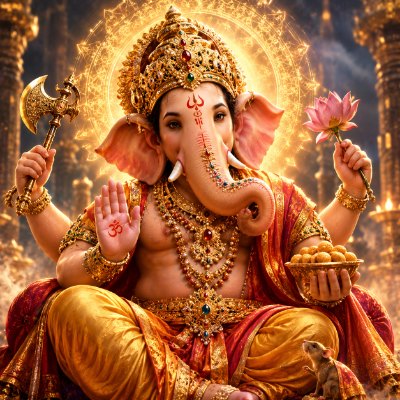
His composite form — the body of a human being with the head of an elephant, one full tusk and one broken tusk, a large belly, and a mouse as a vehicle — is extensively interpreted in the tradition. The elephant head is glossed as the sign of great intelligence, as elephants are recognised in the tradition as animals of exceptional memory and wisdom. The large ears are understood as the capacity to receive and hold all knowledge. The small mouth and large ears signify the priority of listening over speaking. The large belly contains all of the cosmos, in parallel with the cosmic belly of Vishnu. The mouse represents the controlled ego or the penetrating intellect that passes through all barriers. The broken tusk variously represents sacrifice, the priority of duty over physical completeness, and the instrument of writing (in the Mahabharata scribe account).
✦ Iconography
The standard iconic form of Ganesha shows him with the head of an elephant, usually with a single tusk intact on the right side and the left tusk broken, though some regional traditions show the right tusk broken. His body is that of a short, rotund human figure. He is depicted with four arms in the most common form, though two-armed, six-armed, eight-armed, ten-armed, twelve-armed, and sixteen-armed forms are attested in the Agamic and Tantric manuals. His trunk curves to the left in the majority of standard domestic and temple icons; the right-curving trunk form (Siddhi Vinayaka) is considered more powerful and more demanding in its worship requirements, and its icons are relatively rarer. His vehicle is the mouse, Mushika. His standard four-armed attributes are the ankusha (the elephant goad, symbolising the power to direct), the pasha (the noose, symbolising the power to bind or restrain), the broken tusk (held in one hand or naturally part of his form), and a modaka (a sweet rice-ball delicacy, symbolising the reward of wisdom and devotion). The modaka is Ganesha's characteristic food offering and is universally associated with him across all regional traditions.
His colour varies by sectarian affiliation and text. The Shiva Purana associates him with a golden or red complexion. The Mudgala Purana gives distinct colours to his eight forms (white, red, yellow, blue, green, grey, smoke-coloured, and tawny-red). The Tantrasara and Agamic manuals specify vermilion red as his most characteristic colour in domestic worship, which is why he is frequently coated in sindura paste in temple and domestic usage.
The Ashtavinayaka shrines of Maharashtra represent eight self-manifested (svayambhu) forms of Ganesha at eight sacred sites — Morgaon, Siddhatek, Pali, Mahad, Theur, Lenyadri, Ozar, and Ranjangaon — each with a distinct iconographic form and mythological narrative, and each holding the status of a major pilgrimage destination in the Maharashtrian Ganapatya tradition.
✦ Connection to the Wider Genealogy
Ganesha stands within the Shaiva genealogical network at the juncture of several major lineages. His father Shiva is the son (or, in other accounts, the transformation) of Rudra of the Vedic tradition, who is himself a form of the supreme cosmic principle. His mother Parvati is the daughter of Himavat, who is the divine embodiment of the Himalaya mountains and a son or descendant of the mountain lineage of the earth's geography as described in the Puranas. Through Parvati, her sister Ganga — the goddess of the sacred river, who flows from Shiva's matted hair — is Ganesha's maternal aunt. His brother Kartikeya was born from Shiva's seed, which passed through fire (Agni, the Vedic fire god) and water (the Ganga) before giving birth to the six-headed child nurtured by the six Krittikas (the Pleiades asterism, personified as six divine mothers). Kartikeya is thus directly connected to the fire deity Agni, to Ganga, and to the Krittikas in his own genealogical narrative. Ganesha's consorts Riddhi and Siddhi are daughters of Vishvakarma — the divine craftsman of the gods — in some Puranic accounts, which connects him to the artisan lineage of the divine world. His sons Kshema and Labha (where they are recorded) are members of the divine progeny through whom the blessings of Ganesha — welfare and prosperity — extend into the world.
✦ References
Primary Sources
- Shiva Purana, Rudra Samhita, Kumara Khanda: The principal source for the creation of Ganesha from Parvati's body substance, the decapitation episode, the affixing of the elephant head, the appointment as lord of the ganas, the battle with Parashurama and the breaking of the tusk, the celibacy declaration, and the Kubera feast episode.
- Ganesha Purana (Upasana Khanda and Krida Khanda): The principal dedicated Purana of the Ganapatya sect; source for the four avatara forms across the four yugas (Mahotkata, Mayureshvara, Gajanana, Dhumraketu), the battle with Sindura, the Mushikasura subduing episode, the mouse vehicle origin, the Tulasi episode, and the moon-curse episode.
- Mudgala Purana: The other major dedicated Upapurana of the Ganapatya tradition; source for the eight forms of Ganesha and their corresponding demons (the Vakratunda-Matsarasura schema and its seven parallels), the Analasura episode and the significance of durva grass, the Heramba form, and the philosophical identification of Ganesha with the supreme absolute.
- Skanda Purana: A major source for variant birth narratives, the contest between Ganesha and Kartikeya, Kartikeya's departure to the south, and references to Ganesha as teacher of the sage Agastya.
- Brahma Vaivarta Purana, Ganesha Khanda: Source for the Shani's-gaze episode, the replacement of the head via Vishnu's intervention or the northern-sleeping-elephant method, the moon-curse episode, and the account of Ganesha's consort as Pushti.
- Linga Purana: Source for the account in which Shiva creates the child who is then given the elephant form through Parvati's curse on account of his disturbing beauty, and for the appointment as Vighnesha.
- Vamana Purana: Source for the formal divine decree of Ganesha's precedence in worship.
- Matsya Purana: Source for a shorter account of Ganesha's birth in which Shiva creates him with the elephant head from the outset.
- Agni Purana: Contains descriptions of Ganesha's iconography, his mantra forms, and brief birth narrative material.
- Varaha Purana: Contains a brief reference to Ganesha's manifestation in a cosmic battle context.
- Mahabharata, Adiparvan (Book 1): The framing narrative in which Ganesha serves as the scribe for the epic dictated by Vyasa, including the condition of comprehension before writing, and the use of the broken tusk as a writing instrument.
- Ganapati Atharvashirsha Upanishad: The primary Upanishadic text of the Ganapatya sect; source for the identification of Ganesha with Brahman, with all the Vedic deities, and with the formless absolute.
- Rigveda 2.23.1 (Brahmanaspati hymn): The Vedic verse cited by Ganapatya tradition as a proto-reference to Ganesha in the figure of Ganapati; contextually addressed to Brihaspati or Brahmanaspati in Vedic scholarship.
- Atharva Veda, hymn to Ganapati: Another Vedic text claimed by the Ganapatya tradition as an early scriptural authority for Ganesha.
- Manava Grihyasutra: Source for the early textual occurrence of four Vinayakas as obstacle-causing spirits to be propitiated, representing a pre-Puranic stratum of the Vinayaka tradition.
- Yajnavalkya Smriti: Contains references to Vinayaka in the context of inauspicious influences, representing the transitional period between the Vedic Vinayaka spirits and the Puranic Ganesha.
- Adhyatma Ramayana (embedded in the Brahmanda Purana): Source for the later tradition associating Ganesha with the frame of Ramayana composition and the concept of his auspice over the text.
Modern Reference Works
- Mani, Vettam. Puranic Encyclopaedia. Motilal Banarsidass, 1975: Provides a comprehensive survey of Ganesha entries across the major Puranas, cross-referencing variant accounts of his birth, episodes, and epithets.
- Brown, Robert L. (ed.). Ganesh: Studies of an Asian God. State University of New York Press, 1991: A scholarly collection addressing Ganesha's iconography, textual history, sectarian development, and regional variation across South and Southeast Asia.
- Getty, Alice. Ganesha: A Monograph on the Elephant-Faced God. Clarendon Press, 1936: An early but still-cited treatment of Ganesha's iconographic forms and their distribution.
- Courtright, Paul B. Ganesa: Lord of Obstacles, Lord of Beginnings. Oxford University Press, 1985: A detailed study of Ganesha's mythology, ritual role, and psychological interpretive traditions.
- Grimes, John A. Ganapati: Song of the Self. State University of New York Press, 1995: Examines the philosophical and theological dimensions of the Ganapatya tradition and Ganesha's identification with the supreme absolute.
- Wisdomlib (wisdomlib.org), Ganesha entry: Provides indexed cross-references to verses concerning Ganesha across digitised Purana texts, useful for locating specific verse references in the Shiva Purana, Ganesha Purana, and Mudgala Purana.