
About
Sindura — Asura King Defeated by Ganesha, Born of Brahma's Yawn
Sindura · Sindhura · Sindhurasura · Sindura Asura
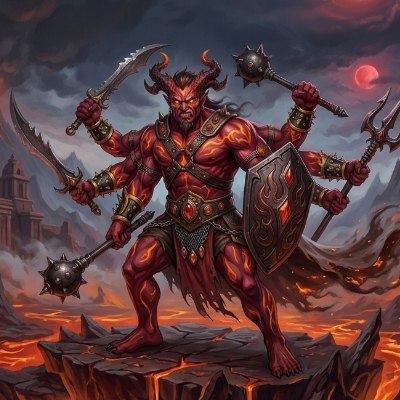
Sindura is an Asura — a class of powerful demonic beings in the Hindu cosmological tradition who oppose the gods and the order of the cosmos — whose narrative appears in the Ganesha Purana, the primary dedicated Purana of the Ganapatya sectarian tradition. He is the principal antagonist overcome by Ganesha in one of that text's major battle episodes. Sindura's name derives directly from his appearance: he was born with a body of reddish vermilion colour, and sindura is the Sanskrit term for the red vermilion pigment that is one of the most characteristic offerings in Ganesha worship. His defeat at Ganesha's hands provides the mythological grounding for several important ritual practices associated with Ganesha veneration, most notably the application of sindura to Ganesha's image. The episode is embedded within the Ganesha Purana's avatara framework, in which Ganesha manifests across the four cosmic ages to defeat specific demonic adversaries and restore righteous order.
✦ The Name
The name Sindura (also rendered Sindhura in variant transliterations) is taken directly from the Sanskrit word for the red vermilion pigment prepared from cinnabar or red lead, widely used in Hindu ritual and as an auspicious marker. The demon received this name because his body at birth was the colour of sindura — a deep, reddish vermilion. The name is therefore purely descriptive of his physical appearance at the moment of his origin. The epithet Sindhurasura is a compound of Sindhura and asura, simply designating him as the Asura named Sindhura, distinguishing him from other demonic figures of similar names in the broader Puranic corpus.
✦ Lineage and Origin
- Origin: According to the popular tradition surrounding the Ganesha Purana, Sindura came into being from a yawn of Brahma — the creator god and first member of the divine Trimurti alongside Shiva and Vishnu. The involuntary nature of this origin — a yawn rather than a deliberate act of creation — situates Sindura as a being born outside the sanctioned order of cosmic generation, consistent with the Puranic pattern in which demonic figures frequently arise from the inadvertent or disordered actions of even the highest gods. Because of his vivid vermilion body, Brahma named him Sindura.
- Divine patron: Brahma, the creator god, who granted Sindura boons following his birth. The granting of boons by Brahma to demonic beings is a recurring Puranic motif, reflecting Brahma's role as the deity bound to honour any austerity or petition regardless of the petitioner's moral character.
✦ The Boons of Invincibility
Following his birth, Sindura obtained boons from Brahma that rendered him effectively invincible within the established order of the cosmos. The boons, as reported in the tradition surrounding the Ganesha Purana, included the protection that no human being and no animal could kill him. This type of precisely bounded boon is characteristic of the Puranic genre: the demon, through austerity or petition, obtains a protection that appears total but contains an unstated gap — in this case, the exclusion of a being who is neither fully human nor animal in the conventional sense, namely Ganesha, who is divine and whose nature transcends the categories of the boon's protection. The specific phrasing and scope of the boon as given in the Sanskrit text of the Ganesha Purana is not verifiable to a precise verse from the available scholarly apparatus; it is reported consistently in the popular tradition surrounding the text and is structurally consistent with the Ganesha Purana's narrative logic.
✦ Sindura's Tyranny
Emboldened by his boons, Sindura rose to become the king of the Asuras and proceeded to assert dominion over the three worlds. He drove the gods from their positions and seized the throne of Indra — the king of the gods, lord of the heavens, and regent of the eastern direction — thereby disrupting the established cosmic hierarchy that the Puranic tradition treats as the precondition for proper sacrificial and ritual order. With Indra dethroned, the rains, the seasons, and the natural order that Indra governs were thrown into disorder, causing widespread suffering among human beings and living creatures. Sindura additionally harassed sages engaged in their austerities and interrupted sacrifices, striking at the ritual foundations through which the gods received their sustenance and through which cosmic order was maintained. The gods, bereft of their positions and their ritual nourishment, found themselves without the power to resist him.
✦ The Appeal to Ganesha
The gods, led by Indra, sought refuge with Shiva — the supreme deity of the Shaiva tradition, Ganesha's father — on Mount Kailasha. Unable to defeat Sindura by their own efforts and finding his boon-protected form impervious to conventional divine weaponry, they placed their appeal before Shiva. Shiva directed the gods to Ganesha, identifying him as the appropriate divine power to address Sindura's particular form of invincibility. This redirection is consistent with the Ganesha Purana's overall theological position: even Shiva recognises Ganesha as the supreme effective power in situations where conventional divine force has failed.
✦ The Avatara and the Battle
The Ganesha Purana presents the battle with Sindura within its avatara framework, in which Ganesha manifests in distinct forms across the four cosmic ages. There is a genuine ambiguity between recensions of the text regarding which avatara is associated with the Sindura episode. In the most widely cited account of the Ganesha Purana's avatara schema, Ganesha manifests as Mayureshvara in the Treta Yuga — a six-armed form riding a peacock — to defeat Sindura. In another account associated with the same text and its tradition, the battle is assigned to the Gajanana form, which corresponds to the Dvapara Yuga. Both accounts are present in the tradition and represent either variant recensions of the Ganesha Purana or differences in later interpretive transmission. The profile notes this ambiguity honestly; no single assignment can be treated as universally canonical across all versions of the text.
In whichever avatara form, Ganesha descended to confront Sindura directly. The battle between them was of great intensity, with Sindura bringing his full demonic power to bear. Despite the demon's enormous size, physical strength, and the protection of his boons, Ganesha overcame him. The popular tradition surrounding the Ganesha Purana describes Ganesha defeating Sindura decisively in combat — some versions specifying that Ganesha tore the demon's body apart, though this precise detail of bisection cannot be confirmed to a specific verse from the scholarly apparatus available. What is consistently attested across the tradition is that Ganesha slew Sindura and that the demon's death involved the release of a vast quantity of his vermilion-red blood.
✦ The Blood and the Ritual Consequence
The popular tradition surrounding the Ganesha Purana narrates that following his victory over Sindura, Ganesha was suffused or bathed in the demon's vermilion blood — an account that in some versions is presented as a deliberate act to prevent the demon from regenerating through his own shed blood, a motif found in several demonic narratives across the Puranas where blood-contact is the mechanism of demonic regeneration. In other versions, the blood-bathing is the incidental result of the battle's violence rather than a purposive ritual act. The precise details of this aspect of the narrative vary in the popular transmission and cannot be confirmed to a specific verse.
As a consequence of this bathing, Ganesha's entire form became red with the demon's vermilion blood, producing an image of the deity coloured entirely in sindura. This narrative moment is presented in the tradition as the mythological origin point for several major ritual practices: the application of sindura paste to Ganesha's image in worship, the characteristic red or vermilion colour in which Ganesha is depicted in domestic and temple contexts, and the classification of sindura as among the most sacred and appropriate offerings for Ganesha's propitiation.
✦ Textual Variants and Inconsistencies
The most significant textual inconsistency in the Sindura episode concerns the avatara identification. As noted above, different accounts within the Ganesha Purana tradition assign the Sindura battle either to the Mayureshvara form (Treta Yuga) or to the Gajanana form (Dvapara Yuga). Since the Ganesha Purana's avatara schema is itself a structured theological system, this discrepancy is not minor — it places the same event in different cosmic ages with different physical manifestations of Ganesha. The discrepancy may reflect variant recensions of the Ganesha Purana, of which the Upasana Khanda and Krida Khanda contain materially different emphases.
The detail of Sindura's birth from Brahma's yawn, while widely reported in popular accounts of this story, does not appear to be confirmable from the available secondary scholarly literature to a specific verse or chapter of the Ganesha Purana. It is structurally consistent with Puranic conventions of accidental divine generation of demonic beings — parallel to, for example, the origin of certain beings from Brahma's anger or fear in other Puranic narratives — but its precise textual location should be treated as belonging to the popular oral and devotional transmission surrounding the Ganesha Purana rather than confirmed to a recoverable Sanskrit verse.
✦ Theological and Symbolic Significance
Within the Ganapatya theological framework, Sindura functions as more than a narrative antagonist. As a being born with a vermilion body from Brahma's inadvertent yawn, he represents creative power operating outside the sanctioned order — abundance and colour without wisdom or restraint. His rise to demonic kingship through the exploitation of divine boons represents the perversion of cosmic opportunity: the same grace that sustains the righteous is seized by the violent and turned against the order it was meant to support. In this reading, Sindura personifies the spiritual vices of pride, cruelty, and ungoverned power — the expansive, acquisitive drives that Ganesha, as the lord of obstacles, exists to check and redirect.
The ritual consequence of his defeat — the application of sindura to Ganesha's image — is theologically significant because it transforms the substance of demonic violence (blood, the colour of the demon) into an auspicious offering. The vermilion that marked the demon's origin becomes, through Ganesha's victory, the substance of his worship. This transformation of the demonic into the auspicious is a recurring structural feature of Puranic mythology, in which the matter of destruction is reconsecrated into the material of devotion.
The epithet Sindurapriya — meaning one who is fond of sindura or the lover of vermilion — is applied to Ganesha in the devotional tradition and is explained by this episode in popular accounts, linking the deity's association with the pigment to his victory over the vermilion-bodied demon. The epithet itself is attested in the tradition; its exclusive derivation from this particular episode, as opposed to the general auspicious and protective associations of the red pigment in Hindu ritual, is the popular explanatory framework rather than a verifiable textual claim.
✦ Connection to the Wider Genealogy
Sindura stands in no recognised genealogical lineage within the Puranic record beyond his origin from Brahma's yawn. He is not assigned parents of the standard demonic dynasties — he is not placed within the Hiranyakashipu lineage, the Kashyapa-Diti descent, or any other named Asura family. His origin is solitary and accidental, which itself marks him as an outsider to the established cosmic order from the moment of his birth. His significance in the wider narrative tradition is entirely confined to his role as Ganesha's adversary and as the mythological origin of the sindura ritual.
✦ References
Primary Sources
- Ganesha Purana, Krida Khanda: The principal source for the Sindura episode, containing the narrative of his tyranny, the gods' appeal to Ganesha, and Ganesha's victory over him; the specific textual home of the avatara battle narrative.
- Ganesha Purana, Upasana Khanda: Contains the avatara schema within which the Sindura battle is placed, with the classification of Ganesha's four manifestations across the four yugas.
Modern Reference Works
- Mani, Vettam. Puranic Encyclopaedia. Motilal Banarsidass, 1975: Provides a concise entry on Sindura, noting his role as Ganesha's adversary in the Ganesha Purana and his connection to the sindura ritual tradition.
- Grimes, John A. Ganapati: Song of the Self. State University of New York Press, 1995: Discusses the avatara framework of the Ganesha Purana including the Sindura episode and its placement within the yuga schema.
- Courtright, Paul B. Ganesa: Lord of Obstacles, Lord of Beginnings. Oxford University Press, 1985: Addresses the mythological basis of the sindura ritual offering and its connection to Ganesha's battle narratives in the Ganesha Purana tradition.