
About
Krauncha — Gandharva Cursed into a Giant Mouse
Krauncha Gandharva · Mushika · Mooshika Vahana · Akhu
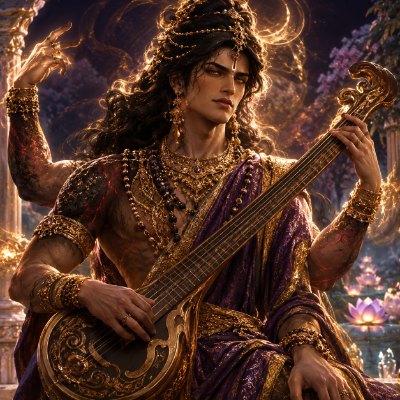
Krauncha is a Gandharva — a class of celestial musician inhabiting the divine realms — who, as a consequence of accidentally stepping on the foot of the sage Vamadeva in the court of Indra, lord of the gods, was cursed to become an enormous mouse. This giant mouse subsequently became the vahana — the divine vehicle or mount — of the god Ganesha, the elephant-headed son of Shiva and Parvati, who is worshipped throughout the Hindu tradition as the remover of obstacles and lord of beginnings. The narrative is preserved principally in the Ganesha Purana and in devotional literature surrounding the Ganesha tradition.
✦ The Name
The name Krauncha derives from the Sanskrit word for a curlew or heron, a bird frequently invoked in classical Sanskrit literature. In this Gandharva's narrative, however, the name does not function as a description of a bird but as a personal name belonging to the celestial musician before his transformation. After the curse takes effect, Krauncha becomes identified in the tradition primarily as Mushika — from the Sanskrit mushika, meaning mouse or rat — which is the standard term used for Ganesha's vehicle in iconographic and devotional contexts. The names Akhu and Mooshika are also used in regional and devotional literature to refer to the divine mouse.
✦ Lineage
- Nature: Gandharva — one of a class of semi-divine celestial beings in the Puranic cosmos, associated with music, beauty, and the heavenly realms, distinct from both the devas (gods) and the asuras (demons).
✦ The Transgression and the Curse
The episode that transforms Krauncha takes place in the celestial court of Indra, the king of the gods and ruler of Svarga, the divine heaven in the Puranic cosmology. In this court, where gods, sages, and celestial beings assembled, the Gandharva Krauncha accidentally stepped upon the foot of the sage Vamadeva — a revered Vedic seer of great ascetic power. The act was unintentional, arising from inattention rather than malice, but it constituted a grave discourtesy toward a figure of such spiritual standing. Vamadeva, whose powers of curse were a recognised attribute of his tapas or ascetic merit, pronounced a curse upon Krauncha, condemning him to take the form of a mouse — and not an ordinary mouse, but one of enormous, mountain-like proportions that would bring devastation wherever it went.
✦ The Giant Mouse and Encounter with Ganesha
Transformed into a colossal mouse by the force of Vamadeva's curse, Krauncha caused great destruction. His enormous size and movements caused damage to the hermitage of the sage Parasara — one of the great Vedic sages, father of the compiler Vyasa — and to the surrounding lands. The distress caused by this giant mouse led ultimately to his encounter with Ganesha, the elephant-headed son of Shiva and Parvati. Ganesha subdued the giant mouse and, rather than destroying him, accepted him as his vahana — his divine vehicle. From that point in the narrative tradition, the mouse in all its iconographic representations as Ganesha's mount is understood to be the former Gandharva Krauncha, now permanently bound to the service of the deity.
✦ Theological and Symbolic Significance
The mouse as Ganesha's vehicle carries layered symbolic meaning in the theological commentarial tradition. The mouse is a creature known for its ability to gnaw through and penetrate obstacles of all kinds, a quality that resonates with Ganesha's own theological function as the remover of obstacles. The subjugation of the formerly destructive giant mouse — a being whose uncontrolled power caused widespread harm — and its conversion into an instrument of divine purpose reflects the broader Puranic pattern in which destructive forces are not annihilated but redirected and brought under divine sovereignty. Some commentators further interpret the mouse as a symbol of the restless, obstacle-generating mind, and Ganesha's lordship over it as emblematic of the deity's sovereignty over all impediments, inner and outer.
✦ Iconographic Significance
In virtually all iconographic representations of Ganesha across every regional tradition of the Indian subcontinent, the mushika or mouse appears as the deity's invariable vehicle. Standard images depict the mouse positioned at the base of Ganesha's seat or throne, frequently shown holding a modaka — the round sweet associated with Ganesha — in its forepaws. The narrative of Krauncha the Gandharva provides the aetiological explanation for this universal iconographic convention, identifying the mouse not as an arbitrary symbol but as a specific being with a history — a celestial Gandharva brought low by a curse and elevated again through association with the divine.
✦ Important Distinction from Krauncha the Asura
The name Krauncha is shared by two entirely distinct figures in the Puranic tradition and the two must not be confused. The Gandharva Krauncha, described in this profile, is the celestial musician cursed by Vamadeva into the form of a giant mouse, who becomes Ganesha's vehicle. A separate figure — Krauncha the Asura — appears in a different narrative cycle, primarily in the Skanda Purana, in which an Asura named Krauncha is cursed to become a mountain, and that mountain is subsequently pierced by the god Kartikeya, son of Shiva, using his divine lance. These two figures — one a Gandharva transformed into a mouse, the other an Asura transformed into a mountain — belong to entirely separate textual traditions and narrative cycles, and share only the name Krauncha.
✦ References
- Primary Sources
- Ganesha Purana: The principal source for the narrative of Krauncha the Gandharva — his accidental transgression in Indra's court, the curse of Vamadeva, his transformation into a giant mouse, and his subsequent role as Ganesha's vahana.
- Secondary Sources
- Mani, Vettam. Puranic Encyclopaedia. Motilal Banarsidass, 1975. Provides a consolidated summary distinguishing the Gandharva Krauncha from the Asura Krauncha and narrating the mouse episode.
- Wisdomlib.org — Puranic Encyclopaedia entry on Krauncha: Distinguishes between the Gandharva and Asura figures of the same name and summarises the respective narrative traditions.