
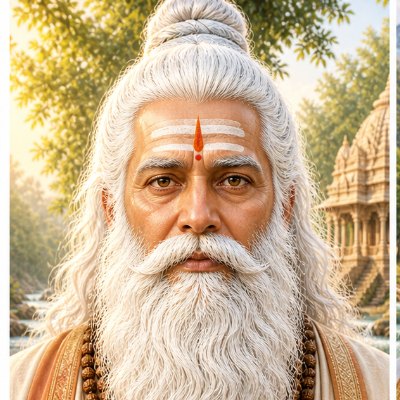
About
Vamadeva — Vedic Seer of the Fourth Mandala, Son of Gautama Maharishi
Vamadeva · Vamadeva Gautama · Vamadevya (as patronymic form used by his descendants)
Vamadeva is one of the great seers (rishis) of the Vedic tradition, celebrated principally as the primary attributed author of the fourth Mandala of the Rigveda — one of the ten books of the oldest surviving Sanskrit text and one of the foundational scriptures of the Hindu tradition. He is identified in the Vedic anukramani (the ancient index tradition that attributes each hymn to a specific seer) by the patronymic designation Vamadeva Gautama, confirming his identification as a son of the sage Gautama Maharishi — one of the seven great sages (saptarishis) of the Vedic and Puranic tradition. Beyond his Vedic authorship, Vamadeva appears in Puranic literature in various narrative and genealogical contexts, and his name is also borne by one of the five aspects of the deity Shiva, though that divine form is a distinct usage of the name and not a reference to the sage. Vamadeva is the father of Brihaduktha, whose identification as Brihaduktha Vamadevya in the Rigvedic hymn tradition confirms the continuation of the seer lineage across generations. The primary sources for Vamadeva are the Rigveda itself and its associated anukramani literature, supplemented by references in the Mahabharata, various Puranas, and the genealogical research of Vedic scholars.
✦ The Name
The name Vamadeva is a Sanskrit compound of vama and deva. The term vama carries several ranges of meaning in classical Sanskrit: it can mean beautiful, pleasing, or auspicious; it can also mean left (as opposed to right) in its directional sense; and in certain Tantric and Shaiva contexts it carries the meaning of the reverse, the contrary, or the transgressive. The element deva means divine being, god, or one who is luminous and celestial. The compound Vamadeva is therefore interpretable as "the beautiful god," "the auspicious divine one," or "the divine being of the left" depending on which sense of vama is applied. In the context of the sage, the most natural reading is the auspicious or beautiful sense — Vamadeva as a name befitting a brahmin seer of divine inspiration.
The patronymic form Vamadeva Gautama — attaching his father's name as a qualifier — is the standard designation in the Vedic anukramani tradition and serves to distinguish this Vamadeva from other bearers of the same name in the broader tradition, most importantly from Vamadeva as an aspect of Shiva. The patronymic Vamadevya functions as a gotra or lineage designator applied to his descendants — most notably to his son Brihaduktha, who is identified in the Rigveda as Brihaduktha Vamadevya, meaning Brihaduktha who belongs to the lineage of Vamadeva.
✦ Lineage
- Father: Gautama Maharishi — one of the seven great sages of the Vedic and Puranic tradition, a brahmin sage of supreme learning and spiritual authority. Gautama is the progenitor of the Gautama gotra lineage. He is the author of the Gautama Dharmasutra, one of the earliest surviving texts of the dharmashastra tradition governing brahminical conduct and law. In the Puranic tradition Gautama is associated with the origin of the sacred river Godavari — the river said to have been brought to earth through his austerities. The Gautama gotra, which takes its name from him, is one of the primary brahmin gotras across northern and southern India.
- Mother: Ahalya — a woman of extraordinary beauty, described in the Ramayana of Valmiki and in the Puranas as the first woman created by Brahma or as the most beautiful of women. She is Gautama's wife and is one of the five great women (panchakanya) of the Hindu tradition whose names are held to be auspicious when recited. Ahalya is most widely known in the tradition for the episode in which Indra — the king of the gods — came to her in the disguise of Gautama and she was deceived. Gautama, upon discovering the deception, cursed Ahalya to become stone or to become invisible and imperceptible, remaining in that state until she was liberated by the touch or sight of Rama — the avatara of Vishnu and the hero of the Ramayana. The liberation of Ahalya by Rama is one of the celebrated episodes of Valmiki's Ramayana. Whether Vamadeva and Nodhas were born before or after this episode is not specified in the texts that name them as Ahalya's sons.
- Brother: Nodhas (also rendered Nodhasa) — a Vedic seer in his own right, attributed with the authorship of certain hymns in the first Mandala of the Rigveda. The anukramani tradition identifies Nodhas as a son of Gautama, making him Vamadeva's brother. He is a less extensively documented figure than Vamadeva but his existence as a separate seer with independent Rigvedic attributions is confirmed in the anukramani literature.
- Remote ancestral lineage: Gautama's lineage is in some texts traced ultimately to Angiras — one of the seven primal brahmin sages (brahmarshis) of the Vedic tradition, a mind-born son of Brahma and the progenitor of the Angirasa family of seers to which a large portion of Rigvedic hymns are attributed. The Angirasa connection places the Gautama lineage within the broader Angirasa gotra complex, though the Gautama gotra is also treated in other texts as an independent primal lineage. This ancestral connection is present in parts of the tradition but is not uniformly stated across all primary sources.
- Son: Brihaduktha — identified in the Rigvedic anukramani tradition as Brihaduktha Vamadevya, where the patronymic Vamadevya confirms him as the son of Vamadeva. Certain suktas of the Rigveda are attributed to Brihaduktha as their authoring seer. Beyond his Vedic attribution and his identification as Vamadeva's son in the genealogical research of Pargiter and in the anukramani tradition, Brihaduktha does not appear as an independent narrative figure in the primary texts.
✦ Vamadeva as Author of Rigveda Mandala IV
The fourth Mandala of the Rigveda is one of the ten books of the oldest stratum of Vedic literature and one of the eight family books (kula mandalas) — books II through VII — in which each Mandala is attributed to a specific seer family. The fourth Mandala is the family book of the Gautama lineage and Vamadeva is its principal attributed seer. The Mandala contains fifty-eight suktas (hymn-units) comprising a substantial body of Vedic verse addressed to the principal Vedic deities, most prominently Indra, Agni, and the Ashvins, as well as to Varuna, Mitra, and the Vishvedevas.
Among the hymns of Mandala IV attributed to Vamadeva, those addressed to Indra are particularly celebrated for their poetic power, their mythological content concerning Indra's cosmic battles — most importantly the slaying of the dragon Vritra — and their theological depth in addressing the nature of divine sovereignty and cosmic order. Vamadeva's hymns to Agni — the fire deity and the sacred conveyor of sacrificial offerings — are also of considerable importance in the Vedic ritual tradition, reflecting the centrality of fire sacrifice to Vedic religion.
The tradition surrounding the composition of these hymns presents Vamadeva as a rishi of the highest order of inspiration — one who received the hymns through direct divine vision (drashta, the seer who sees rather than merely composes). The anukramani tradition records that certain of Vamadeva's hymns were received while he was still in the womb of his mother, a narrative that emphasises the extraordinary nature of his spiritual vision. This prenatal enlightenment account is referenced in later philosophical literature as an example of the possibility of jnana (knowledge) arising independently of ordinary sense experience.
✦ The Prenatal Vision and the Womb Episode
One of the most distinctive narratives associated with Vamadeva concerns his spiritual realisation while still in his mother's womb. This episode is referenced in the Aitareya Upanishad — one of the principal Upanishads associated with the Rigveda — where Vamadeva is cited as a sage who attained full knowledge of the self and of Brahman before birth, transcending the ordinary cycle of birth and death through his realisation. The Aitareya Upanishad presents this as evidence that genuine knowledge of Brahman is not limited by the conditions of embodied existence and can arise even before the conventional beginning of conscious life. Vamadeva's experience in the womb is described as a direct vision of all forms of existence and of the unity underlying them.
This episode gives Vamadeva a unique position in the Vedantic tradition: he is one of the very few figures cited in the Upanishads as an example of liberation achieved under the most extraordinary circumstances. Later Vedantic commentators, including Shankaracharya — the eighth-century philosopher who systematised Advaita Vedanta — reference Vamadeva's womb-enlightenment in the context of discussions about the nature of jivanmukti (liberation while living) and the relationship between knowledge and birth.
✦ Vamadeva in the Mahabharata
Vamadeva appears in the Mahabharata in several contexts, primarily as a celebrated brahmin sage whose wisdom and spiritual authority are invoked as examples of the brahmin ideal. He is mentioned in lists of great rishis who attend divine assemblies, sacrifices, and gatherings of sages. In the Shanti Parvan — the twelfth book of the Mahabharata, which contains extensive philosophical and ethical instruction — Vamadeva is referenced in discussions of brahminical knowledge and the path of wisdom. His authority as a Vedic seer gives his name weight in these contexts even where he does not appear as an active narrative participant.
✦ Vamadeva and the Krauncha Episode
As noted in the tradition surrounding the Ganesha mouse-vehicle narrative, a sage named Vamadeva appears as the figure upon whom the gandharva Krauncha accidentally trod, prompting Vamadeva to curse Krauncha and transform him into a giant mouse. This mouse subsequently became the vehicle of Ganesha. Some accounts in the popular and devotional tradition identify this Vamadeva with Vamadeva Gautama, the Vedic seer, on the basis of the name alone. However, this identification is not explicitly confirmed in the primary textual accounts of the Krauncha episode, which do not provide the sage's genealogy or patronymic. The identification of the Vamadeva of the Krauncha episode with the Rigvedic seer Vamadeva Gautama must therefore be treated as a reasonable popular inference based on the name rather than a confirmed primary source statement.
✦ Vamadeva as an Aspect of Shiva
The name Vamadeva is also one of the five names of the five faces (panchamukha or panchavaktra) of Shiva in the Shaiva Agamic tradition. In this schema Shiva is conceived as having five faces oriented in the five directions: Sadyojata (west), Vamadeva (north), Aghora (south), Tatpurusha (east), and Ishana (upward). Each face embodies a distinct divine function and cosmological principle. The Vamadeva face of Shiva is associated with the northern direction, with preservation and sustenance, and in some Agamic texts with the water element. This Vamadeva is entirely a theological designation — an aspect of Shiva's divine form — and has no biographical connection to the sage Vamadeva Gautama. The two usages of the name exist independently in the tradition and must not be conflated.
✦ Connection to the Wider Genealogy
Vamadeva stands within the Gautama lineage, one of the principal brahmin sage lineages of the Vedic tradition. His father Gautama Maharishi is among the seven eternal sages (saptarishis) whose names recur across cosmic cycles in the Puranic tradition. Through Gautama, Vamadeva is connected to the wider network of Vedic brahmin families — the Vishvamitra, Jamadagni, Bharadvaja, Atri, Vasishtha, and Kashyapa lineages — who together constitute the authorial and spiritual foundation of the Rigvedic hymn tradition. His mother Ahalya connects him indirectly to the narrative world of the Ramayana, in which her liberation by Rama is one of the celebrated episodes of the Balakanda. His brother Nodhas extends the Gautama seer family's presence across two Mandalas of the Rigveda. His son Brihaduktha carries the Vamadevya lineage forward as an independently attested Rigvedic seer, confirming the continuation of the family's tradition of Vedic vision across three generations — Gautama, Vamadeva, and Brihaduktha.
✦ References
Primary Sources
- Rigveda, Mandala IV (complete): The primary source for Vamadeva as seer; the family book of the Gautama lineage containing the hymns attributed to Vamadeva Gautama, addressed principally to Indra, Agni, and the Ashvins.
- Rigveda, Mandala I, hymns attributed to Nodhas: Confirms Nodhas as an independently attested seer of the Gautama family, corroborating Vamadeva's family context.
- Rigveda anukramani (Katyayana's Sarvanukramani): The ancient Vedic index tradition that attributes each hymn to its seer; the primary source for the patronymic Vamadeva Gautama and for the identification of Brihaduktha Vamadevya as a son of Vamadeva.
- Aitareya Upanishad (associated with the Rigveda): The primary Upanishadic source for the account of Vamadeva's prenatal spiritual realisation and his attainment of knowledge of Brahman while in the womb; a foundational text for the tradition of citing Vamadeva as an exemplar of extraordinary jnana.
- Mahabharata, Shanti Parvan: Contains references to Vamadeva in the context of lists of great brahmin sages and in philosophical discussions invoking his authority as a Vedic seer.
- Valmiki Ramayana, Balakanda: The primary source for the Ahalya episode and Gautama's curse; establishes the narrative context of Vamadeva's mother without directly naming Vamadeva in the same passage.
- Shiva Purana, Agamic texts on Panchamukha Shiva: The source for Vamadeva as the northern face of Shiva — a distinct and separate usage of the name established here for the purpose of disambiguation.
Modern Reference Works
- Pargiter, F.E. Ancient Indian Historical Tradition. Oxford University Press, 1922: The genealogical research identifying Vamadeva as the father of Brihaduktha within the reconstruction of ancient brahmin seer lineages from Vedic and Puranic sources.
- Mani, Vettam. Puranic Encyclopaedia. Motilal Banarsidass, 1975: Provides entries on Vamadeva noting his Rigvedic authorship, his connection to the Gautama lineage, and the disambiguation from the Shaiva theological usage of the name.
- Macdonell, A.A. and Keith, A.B. Vedic Index of Names and Subjects. John Murray, 1912: The standard scholarly reference for Vedic proper names; provides the philological basis for the identification of Vamadeva Gautama in the anukramani tradition and his relationship to other members of the Gautama seer family.
- Oldenberg, Hermann. The Religion of the Veda (Die Religion des Veda). 1894, English translation: Addresses the family books of the Rigveda including Mandala IV and the seer lineages associated with them, providing scholarly context for Vamadeva's position in the Vedic tradition.