
About
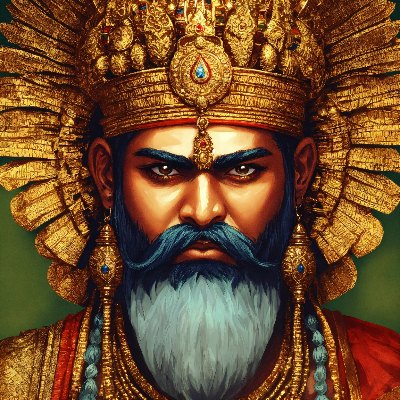
Mudgala — Rajarishi of Panchala, Vedic Seer, Patriarch of the Moudgalya Lineage
Mudgala · Moudgalya · Mudgala Muni · Mudgalani (feminine form, used of his wife in Rigveda 10.102 attribution)
Mudgala is a sage of considerable importance in both the Vedic and Puranic canonical traditions. He is a rajarishi — a royal sage, one who was born into the Kshatriya order of kings but attained brahminical status through the power of spiritual practice and merit — whose father Bharmyashva was a king of the Panchala kingdom of the Lunar dynasty. Mudgala is attested as a seer in the Rigveda, where Sukta 10.102 of the tenth Mandala is attributed to him or to his wife Mudgalani in the anukramani tradition. He appears prominently in the Vana Parvan of the Mahabharata, where his practice of Unchavritti, his legendary hospitality, and his ultimate renunciation of the offer of heaven in his physical body are narrated as a teaching on the nature of true renunciation. Mudgala is the eponymous patriarch of the Moudgalya gotra, one of the major brahmin lineage groups still maintained in the tradition. The Mudgala Purana — a significant Upapurana of the Ganapatya sectarian tradition — takes its name from the sage and is attributed to his authority. The Bhagavata Purana names him as the direct father of twin children, a son Divodasa and a daughter Ahalya; the Vishnu Purana inserts an intermediate generation in the form of his son Bahvashva as their actual father. The primary sources for Mudgala are the Rigveda anukramani, the Mahabharata Vana Parvan, the Bhagavata Purana, the Vishnu Purana, the Harivamsha, and the Mudgala Purana itself.
✦ The Name
The name Mudgala is of uncertain etymology but is attested in the Vedic corpus as a proper name without a transparent Sanskrit derivation that commands scholarly consensus. Some interpretations have connected it to mudga, a type of green gram or pulse associated with ascetic subsistence, though this connection is popular rather than philologically established. The patronymic or lineage form Moudgalya is derived from Mudgala by the standard Sanskrit mechanism of adding the suffix -ya to denote descent or gotra affiliation, yielding "of the lineage of Mudgala" or "descended from Mudgala." This patronymic form is the name of the gotra and the designation used in brahminical gotra recitation. The feminine form Mudgalani — meaning the wife of Mudgala — appears in the anukramani tradition as the attributed seer of Rigveda 10.102, a title rather than a personal name referring to the same figure as Nalayani, his wife.
✦ Lineage
- Father: Bharmyashva — also rendered Bharmyasva or Bhamyasva; a king of the Panchala kingdom of the Lunar dynasty, descended from Ajamidha through the line of Nila and Shanti. The Bhagavata Purana records that Bharmyashva had five sons — Mudgala, Yavinara, Brihadishnu, Kampilya, and Sanjaya — whom he charged with ruling five territories, giving rise to the name Panchala for the region and its people. Mudgala is explicitly named in the Mahabharata's genealogical passages as the son of Bharmyashva.
- Status: Mudgala is identified in the Mahabharata as a rajarishi — a royal sage who attained brahminical rank through spiritual merit rather than birth, placing him in the distinguished category of sages who transcended their birth-varna through tapas.
- Wife: Nalayani — also called Indrasena in some accounts. She is the wife of Mudgala whose narrative becomes significant in the broader Mahabharata tradition through her connection to the origin story of Draupadi's five husbands. The name Mudgalani used in the Rigvedic anukramani for the attributed seer of Rigveda 10.102 is a title rather than a personal name and refers to Nalayani as the wife of Mudgala.
- Son: Bahvashva — recorded as Bahwashwa in the Vishnu Purana, as Badhryashva in the Vayu Purana, as Bandhyashva in the Matsya Purana, and as Panchashva in the Agni Purana. The Vishnu Purana states that Mudgala had a son named Bahwashwa, and that Bahwashwa was the father of the twin pair Divodasa and Ahalya. In this account, Bahvashva stands as an intermediate generation between Mudgala and the twins. The Bhagavata Purana, by contrast, names Mudgala directly as the father of the twins without naming Bahvashva, treating Divodasa and Ahalya as Mudgala's own children; see the Textual Variants section.
- Grandson (through Bahvashva) or son (Bhagavata Purana account) — male: Divodasa — a celebrated king of Panchala, the male of the twin pair; father of Mitrayu, from whom the line of Panchala kings descends through Chyavana, Sudasa, Saudasa, Somaka, Prishata, and ultimately to Drupada of the Mahabharata. The Bhagavata Purana at 9.21.31–34 names him as the direct son of Mudgala; the Vishnu Purana names him as the son of Bahvashva, son of Mudgala.
- Granddaughter (through Bahvashva) or daughter (Bhagavata Purana and Harivamsha accounts) — female: Ahalya — the female of the twin pair; she married the sage Gautama and by him became the mother of Shatananda, who is celebrated in the Ramayana as the family priest of King Janaka of Mithila. The Bhagavata Purana at 9.21.34 and the Harivamsha both name Ahalya as belonging to Mudgala's family and as the twin of Divodasa. The Vishnu Purana places her as the daughter of Bahvashva rather than of Mudgala directly. The Matsya and Vayu Puranas record a variant in which the father of Ahalya is named as Vindhyashva or Badhryashva, which is consistent with the Bahvashva tradition under a variant name. The Ramayana presents Ahalya as a figure of divine origin without specifying Mudgala or Bahvashva as her father; this is a genuine divergence between the epic and the Puranic traditions on her parentage.
✦ Vedic Attribution — Rigveda 10.102
Sukta 10.102 of the Rigveda — the one hundred and second hymn of the tenth and final Mandala — is attributed in the anukramani tradition to Mudgalani, the wife of Mudgala, with Mudgala himself associated with the hymn through the family attribution. The tenth Mandala is the latest stratum of the Rigveda and the most diverse in its subject matter. Sukta 10.102 is unusual among Rigvedic hymns in containing vivid imagery of a chariot race — the hymn describes a woman driving a chariot in what appears to be a competitive or martial context, and the figure of Mudgalani as charioteer is one of the striking images of the later Rigveda. The hymn is addressed to Indra and invokes his power in the context of battle or contest. The attribution of this hymn to a woman rather than to Mudgala himself is notable and reflects the Vedic tradition's limited recognition of female seers as receivers and transmitters of sacred verse.
✦ The Unchavritti Practice
The Mahabharata's Vana Parvan introduces Mudgala through his practice of Unchavritti — a mode of ascetic subsistence in which the practitioner gathers only the grains left behind by harvesters in the fields after the main harvest has been collected, living entirely on these remnants without asking anything from anyone and without cultivating or storing food. This practice represents the most extreme end of the brahminical ideal of non-accumulation — the deliberate reduction of one's material life to the absolute minimum consistent with survival. Despite the poverty this entailed, the Mahabharata presents Mudgala as maintaining a household in which hospitality was offered generously to any guest who arrived. The text specifies that he performed sacrifices at the Kurukshetra sacred field, and that the gods including Indra attended his sacrifices and partook of their merit — establishing his spiritual standing as recognised at the divine level despite his material poverty.
✦ The Test of Patience — The Repeated Guest
The central episode of Mudgala's narrative in the Mahabharata Vana Parvan concerns a series of visits by a guest who arrived repeatedly and on each occasion consumed all the food that Mudgala had laboriously accumulated through his gleaning over an extended period. Despite having his entire store consumed at a single sitting on each occasion, Mudgala remained entirely unperturbed, received the guest with perfect equanimity, and offered whatever he had without complaint or resentment. The popular tradition has strongly associated this testing guest with the sage Durvasa — the notoriously irascible sage known throughout the Puranic tradition for testing devotees with extreme demands. However, the primary Mahabharata text in the Vana Parvan identifies the visitor in terms of his testing function rather than giving him a single consistent personal name across all versions of the passage. The identification as Durvasa is the popular tradition's crystallisation of the episode and is reported here as such rather than as a confirmed primary text statement.
✦ The Invitation to Heaven and Its Renunciation
Following the test of patience, a divine messenger arrived at Mudgala's hermitage and informed him that his perfect equanimity in repeated deprivation and his unwavering hospitality had earned him the right to ascend to heaven in his physical body without undergoing death — one of the highest rewards the Vedic tradition recognises. Rather than accepting, Mudgala asked the messenger to describe the nature of the heavenly realm in detail — its pleasures, its duration, and the conditions under which a being there would eventually have to leave. The messenger confirmed that residence in heaven is impermanent: when the merit that earned one's place there is exhausted, the being descends again to the mortal realm. Upon hearing this, Mudgala declined the offer. He stated that a heaven conditioned by and limited to accumulated merit — and which therefore must end — is not a refuge worth seeking, and expressed his preference for pursuing what is unconditioned and permanent. He sent the messenger away and continued his austerities. This episode is one of the most philosophically significant in the Vana Parvan and is cited in later Vedantic literature as an illustration of the distinction between the conditioned rewards of meritorious action and the unconditioned liberation that transcends all accumulation and exhaustion of merit.
✦ Nalayani and the Origin of Draupadi's Five Husbands
The Mahabharata tradition contains a narrative connecting Mudgala's wife Nalayani to the origin story of Draupadi's marriage to the five Pandava brothers. In this strand, Nalayani is said to have been so devoted to Mudgala that she accumulated great merit through total self-abnegation, but harboured an insatiable longing for a husband who embodied all the qualities she admired, no single man being sufficient to satisfy the full range of her desires. Mudgala's pronouncement — presented in some versions as a curse and in others as a prophetic statement — held that in her next life Nalayani would be born as a woman with five husbands, each embodying one aspect of the ideal she sought. This account coexists with other origin accounts for Draupadi's situation, most prominently the account in which a woman repeatedly prays to Shiva for a husband and Shiva grants her prayer five times, and no single account is presented as exclusively canonical within the Mahabharata itself.
✦ The Mudgala Purana
The Mudgala Purana is a significant Upapurana outside the canonical eighteen Mahapuranas and is the most systematically developed text of the Ganapatya sectarian tradition, which venerates Ganesha as the supreme deity underlying all existence. The Purana takes its name from the sage Mudgala and is attributed to his authority in the traditional sense — meaning it is presented as wisdom transmitted through or associated with the sage rather than necessarily composed by the historical figure of the Mahabharata. The relationship between the Mahabharata's Mudgala and the Mudgala Purana's attributed author is one of traditional association rather than confirmed biographical continuity. The Purana is structured around a systematic theology of Ganesha's eight forms — each of which defeats a specific demon representing a human vice or spiritual obstacle — and additionally presents Ganesha as the supreme metaphysical principle from which Brahma, Vishnu, and Shiva themselves emerge as secondary manifestations, a position shared with the Ganapati Atharvashirsha Upanishad.
✦ The Moudgalya Gotra
The Moudgalya gotra — the brahminical lineage group tracing its descent from Mudgala — is one of the significant gotras among brahmin communities across northern, western, and southern India. In the brahminical tradition, gotra membership is patrilineal and determines ritual eligibility and marriage prohibition: members of the same gotra may not intermarry, as they share a common male ancestor in the seer from whom the gotra takes its name. The Moudgalya gotra's pravara — the list of ancestral sages recited at the commencement of Vedic rituals — typically includes Mudgala among the primary ancestral names. The quality of forbearance exemplified by Mudgala's perfect patience in the hospitality episode is traditionally associated with the character of this gotra in the brahminical literature concerning lineage qualities.
✦ Textual Variants and Inconsistencies
The primary textual inconsistency surrounding Mudgala concerns the generational distance between him and the twin pair Divodasa and Ahalya. The Bhagavata Purana at 9.21.31–34 names Mudgala directly as the father of the twins, making Divodasa and Ahalya his immediate children. The Vishnu Purana, however, states explicitly that Mudgala had a son named Bahwashwa (Bahvashva), and that it was Bahwashwa — not Mudgala — who fathered the twins. In this account, Divodasa and Ahalya are Mudgala's grandchildren rather than his children. The Vayu Purana names this same intermediate figure as Badhryashva, the Matsya Purana as Bandhyashva, and the Agni Purana as Panchashva, all representing variant name-forms for the same position in the lineage. The Bhagavata Purana thus compresses this sequence by one generation while the Vishnu Purana preserves the intermediate figure. This is a genuine structural disagreement between primary texts and cannot be resolved from within the surviving sources.
A secondary inconsistency concerns Ahalya's parentage across different textual traditions. The Bhagavata Purana, the Harivamsha, and the Shiva Purana all confirm Ahalya as belonging to Mudgala's immediate family and as the twin of Divodasa, naming Mudgala as her father. The Matsya and Vayu Puranas, through their naming of Vindhyashva or Badhryashva as her father, align with the Vishnu Purana's Bahvashva tradition, placing an intermediate generation between Mudgala and Ahalya. The Valmiki Ramayana presents Ahalya as a figure of divine origin, created by Brahma, without naming Mudgala or Bahvashva as her father; this represents a genuine divergence between the Ramayana and the Puranic traditions on her parentage.
✦ Connection to the Wider Genealogy
Mudgala stands at the intersection of several significant genealogical networks. Through his father Bharmyashva he is embedded in the Panchala branch of the Lunar dynasty. Through his son Bahvashva — or directly in the Bhagavata Purana account — he is the grandfather or father respectively of Divodasa, king of Panchala, from whom the line descends through Mitrayu, Chyavana, Sudasa, Saudasa, Somaka, Prishata, and Drupada to Draupadi and Dhrishtadyumna of the Mahabharata. Through the same immediate generation, Ahalya's marriage to Gautama and the birth of their son Shatananda connects Mudgala's family to the brahmin sage lineage of Gautama and to the tradition of Mithila, where Shatananda served as the family priest of King Janaka. Through the Moudgalya gotra he is the progenitor of a continuing brahmin lineage carrying his spiritual legacy into the living tradition. Through the Mudgala Purana he is the named authority of the most systematic theological text of the Ganapatya tradition. Through his wife Nalayani he is connected to the origin narrative of Draupadi and the Pandava lineage.
✦ References
- Primary Sources
- Rigveda, Mandala X, Sukta 102: The hymn attributed in the anukramani tradition to Mudgalani — wife of Mudgala — addressed to Indra; the primary Vedic textual attestation of the Mudgala family's seer status.
- Rigveda anukramani (Katyayana's Sarvanukramani): The ancient index tradition recording the attribution of Rigveda 10.102 to Mudgalani and establishing the Mudgala family's position in the Vedic seer tradition.
- Mahabharata, Vana Parvan (Aranya Parvan): Principal narrative source for Mudgala — containing the Unchavritti episode, the repeated-guest test of patience, the divine messenger's offer of heaven, and Mudgala's renunciation of that offer; the most extensive primary account of his character and teaching significance.
- Mahabharata, Adi Parvan: Contains genealogical passages establishing Mudgala's descent from Bharmyashva and his position within the Lunar dynasty's Panchala branch.
- Bhagavata Purana, Book IX, Chapter 21, verses 31–34: Records Mudgala as the direct father of the twin pair Divodasa and Ahalya, omitting the intermediate Bahvashva generation; the principal Puranic source for the compressed two-generation account of this portion of the lineage.
- Vishnu Purana, Book IV, Chapter XIX (H. H. Wilson translation, p. 454): Records Mudgala as the father of Bahwashwa (Bahvashva) and Bahwashwa as the father of the twins Divodasa and Ahalya; the principal source for the three-generation account; footnote 51 records the variant names for Bahvashva across the Vayu, Matsya, and Agni Puranas.
- Harivamsha Purana, Adi Parva: Confirms Ahalya as belonging to Mudgala's family and as the twin of Divodasa; a supporting primary source for the Puranic genealogical tradition on Ahalya's parentage.
- Shiva Purana: Names Ahalya as the daughter of Mudgala, wife of Gautama, and mother of Shatananda, consistent with the Bhagavata Purana's direct father-daughter account.
- Matsya Purana and Vayu Purana: Name the father of Ahalya as Vindhyashva or Badhryashva respectively, representing variant name-forms for the Bahvashva tradition of the Vishnu Purana.
- Valmiki Ramayana, Balakanda: Consulted to establish the Ramayana's account of Ahalya's origin, which presents her as created by Brahma without naming Mudgala or Bahvashva as her father; the primary source for the divergence between epic and Puranic traditions on Ahalya's parentage.
- Mudgala Purana: The Ganapatya Upapurana attributed to Mudgala's authority; source for the eight-form theological schema of Ganesha and the philosophical identification of Ganesha with the supreme principle.
- Secondary Sources
- Wisdomlib.org, "Mudgala: 9 definitions": Aggregates Puranic Index entries from the Bhagavata Purana, Brahmanda Purana, and Vayu Purana; records Mudgala as the father of twins Divodasa and Ahalya per the Bhagavata account and cross-references the Vishnu Purana's Bahvashva tradition.
- Wisdomlib.org, "Ahalya: 15 definitions": Aggregates the full range of primary source attestations for Ahalya's parentage across the Bhagavata Purana, Harivamsha, Shiva Purana, Matsya Purana, Vayu Purana, and Vishnu Purana; essential for establishing the range and nature of the textual variants on Mudgala's connection to the twins.
- Mani, Vettam. Puranic Encyclopaedia. Motilal Banarsidass, 1975: Provides a substantial entry on Mudgala covering his Mahabharata narrative, his Vedic attribution, his family, and his connection to the Moudgalya gotra tradition; the Ahalya entry traces the full patrilineal sequence Bharmyashva — Panchala (Mudgala) — Ahalya in the Puranic Encyclopaedia's reconstruction.
- Pargiter, F.E. Ancient Indian Historical Tradition. Oxford University Press, 1922: The genealogical reconstruction placing Mudgala within the Panchala dynastic lineage and examining his family connections; relevant for the Divodasa and Bahvashva variants across Puranic texts.
- Macdonell, A.A. and Keith, A.B. Vedic Index of Names and Subjects. John Murray, 1912: Provides the philological basis for the Rigvedic attribution of Sukta 10.102 to Mudgalani and the associated Mudgala family seer tradition.
- Grimes, John A. Ganapati: Song of the Self. State University of New York Press, 1995: Discusses the Mudgala Purana's theological content and its attribution to the sage Mudgala within the Ganapatya tradition.