
About
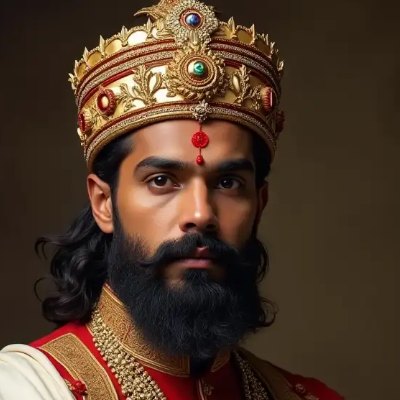
Divodasa — King of Panchala, Son of Bahvashva, Celebrated Vedic Patron-King
Divodasa · Divodasa Atithigva · Divodasa Panchala · Divodasa Bharadvaja (in Rigvedic association)
Divodasa is a king of considerable prominence in both the Vedic and Puranic canonical traditions, belonging to the Bharmyashva branch of the Panchala line within the Lunar dynasty. He is the son of Bahvashva — also recorded as Badhryashva in the Vayu Purana — who was the son of Mudgala, the celebrated sage-king of Panchala and one of the five sons of Bharmyashva. In the Rigveda, Divodasa is one of the most celebrated royal patrons of the Vedic poets, associated with lavish gifts to the seers, with military victories over demonic adversaries, and with the protection of brahminical sacrifice. His association with the sage Bharadvaja is among the most prominent patron-seer relationships of the Rigvedic canon. The name Divodasa appears in the tradition in reference to more than one figure — most significantly the Panchala king of the Lunar dynasty relevant to this lineage, and a distinct king of Kashi whose narrative is associated with Shiva's departure from and return to the sacred city of Varanasi — and these figures must not be conflated. The primary sources for Divodasa of the Panchala lineage are the Rigveda and its anukramani tradition, the Bhagavata Purana, the Vishnu Purana, the Harivamsha, and the Mahabharata.
✦ The Name
The name Divodasa is a Sanskrit compound of diva or divo, meaning "of heaven," "celestial," or "of the sky-gods," and dasa, meaning "servant," "devotee," or "slave." The compound therefore carries the meaning of "servant of heaven" or "devotee of the celestial realm," positioning the king as one who owes allegiance to the divine order — a name consistent with the Vedic understanding of righteous kingship as a form of service to the gods. The epithet Atithigva, associated with Divodasa in certain Rigvedic passages, carries meanings of "one who strikes down the foe" or "one who bows to the guest," depending on the etymological reading, and is one of the oldest epithets attached to his name in the Vedic corpus.
✦ Lineage
- Remote patrilineal ancestor: Ajamidha — a king of the Puru lineage and son of Riksha, identified in the Puranas as the progenitor of both the Panchala and Kuru dynastic branches. Through Ajamidha's descendant Bharmyashva, the Panchala line is established and the Bharmyashva sub-line is named.
- Paternal great-grandfather: Bharmyashva — a king of Panchala, son of Arka, from whom the Bharmyashva sub-line takes its name. The Bhagavata Purana records him as having five sons — Mudgala, Yavinara, Brihadishnu, Kampilya, and Sanjaya — whom he charged with ruling his five territories, giving rise to the name Panchala for the region and its people.
- Paternal grandfather: Mudgala — one of the five sons of Bharmyashva; a figure of great standing in both the Puranic and epic traditions. He is celebrated in the Mahabharata's Vana Parva as an ascetic who lived in Kurukshetra, subsisting solely on gleaned grain and practising extreme equanimity. From his descendants arose the Maudgalya brahmin gotra. The Bhagavata Purana records him as the father of the twin pair Divodasa and Ahalya directly, while the Vishnu Purana places an intermediate generation — Bahvashva — between Mudgala and Divodasa.
- Father: Bahvashva — son of Mudgala; recorded as Bahwashwa in the Vishnu Purana, as Badhryashva in the Vayu Purana, as Bandhyashva in the Matsya Purana, and as Panchashva in the Agni Purana. He is the father of the twin pair Divodasa and Ahalya according to the Vishnu Purana. The Bhagavata Purana omits this generation and names Mudgala directly as the father of Divodasa; see the Textual Variants section.
- Twin sister: Ahalya — the female of the twin children of Bahvashva; she married the sage Gautama and by him became the mother of Shatananda, who is celebrated in the Ramayana as the family priest of King Janaka of Mithila. The Ahalya of the Panchala-Bharmyashva line is a princess of the Puru dynasty and is recorded as a distinct figure from the more widely celebrated Ahalya of the Ramayana tradition, though both share the name and a husband named Gautama.
- Son: Mitrayu — also recorded as Mitreyu and Mitraya; a king of Panchala and the sole recorded child of Divodasa in the Puranic genealogical tables. His name varies between Mitrayu in the Vishnu Purana and Mitreyu in the Bhagavata Purana, reflecting differences between recensions.
- Associated sage (patron relationship): Bharadvaja — one of the seven great sages of the Vedic and Puranic tradition, whose family book forms Mandala VI of the Rigveda. He is Divodasa's associated seer in the Rigvedic patron-poet relationship, composing or receiving hymns that celebrate Divodasa's victories and generosity.
✦ Divodasa in the Rigveda
Divodasa is one of the most frequently mentioned royal patrons in the Rigveda, appearing across multiple Mandalas in the context of the dana-stutis — hymns of praise composed by Vedic seers honouring kings who gave lavish gifts to brahmin poets and sacrificers. His name appears in Mandala I, Mandala VI — the family book of the Bharadvaja lineage, with which Divodasa is most closely associated — and in other Mandalas of the collection. The Rigvedic Divodasa is celebrated for his military victories, most prominently his defeat of the demon Shambara, who is described in multiple passages as a powerful adversary dwelling in mountain fortresses. Indra is credited with aiding Divodasa against Shambara, and this defeat is one of the recurring narrative references of the Rigvedic hymns. Whether the Rigvedic Divodasa and the Panchala Divodasa of the Puranic genealogy are the same figure is a question the scholarly literature has not definitively resolved; the Puranic tradition tends toward identification, embedding the Rigvedic king's attributes within the biography of the dynastic figure, and this profile follows that identification while noting the scholarly uncertainty.
✦ The Defeat of Shambara
The battle between Divodasa and the demon Shambara is the most extensively referenced military episode associated with Divodasa in the Rigveda. Shambara is described as a powerful adversary possessing ninety-nine or a hundred mountain fortresses — the precise number varying by hymn — representing a form of entrenched power that defied the plains-dwelling Vedic order. Indra, invoked by the sage Bharadvaja on behalf of Divodasa, shattered Shambara's fortresses and delivered victory. The episode is referenced across several hymns of Mandala VI and other Mandalas, establishing it as one of the paradigmatic battles of the Rigvedic heroic tradition — a battle in which the righteous king, supported by his brahmin seer and by the divine warrior Indra, overcomes a demonic power fortified against the natural order.
✦ Divodasa and the Sage Bharadvaja
The relationship between Divodasa and the sage Bharadvaja is one of the most prominent patron-seer relationships of the Rigvedic tradition. Bharadvaja composed or received hymns celebrating Divodasa's victories, his generosity in the gift of cattle and wealth to the brahmin poets, and his protection of sacrifice. This relationship follows the established Vedic pattern in which a great king provides material support and protection to a brahmin sage and his sacrificial establishment, while the sage invokes the gods on the king's behalf and serves as the spiritual authority legitimising the king's temporal power. Bharadvaja's association with Divodasa as the king's purohita places Divodasa at the centre of one of the Rigveda's most important sacral kingship relationships, and through Bharadvaja's hymns, Divodasa's name and achievements entered the permanent record of the Rigvedic canon.
✦ Disambiguation — Divodasa of Kashi
A figure named Divodasa of Kashi appears in the Mahabharata and in several Puranas in an extended narrative in which Shiva abandoned the sacred city of Varanasi because Divodasa ruled it so justly and prosperously that there was no imperfection through which Shiva's presence — associated with the burning ground, death, and dissolution — could find its natural expression. Shiva sent divine emissaries, including Ganesha in some versions, to find a flaw in Divodasa's rule; all failed because his kingship was without fault, until finally Vishnu intervened and Divodasa voluntarily renounced his kingdom, after which Shiva returned permanently to Kashi. This Divodasa of Kashi belongs to the Kashi royal lineage descended from Dhanvantari, entirely separate from the Panchala Lunar dynasty, and his narrative has no connection to the line of Mudgala, Bahvashva, and Mitrayu. The two figures share only a name.
✦ Textual Variants and Inconsistencies
The most significant variant affecting this profile is the generational position of Divodasa relative to Mudgala. The Vishnu Purana explicitly names Bahwashwa (Bahvashva) as the son of Mudgala and the father of the twins Divodasa and Ahalya, inserting a generation between Mudgala and Divodasa. The Vayu Purana names this intermediate figure as Badhryashva; the Matsya Purana names him Bandhyashva and adds a further generation through a figure named Indrasena; the Agni Purana names him Panchashva. The Bhagavata Purana, by contrast, names Mudgala directly as the father of the twin pair and omits the intermediate generation entirely. This is not a minor scribal difference but a structural disagreement between primary texts as to whether Divodasa is the son or grandson of Mudgala. The user's lineage — Mudgala → Bahvashva → Divodasa — follows the Vishnu Purana and Vayu Purana account, which is the more detailed of the available traditions.
A secondary variant concerns the identity of Divodasa's son. The Vishnu Purana and Bhagavata Purana agree that his son was Mitrayu (Mitreyu), and from Mitrayu the Panchala line continued to Chyavana, Sudasa, and ultimately to Drupada and the figures of the Mahabharata. However, the Bhagavata Purana's compressed genealogy, which makes Cyavana, Sudasa, Sahadeva, and Somaka all sons of Mitreyu rather than a sequential succession, is a further source of internal inconsistency in how this portion of the line is reckoned. Finally, the question of whether the Rigvedic Divodasa celebrated in the hymns of Bharadvaja is the same individual as the Panchala dynastic Divodasa of the Puranas remains unresolved in the primary texts and is discussed in the Rigveda section above.
✦ Connection to the Wider Genealogy
Divodasa belongs to the Bharmyashva branch of the Panchala kings, which descends from the Puru lineage through Ajamidha and Bharmyashva, and within that branch to the Mudgala sub-line. His twin sister Ahalya's marriage to Gautama connects the family to the brahmin sage lineage of Gautama, through whose son Shatananda the line reaches the traditions of Mithila. Through his son Mitrayu and the generations of Chyavana, Sudasa, Saudasa, Somaka, Prishata, and Drupada, Divodasa is a direct patrilineal ancestor of Draupadi and Dhrishtadyumna, the central Panchala figures of the Mahabharata. Through his association with Bharadvaja, Divodasa is connected to Mandala VI of the Rigveda and to one of the seven great brahmin sage families of the Vedic tradition.
✦ References
- Primary Sources
- Rigveda, Mandala VI (Bharadvaja family book): Principal Rigvedic source for Divodasa as patron-king; contains hymns celebrating his victories over Shambara and his generosity to Vedic poets.
- Rigveda, Mandala I and other Mandalas: Additional Rigvedic references to Divodasa attesting his prominence as a royal patron across multiple seer families.
- Vishnu Purana, Book IV, Chapter XIX (H. H. Wilson translation, p. 454): The principal Puranic source explicitly naming Bahwashwa (Bahvashva) as the son of Mudgala and the father of the twins Divodasa and Ahalya; confirms the three-generation sequence Mudgala — Bahvashva — Divodasa, with footnote recording the variant names across the Vayu, Matsya, and Agni Puranas.
- Bhagavata Purana, Book IX, Chapter 21, verses 31–34: The Puranic source recording Mudgala as the direct father of the twin pair Divodasa and Ahalya, omitting the intermediate Bahvashva generation; also records Divodasa's son as Mitrayu.
- Vayu Purana: Names the intermediate figure between Mudgala and Divodasa as Badhryashva, parallel to the Vishnu Purana's Bahwashwa; a supporting source for the three-generation account.
- Harivamsha Purana, Adi Parva: Contains genealogical material on the Lunar dynasty including the Panchala branch; a supplementary source for Divodasa's dynastic position and the identification of Ahalya as a princess of the Puru dynasty.
- Mahabharata, Adi Parvan: Contains genealogical passages on the Panchala kingdom within which Divodasa's position in the royal succession is noted.
- Secondary Sources
- Sacred-texts.com, Vishnu Purana Book IV Chapter XIX (H. H. Wilson translation) with footnotes: The critical footnote at p. 454, note 51, documents the variant names for Bahvashva across the Vayu (Badhryashva), Matsya (Bandhyashva), Agni (Panchashva), and Bhagavata (which omits the generation entirely) Puranas; essential for understanding the textual variants surrounding Divodasa's parentage.
- Wisdomlib.org, "Mudgala: 9 definitions": Aggregates Puranic Index entries across the Bhagavata Purana (direct father-son reading) and cross-references to the Vishnu Purana (intermediate Bahvashva generation); useful for establishing the range of primary source attestations.
- Mani, Vettam. Puranic Encyclopaedia. Motilal Banarsidass, 1975: Provides separate entries for Divodasa of Panchala and Divodasa of Kashi, maintaining the distinction between the two figures and summarising their respective narratives; the Ahalya entry traces the full patrilineal sequence Bharmyashva — Panchala (Mudgala) — Ahalya in the Puranic Encyclopaedia's reconstruction.
- Pargiter, F.E. Ancient Indian Historical Tradition. Oxford University Press, 1922: Examines Divodasa's position within the Panchala royal lineage and his relationship to Mudgala, Sudas, and the broader Lunar dynasty framework; the genealogical reconstruction that first brought systematic attention to the variant readings across Puranic texts for this portion of the lineage.
- Macdonell, A.A. and Keith, A.B. Vedic Index of Names and Subjects. John Murray, 1912: The standard philological reference for Vedic proper names; provides comprehensive treatment of Divodasa's Rigvedic attestations, his epithets, and his relationship to the Bharadvaja seer family.