
About
Shambara — Danava Sorcerer and Abductor of Pradyumna
Shambara · Shambarasura · Sambara · Sambarasura
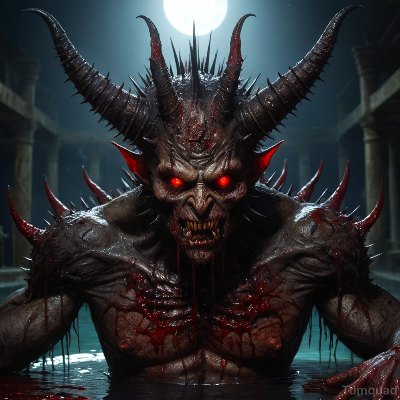
Shambara, also referred to as Shambarasura, is an Asura of the Danava class who appears in both the Vedic and Puranic textual traditions, though in substantially different roles across these two bodies of literature. In the Rigveda, Shambara appears as a powerful non-Vedic king — a Dasyu — who held ninety-nine or one hundred mountain fortresses and was overcome through the intervention of the god Indra on behalf of the Vedic king Divodasa. In the Puranic tradition, a figure of the same name appears as a formidable sorcerer and Danava — a class of beings descended from the sage Kashyapa and his wife Danu, daughter of the progenitor Daksha — who is principally known as the abductor of Pradyumna, the son of Krishna and Rukmini, and as the keeper of Mayavati, who was in truth the goddess Rati in human form. Shambara is recorded in the Vayu Purana among the prominent Danavas, and the narrative of his conflict with Pradyumna is detailed in the Bhagavata Purana, the Vishnu Purana, and the Harivamsha. Whether the Vedic Shambara and the Puranic Shambarasura represent the same figure mythologised across eras, or are two entirely distinct beings who share a name, is not resolved with certainty in the primary sources.
✦ The Name
The name Shambara — Sanskrit Sambara — appears across Vedic and Puranic literature without a consistently fixed etymological explanation in the primary sources themselves. The suffix asura, added in the form Shambarasura, is the general Puranic designation for a class of powerful beings in opposition to the gods, and its addition to the name Shambara signals his categorisation as an adversary of the divine order in the Puranic narrative cycle. His mastery of maya — the power of magical illusion — is a defining characteristic, and his association with mayavidya, the science of illusion, is central to the narrative of his conflict with Pradyumna.
✦ Lineage
- Class: Danava — a race of beings in the Puranic cosmology born of the union of the sage Kashyapa, son of Marichi and grandson of Brahma, and his wife Danu, a daughter of the progenitor Daksha. The Danavas are a distinct branch of Asuras, separate from the Daityas who descend from Kashyapa's wife Diti.
- Puranic genealogy: The Vayu Purana lists Shambara among the prominent Danavas, placing him within the Kashyapa-Danu lineage as a class member; the individual parentage of Shambara within this lineage is not specified with precision in the available primary sources.
- Wife: Mayavati — a figure of great significance who was in truth Rati, the goddess of love and the consort of Kamadeva, the god of desire, reborn in human form and serving within Shambara's household as a cook. Rati had taken this form in order to be near the reincarnated Kamadeva, who was reborn as Pradyumna.
- Children (variant account): Some secondary sources, including the Puranic Encyclopaedia of Vettam Mani, record sons named Mayasura, Shringaketu, and Kumbhaketu. The attribution of Mayasura as Shambara's son should be treated as a textual variant: the primary Puranic tradition — including the Mahabharata and the Vishnu Purana — identifies Mayasura, the renowned Danava architect, as a direct son of Kashyapa and Danu rather than as a son of Shambara. The sons Shringaketu and Kumbhaketu are not prominently developed in surviving primary texts.
✦ The Vedic Shambara — Keeper of a Hundred Forts
In the Rigveda, Shambara appears repeatedly as a formidable adversary associated with a large number of mountain fortresses — the hymns variously cite ninety, ninety-nine, or one hundred such strongholds. He is categorised as a Dasyu, a term used in the Rigveda for non-Vedic peoples or forces opposed to the Vedic ritual and social order. The Vedic hymns recount that the god Indra, acting in support of the Vedic king Divodasa — a celebrated ruler of the Bharata dynasty — destroyed the forts of Shambara and ultimately brought about his defeat. Multiple hymns in the Rigveda, spread across several mandalas, reference this episode, with the number of destroyed fortresses varying slightly between hymns. According to some Rigvedic references, Indra pursued Shambara for forty years before finding him concealed in the mountains and finally defeating him at a location called Udavraja. The precise nature of Shambara as a historical figure, a mythological demon, or a symbolic representation of non-Vedic adversarial forces has been a subject of scholarly discussion, and no single interpretation is universally accepted.
✦ The Abduction of Pradyumna
The central narrative episode of the Puranic Shambara concerns his abduction of Pradyumna, the firstborn son of the god Krishna — one of the principal avatars of Vishnu and the supreme deity of the Vaishnava tradition — and Rukmini, Krishna's principal wife. The episode is narrated in the Bhagavata Purana, the Vishnu Purana, and the Harivamsha.
Shambara had received knowledge — through prophecy or divine forewarning — that Krishna's firstborn son was destined to bring about his death. Determined to forestall this fate, Shambara entered the city of Dvaraka, the divine city of Krishna's kingdom, in disguise, and abducted the infant Pradyumna when the child was only ten days old. He then cast the infant into the ocean, intending to drown him and thereby avert the prophesied death.
The infant Pradyumna, however, survived: he was swallowed by a large fish in the ocean. That same fish was subsequently caught by fishermen and brought to Shambara's own kitchen as part of a purchase of fish. When the fish was cut open in Shambara's kitchen, the infant was found alive within it by Mayavati, who served as a cook in Shambara's household. Mayavati recognised Pradyumna as the reincarnation of Kamadeva — the god of desire who had been burnt to ashes by the fire of Shiva's third eye when Kamadeva had attempted to arouse desire in the meditating Shiva, and who was subsequently reborn as Pradyumna. Since Mayavati was in truth the goddess Rati, Kamadeva's own consort reborn in human form, she understood that Pradyumna was her husband reborn. She raised the child in secret within Shambara's household.
✦ The Defeat and Death of Shambara
When Pradyumna had grown to adolescence, Mayavati revealed to him his true identity — that he was Pradyumna, son of Krishna, and the reincarnation of Kamadeva — as well as her own true identity as Rati. She also disclosed to him that Shambara was his mortal enemy and the one who had cast him into the ocean as an infant. Mayavati further instructed Pradyumna in the knowledge of mahamaya vidya — the science of countering the powerful illusions of the Asuras — equipping him with the means to neutralise Shambara's formidable powers of magical deception.
Pradyumna confronted Shambara. The demon employed the full range of his asura magic and powers of illusion in the battle, but Pradyumna, armed with the counter-knowledge taught by Mayavati, neutralised each of Shambara's illusions in turn. Pradyumna then severed Shambara's head with a single blow of his sword, bringing the demon's long life of magical power and violence to an end. After killing Shambara, Pradyumna returned to Dvaraka with Mayavati, where he was reunited with his family, including his parents Krishna and Rukmini.
✦ Shambara's Mastery of Maya
A consistent characteristic attributed to the Puranic Shambara across the texts that describe him is his exceptional mastery of maya — the power of magical illusion. He is described as a practitioner of mayavidya, the science of illusion by which reality can be distorted, false appearances created, and adversaries confounded. This quality connects the Puranic Shambara to the broader category of Asuras who are defined by their possession of maya-power, a trait frequently attributed to the Danava class in particular. It is this same mastery of illusion that makes Shambara a formidable opponent requiring specialised counter-knowledge to defeat — knowledge that only Mayavati, herself possessed of mahamaya vidya, was able to provide to Pradyumna.
✦ Textual Variants and Inconsistencies
The relationship between the Vedic Shambara and the Puranic Shambarasura is not clarified in the texts themselves. The Vedic Shambara is a Dasyu king associated with mountain forts, defeated by Indra for the benefit of Divodasa; the Puranic Shambarasura is a Danava sorcerer who abducts Krishna's son. Whether these represent the same mythological figure across a long period of textual development and reinterpretation, or are two distinct figures who share a name, is a question the primary sources leave open.
Within the Puranic tradition, the Bhagavata Purana, the Vishnu Purana, and the Harivamsha all narrate the Pradyumna episode with broad consistency, though minor variations in detail exist between them. The number of days the infant Pradyumna had been alive at the time of abduction is given differently in some accounts — ten days in the most widely cited version. The question of whether Narada played a role in alerting Mayavati to Pradyumna's identity is not confirmed in the primary Puranic accounts; the Bhagavata Purana presents Mayavati's recognition of Pradyumna as arising from her own knowledge rather than from Narada's disclosure, and the attribution to Narada in some secondary retellings should be treated with caution.
The identification of Mayasura as a son of Shambara, found in some secondary sources, conflicts with the primary Puranic tradition in which Mayasura is independently established as a direct son of Kashyapa and Danu — making him a Danava of the same generation as Shambara rather than his son. Both accounts exist in the tradition and should be treated as variant genealogical claims rather than as settled fact.
✦ Connection to the Wider Genealogy
Shambara belongs to the Danava branch of the Asura race, a lineage descending from the sage Kashyapa — one of the seven great Vedic sages, son of Marichi, and grandson of Brahma, the creator within the Hindu trinity — and Danu, a daughter of the progenitor Daksha. His story connects him directly to the Vaishnava narrative cycle surrounding Krishna — the eighth avatar of Vishnu — through his role as the abductor of Pradyumna, who is himself an avatar of the god Kamadeva. Shambara's defeat by Pradyumna thus forms part of the broader cycle of narratives in which the divine forces associated with Vishnu overcome adversarial Asura powers in each successive era.
✦ References
- Primary Sources
- Rigveda, multiple mandalas (including 1.51.5, 1.130.7, 2.14.6, 2.19.6, 4.26.3, 6.31.4): The primary Vedic source for the figure of Shambara as a Dasyu king with ninety-nine or one hundred mountain fortresses, defeated through Indra's intervention on behalf of Divodasa.
- Bhagavata Purana, Canto 10, Chapter 55: The principal Puranic source for the narrative of Shambarasura — the abduction of the infant Pradyumna, his survival in the fish, Mayavati's recognition and raising of the child, and Pradyumna's eventual killing of Shambara.
- Vishnu Purana: Contains a parallel account of the Pradyumna episode and Shambara's death; the Wilson translation provides a detailed chapter on Shambara killed by Pradyumna.
- Harivamsha: The appendix to the Mahabharata, attributed to Vyasa, which contains a version of the Pradyumna-Shambara narrative as part of the broader account of Krishna's lineage and descendants.
- Vayu Purana: Lists Shambara among the prominent Danavas, situating him within the Kashyapa-Danu genealogical tradition of that class of beings.
- Secondary Sources
- Mani, Vettam. Puranic Encyclopaedia. Motilal Banarsidass, 1975. Provides consolidated summaries of the Shambara narrative across Puranic sources and lists his children, including the variant attribution of Mayasura as his son.
- Wisdomlib.org — entry on Shambara: Consolidates primary source references to Shambara across Puranic and Vedic texts, including the Bhagavata Purana chapter on Pradyumna's return.