
About
Dambha — Danava Chieftain and Father of Shankhachuda
Dambha · Dampha · Dambha Danava
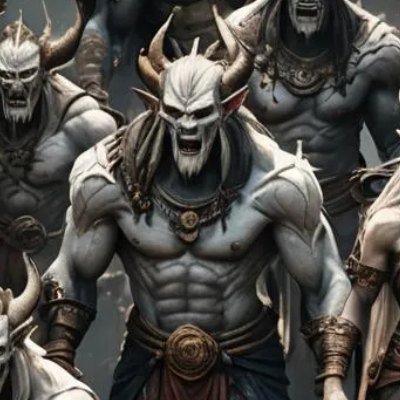
Dambha is a Danava — a member of the race of Asuras born of the union of the primordial sage Kashyapa and his wife Danu — who appears in the Shiva Purana and the Devi Bhagavata Purana principally as the father of Shankhachuda, the great Danava king who conquered the three worlds and was ultimately killed by Shiva. Dambha is the son of Viprachitta, one of the most prominent of the direct sons of Kashyapa and Danu, placing Dambha in the second generation of the Danava lineage. He is described in the Shiva Purana as a great devotee of Vishnu, a quality that distinguishes him within the Danava class and that shapes the nature of the boon he obtains. His primary significance in the textual tradition is as the figure whose intense penance at Pushkara secured the birth of Shankhachuda — whose own story encompasses one of the major narrative episodes of the Shiva Purana. Beyond his role in that birth narrative, Dambha has no independently developed episode or episode-cycle recorded in the surviving primary sources.
✦ The Name
The Sanskrit word dambha carries the meanings of pride, arrogance, hypocrisy, and ostentation, and in the Puranic and ethical literature of Hinduism it is used as a term for one of the vices — the pretence of virtue without its substance. In the context of the Asura races, the use of such a name for a Danava is consistent with the broader Puranic convention of naming demonic figures after qualities that distinguish the Asura nature from the Deva nature. The name is recorded uniformly as Dambha across all relevant passages of the Shiva Purana and the Devi Bhagavata Purana, and there are no significant variant spellings in the primary textual tradition.
✦ Lineage
- Grandfather: Kashyapa — the great primordial sage, son of Marichi and grandson of Brahma the creator, who is regarded in the Puranic tradition as the progenitor of gods, Asuras, Nagas, and many other classes of beings through his multiple wives, daughters of Daksha.
- Grandmother: Danu — one of the daughters of the progenitor Daksha, and wife of Kashyapa. Her union with Kashyapa produced the race of Danavas. The Shiva Purana, in its genealogical chapter on the family of Kashyapa, lists Viprachitta among the sons born of Danu, alongside other notable Danavas including Shambara, Svarbhanu, Vrishparva, and Puloma.
- Father: Viprachitta — one of the foremost and most powerful of the direct sons of Kashyapa and Danu, described across multiple Puranic texts as a leader of the Danavas and a figure of great military and cosmic significance. Viprachitta married Simhika, a daughter of Kashyapa by his wife Diti — making Simhika both a Daitya by birth and a daughter-in-law of the Danava line — and their offspring are counted among the Danavas. The Shiva Purana's chapter on the birth of Shankhachuda explicitly identifies Dambha as the virtuous son of Viprachitta.
- Son: Shankhachuda — the great Danava king who, in his prior birth, was the cowherd Sudama, an intimate companion of Krishna in Goloka, cursed by the goddess Radha to take birth in the Danava race. Shankhachuda performed penance at Pushkara, received boons from Brahma and the divine armour of Krishna, married Tulsi — an incarnation of Lakshmi — became emperor of all three worlds, and was killed by Shiva's trident only after a prolonged cosmic conflict requiring the combined intervention of Brahma, Vishnu, and Shiva. After his death, Shankhachuda returned to Goloka as Sudama and his bones became the conch shells of the ocean.
✦ The Penance at Pushkara and the Boon of a Son
The Shiva Purana narrates in its chapter on the birth of Shankhachuda that Dambha was childless and greatly distressed by this condition. Acting on the counsel of Shukracharya — the sage who serves as the family preceptor and spiritual guide of the Danavas and Daityas, a son of the great seer Bhrigu and the possessor of the Mritasanjivani knowledge — Dambha received from him initiation into the Vishnu mantra, the sacred formula of devotion addressed to Vishnu. Armed with this mantra, Dambha proceeded to Pushkara — the celebrated sacred pilgrimage site — and there undertook an extraordinary penance lasting one hundred thousand years, seated in a stable meditative posture and repeating the Vishnu mantra without cessation.
The intensity of Dambha's austerity was such that an unbearable blazing refulgence arose from his head and spread throughout the cosmos, scorching all gods, sages, and Manus. Unable to endure the heat of this ascetic fire, the gods — led by Indra, king of the heavenly realm — approached Brahma the creator and reported the crisis. Brahma accompanied the gods to Vaikuntha, the supreme abode of Vishnu, and laid the situation before him. Vishnu, recognising Dambha as his devotee and satisfied by the sincerity and power of the penance, descended in person to Pushkara and appeared before Dambha to grant the requested boon.
Dambha, overwhelmed with devotion at the sight of Vishnu standing before him, prostrated and eulogised the god. He then made his request: that he be given a powerful and valorous son who would be a devotee of Vishnu, who would be invincible to the gods, and who would conquer the three worlds. Vishnu granted the boon in full. He then directed Dambha to desist from his penance and departed. Dambha, his penance concluded and his desire fulfilled, paid obeisance in the direction Vishnu had gone and returned home. In time, Dambha's wife became pregnant and gave birth to Shankhachuda.
✦ Character as Described in the Primary Sources
The Shiva Purana describes Dambha in terms that set him apart from the standard portrait of an adversarial Danava. He is explicitly called virtuous and a man of self-control — the Sanskrit text characterises him as a great devotee of Vishnu, qualities of inner discipline and devotion that distinguish him within the Danava class. This characterisation is theologically significant within the Shiva Purana's framing of the Shankhachuda episode: the text is at pains to note that Shankhachuda himself, though born a Danava, had an inherently sattvik nature — a nature of goodness and righteousness — that is traceable precisely to his birth in the household of so devout a father. The Dambha of the Shiva Purana is thus not presented as an adversarial figure but as a pious householder whose sole desire was a son and whose means of obtaining that son was legitimate devotional practice.
✦ Textual Variants and Inconsistencies
The Shiva Purana and the Devi Bhagavata Purana are consistent on the essential details of Dambha's lineage and penance, agreeing that he is the son of Viprachitta and the father of Shankhachuda, and that his son was born through a boon obtained by penance at Pushkara. The Devi Bhagavata Purana's Skandha 9 additionally specifies that Dambha received the Vishnu mantra from Shukracharya before undertaking the penance, a detail corroborated in the Shiva Purana's account. No significant contradictions on Dambha's own person or lineage are recorded between the primary texts that mention him. His wife — the mother of Shankhachuda — is not named in the available primary source passages, and her identity should therefore not be stated.
✦ Connection to the Wider Genealogy
Dambha occupies the second generation of the Danava lineage as reckoned from Kashyapa and Danu. His grandfather Kashyapa is one of the seven great Vedic sages, son of Marichi who is himself a mind-born son of Brahma the creator; through Kashyapa the Danavas share an ultimate ancestral connection with both the gods — who descend from Kashyapa by his wife Aditi — and the Daityas — who descend from Kashyapa by his wife Diti. Dambha's father Viprachitta is one of the most prominent first-generation Danavas, married to Simhika, herself a daughter of Kashyapa and Diti, which makes Simhika simultaneously a Daitya by birth and a matriarch of certain Danava sub-branches. Through his son Shankhachuda, Dambha is connected to the central theology of the Shiva Purana's Yuddha Khanda — the section devoted to the battles of Shiva — and through that narrative to the divine personalities of Shiva, Vishnu, Brahma, Radha, Krishna, and the goddess Tulsi, who is an incarnation of Lakshmi.
✦ References
- Primary Sources
- Shiva Purana, Rudra Samhita, Chapter 27 (The Birth of Shankhachuda): The principal primary source for Dambha — his lineage as son of Viprachitta, his childlessness, his initiation into the Vishnu mantra by Shukracharya, his penance of one hundred thousand years at Pushkara, the scorching refulgence arising from his austerity, Vishnu's descent to grant the boon, the specific boon requested, and the subsequent birth of Shankhachuda. The text also identifies him as virtuous and a devoted worshipper of Vishnu.
- Shiva Purana, Chapter 32 (Description of Creation — The Family of Kashyapa): Lists Viprachitta among the sons of Danu born of Kashyapa, establishing Dambha's place in the broader genealogical framework of the Danava lineage.
- Devi Bhagavata Purana, Skandha 9: Corroborates the identification of Dambha as son of Viprachitta and describes his receipt of the Vishnu mantra from Shukracharya as a precondition to his penance, providing a parallel account of the episode that also names Dambha as the father of Shankhachuda.
- Secondary Sources
- Mani, Vettam. Puranic Encyclopaedia. Motilal Banarsidass, 1975. Provides a consolidated entry on Dambha identifying him as a Danava, son of Viprachitta, and father of Shankhachuda, with reference to the Devi Bhagavata Purana as the primary source for the penance episode.
- Wisdomlib.org — definition entry on Dambha: Consolidates the primary source references to Dambha from the Shiva Purana and Devi Bhagavata Purana, identifying his lineage from Viprachitta and his role in the birth of Shankhachuda, with the specific chapter reference for the Shiva Purana translation.