
About
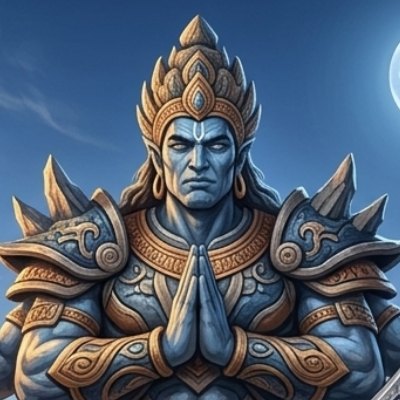
Shankhachuda — Danava King, Incarnation of Sudama, Slain by Shiva
Shankhachuda · Sankhachuda · Shankachura · Sudama (prior birth) · Shridama (variant)
Shankhachuda is a Danava — a class of Asura descending from the sage Kashyapa and his wife Danu — who figures as the principal antagonist in one of the major narrative episodes of the Shiva Purana. He is the son of Dambha, a Danava chieftain, and was born as the result of a curse pronounced by the goddess Radha upon Sudama, a cowherd companion of Krishna in Goloka, the supreme celestial abode. By nature and by prior spiritual attainment, Shankhachuda was no ordinary demon; his character was fundamentally sattvik — aligned with righteousness and devotion to Vishnu — and the Shiva Purana itself notes that although born a Danava, his inner nature was wholly different. He married Tulsi, the daughter of the king Dharmadhvaja, who was herself an incarnation of the goddess Lakshmi. Protected by the armour of Krishna given to him by Brahma and by the power of his wife's inviolable chastity, Shankhachuda proved unconquerable, overthrew Indra, and ruled all three worlds. His defeat and death came about through the combined intervention of the three supreme gods — Brahma, Vishnu, and Shiva — in a complex sequence involving the stripping of his armour and the violation of his wife's chastity by Vishnu in disguise, after which Shiva killed him with his trident. At the moment of his death he shed the Danava form and returned to Goloka as Sudama. His bones became the conch shells of the ocean. This narrative is contained principally in the Shiva Purana and is also referenced in the Devi Bhagavata Purana and the Brahmavaivarta Purana.
✦ The Name
The name Shankhachuda is a Sanskrit compound of shankha, meaning conch shell, and chuda, meaning crest or topknot — thus the name carries the sense of one whose crest or crown is like a conch, or one distinguished by the conch. The name acquires additional resonance at the end of his narrative, when his bones are stated to become the conch shells of the ocean, creating a posthumous identification between the demon and the sacred instrument. His prior-birth name, Sudama — meaning one who gives well or the good giver — is the name by which he is known in Goloka and to which he returns at the conclusion of the narrative. Some accounts use the name Shridama rather than Sudama for the prior birth, and this variant appears in different recensions of the Shiva Purana; the distinction between Sudama, Shridama, and Sridama in this context reflects copying variations across manuscript traditions rather than a meaningful theological difference in the primary sources.
✦ Lineage
- Prior identity: Sudama — a cowherd companion and intimate associate of Krishna in Goloka, the supreme celestial abode described in the Shiva Purana and related devotional literature. He was among the most beloved of Krishna's companions in that realm.
- Prior-life curse: Radha — the supreme goddess of Goloka, the eternal consort of Krishna and the presiding deity of divine love — pronounced a curse upon Sudama as a result of an altercation or transgression in Goloka. The Shiva Purana records that by the curse of Radha, Sudama was compelled to take birth as a Danava. Krishna himself acknowledged the curse and ordained that Shankhachuda's death would come through Shiva's trident and that after death he would return to Goloka.
- Grandfather (by Danava lineage): Kashyapa — the primordial sage, son of Marichi and grandson of Brahma the creator, whose union with Danu, a daughter of the progenitor Daksha, produced the race of Danavas. The Wisdomlib entry on Shankhachuda identifies him as a grandson of Kashyapa and Danu through his father Dambha.
- Father: Dambha — a Danava chieftain who performed severe penance to obtain a son, appealing to Vishnu, who granted the boon. Shankhachuda was born to Dambha as the fruit of this penance.
- Wife: Tulsi — daughter of the king Dharmadhvaja, a devout ruler whose family lineage traces back to the king Vrishadhvaja, a passionate Shaiva devotee. Tulsi was an incarnation of the goddess Lakshmi, who was born as a mortal through a chain of events involving a curse on the family of Vrishadhvaja. Tulsi had performed severe penance at Badarikashrama desiring Vishnu as her husband, but was instructed by Brahma that she must first marry Shankhachuda before eventually attaining Vishnu. The chastity of Tulsi as a devoted wife formed one of the two pillars of Shankhachuda's invincibility.
✦ The Prior Birth — Sudama in Goloka
The Shiva Purana's account of Shankhachuda opens with the prior-birth episode in Goloka. Sudama was a cowherd of the highest standing in that divine realm, among Krishna's innermost companions. A transgression or altercation occurred — the specific details vary in retelling but centre on an incident involving Radha, the presiding goddess of Goloka. Radha cursed Sudama to be expelled from Goloka and to take birth as a Danava in the mortal world. Krishna, who ordained the course of the curse, simultaneously determined that the death of Shankhachuda — the form Sudama would take — would come through Shiva's trident, and that after his death he would be released from the curse and return to Goloka. Shankhachuda himself, speaking in the Shiva Purana, states with full awareness: he knows he is a Danava by birth only, that in his prior life he was the cowherd Sudama, a companion of Krishna, and that he was born as a Danava through Radha's curse — and that by the grace of Krishna he retains the memory of his prior birth throughout his mortal life as a demon king.
✦ Penance, Boons, and Marriage
Born as the son of Dambha, Shankhachuda grew up and undertook severe penance at the sacred pilgrimage site of Pushkara — identified with the town of Pushkar in present-day Rajasthan — in order to propitiate Brahma, the creator. Brahma, pleased with the intensity of his austerity, appeared before him and granted two boons: first, the condition of invincibility against the gods; and second, the divine amulet or armour of Krishna, described as the most auspicious of all protective objects, conferring victory in all directions. Brahma further instructed Shankhachuda to proceed to Badarikashrama in the Himalayas, where he would find his destined wife, Tulsi, performing penance. Shankhachuda went to Badarikashrama and, after an exchange in which he introduced himself and acknowledged his Danava identity and prior Goloka existence to her, married Tulsi according to the Gandharva rite — a form of marriage by mutual consent without formal ceremony. He then returned to his capital with Tulsi as his wife. Shortly thereafter, Shukracharya — the preceptor of the Danavas and Daityas, the sage responsible for guiding the asura races — crowned him emperor of the Danavas.
✦ Conquest of the Three Worlds
Armed with Krishna's divine armour and fortified by the power of Tulsi's chastity as his wife, Shankhachuda led the assembled forces of the Danavas, Daityas, and Rakshasas against the gods. He attacked Indra's city, routed the divine armies, drove Indra from his throne, and assumed control of all three worlds — the heavenly realm, the atmospheric realm, and the earthly realm. The Shiva Purana emphasises that despite this conquest Shankhachuda was not a tyrant by nature: under his rule there was no famine, no plague, no inauspicious planetary alignment, and the subjects of all three worlds lived in happiness. The text explicitly attributes this to his inherently sattvik character — the character of his prior self, the cowherd Sudama — which persisted even within the Danava birth.
The defeated gods, deprived of their heavenly realm, went first to Brahma and then to Vishnu and finally to Shiva, seeking intervention. Vishnu acknowledged that he had full foreknowledge of Shankhachuda's identity and situation, directed the gods to Shiva as the one ordained to end the demon king, and agreed to play his own necessary part in removing the conditions of Shankhachuda's invincibility.
✦ The Battle with Shiva and the Strategy of Defeat
Shiva agreed to kill Shankhachuda and assembled an immense divine army — including his ganas, the eight Bhairavas, the eleven Rudras, the eight Vasus, the twelve Adityas, Kartikeya, Ganesha, Mahakali, and the forces of Indra and the other gods. He first sent the Gandharva king Pushpadanta as a messenger to Shankhachuda, offering him the option of peaceful surrender and restoration of the gods' realm. Shankhachuda refused, stating with reasoned eloquence that the gods had never been fair to the Asuras and that he would not give up what he had won by right of battle. He handed over the kingdom to his son, took leave of Tulsi, and marched to the battlefield at the banks of the river Chandrabhaga. The battle that followed was prolonged and fierce. Mahakali and the divine forces inflicted massive casualties on the demon armies, but Shankhachuda himself proved completely invulnerable to all weapons as long as he wore Krishna's armour and Tulsi's chastity remained intact.
The resolution of the impasse required the combined action of both Vishnu and Shiva. During the battle, Vishnu appeared before Shankhachuda in the disguise of a brahmin mendicant seeking alms. Shankhachuda, known for his generosity and unwilling to refuse a brahmin's request, donated whatever was asked — including, when the disguised Vishnu demanded it, his own divine armour. Having obtained the armour, Vishnu then took on the form of Shankhachuda himself and went to Tulsi, creating a deceptive appearance of the king returning victorious from battle — complete with a festive escort of soldiers and music. Tulsi, unable to see through the divine disguise, received Vishnu-as-Shankhachuda as her husband. In this encounter, her chastity as Shankhachuda's wife was violated. At that precise moment, Shiva hurled his trident at Shankhachuda on the battlefield. The weapon struck him and consumed him in flames along with his chariot.
✦ Death, Transformation, and Return to Goloka
At the moment of his death, Shankhachuda shed the Danava form and assumed once more the divine form of Sudama — a two-armed cowherd youth, adorned with jewels, holding a flute — and ascended in a celestial chariot surrounded by vast hosts of cowherds from Goloka. He returned to Goloka — the supreme divine abode — and bowed at the feet of Radha and Krishna, who received him back with joy, the curse of Radha now fully spent and its purpose accomplished. Krishna himself, in the Shiva Purana, had addressed Shiva before the battle to confirm that Sudama was his own companion who had taken Danava birth through Radha's curse and to request that through the death of Shankhachuda, the curse be lifted and the soul be liberated and returned to him.
The bones of Shankhachuda's body, the Shiva Purana states, were transformed into the conch shells found in the oceans of the world. This aetiological detail — the origin of conch shells — places the narrative of Shankhachuda within the broader Puranic practice of explaining the origins of sacred objects and natural phenomena through mythological events. The conch shell holds great significance in the Hindu tradition as an instrument of worship, particularly in Vaishnava devotional practice, where Vishnu is depicted holding a conch as one of his four emblems.
✦ The Aftermath — Tulsi's Curse and Transformation
When Tulsi discovered that the person who had violated her chastity was not her husband but Vishnu in disguise, she was consumed with grief and fury. She cursed Vishnu to become a stone — declaring that he was as unfeeling and hard as rock in orchestrating her defilement and her husband's death, even though she was herself his devotee. Shiva, who arrived at this moment, consoled Tulsi by revealing to her the full theological context: that she had in a prior existence performed intense penance specifically desiring Vishnu as her husband, that the entire sequence of events — including her marriage to Shankhachuda and its end — was the fulfilment of that desire, and that she would now attain Vishnu in another form. Vishnu, appearing in his true form, confirmed these words. In consequence of Tulsi's curse, Vishnu assumed the form of a sacred stone on the banks of the Gandaki river, worshipped as the Shalagrama or Shaligram. The physical body of Tulsi became the river Gandaki, and from her hair grew the tulsi plant — the sacred basil held as the most holy of all plants in the Vaishnava tradition, required in all worship of Vishnu.
✦ The Distinct Figure of Shankhachuda in the Bhagavata Purana
The name Shankhachuda is borne by a second and entirely distinct figure in the Bhagavata Purana — a yaksha or gana in the retinue of Kubera, the lord of wealth and treasurer of the gods. This second Shankhachuda appears in Bhagavata Purana Canto 10, in an episode set in Vrindavana during Krishna's pastoral youth. While Krishna and Balarama were sporting with the gopis, this Shankhachuda — described as a follower of Kubera, distinct in character and origin from the Danava Shankhachuda of the Shiva Purana — abducted a group of gopi women. Krishna and Balarama gave chase; Krishna struck off this Shankhachuda's head with a single blow, and the crest jewel — the ratna or precious stone — taken from the slain being's head was presented by Krishna to Balarama. This figure has no prior-birth narrative, no connection to Sudama or Radha's curse, no wife named Tulsi, and no connection to the Shiva-trident episode. He is a separate being who happens to share the name and must not be conflated with the Danava Shankhachuda of the Shiva Purana.
✦ Textual Variants and Inconsistencies
The prior-birth name of Shankhachuda varies between Sudama and Shridama across different recensions of the Shiva Purana and its secondary elaborations. The Shiva Purana's own Sanskrit verses, as cited in the Wisdomlib translation, use Sudama as the name in the passages where Shankhachuda himself declares his prior identity and where Krishna addresses Shiva before the battle. The variant Shridama or Sridama appears in other versions. These should be understood as manuscript variants rather than separate traditions.
The precise nature of the transgression in Goloka that prompted Radha's curse is not elaborated in uniform detail across all accounts. Some retellings specify that Sudama spoke disrespectfully to or in defence of Krishna against Radha during a disagreement; others leave the cause of the curse more implicit. The Shiva Purana itself does not dwell on the details of the original transgression but focuses on its consequence and resolution.
A parallel structural narrative exists in the Shiva Purana involving a different demon, Jalandhara, whose wife Vrinda was similarly deceived by Vishnu in disguise, leading to Shiva's killing of Jalandhara. Scholars of the Puranic tradition have noted the structural similarity between the Shankhachuda-Tulsi episode and the Jalandhara-Vrinda episode. Some regional traditions conflate or confuse the two narratives, and some secondary retellings apply details from one to the other. The primary texts treat them as distinct episodes involving distinct beings.
✦ Theological and Symbolic Significance
The narrative of Shankhachuda embodies several interlocking theological concerns characteristic of the Shiva Purana. The episode demonstrates the combined sovereignty of the three supreme gods — Brahma who grants boons, Vishnu who fulfils devotion and also executes the necessary deception, and Shiva who delivers the final blow — working in concert even when their actions appear in tension with one another. It also enacts the Puranic principle that boons granted to the virtuous can create cosmic imbalance requiring coordinated divine response. Shankhachuda's invincibility stems not from illegitimate usurpation but from lawfully obtained boons and from the genuine virtue of his wife; his defeat therefore requires extraordinary means that go beyond straightforward battle.
The episode also establishes the sacred origins of the tulsi plant and the shalagrama stone — two of the most widely used sacred objects in Vaishnava daily worship — and of the conch shell, which is a universal instrument of Hindu ritual. The narrative thus functions simultaneously as a theological drama and as an aetiology for central elements of the devotional material culture of the tradition.
✦ Connection to the Wider Genealogy
As a Danava, Shankhachuda belongs to the lineage of Kashyapa — son of Marichi, grandson of Brahma — and Danu, a daughter of Daksha. His father Dambha is placed within this Danava lineage. His wife Tulsi is a daughter of Dharmadhvaja, whose family lineage connects to the king Vrishadhvaja and, through the incarnation of Lakshmi, to the divine family of Vishnu and Lakshmi. The narrative of Shankhachuda connects him to Krishna — the eighth avatar of Vishnu — through his prior identity as Sudama in Goloka, and to Radha, the presiding goddess of Goloka, as the figure who pronounced the curse. It connects him to Shiva and Parvati through the war narrative, and to Vishnu through the deception episode and through the armour of Krishna that protected him. His story is thus one of the most densely connected narratives in the Shaiva Puranic tradition, touching the innermost theological geography of the major deity-relationships of Hinduism.
✦ References
- Primary Sources
- Shiva Purana, Rudra Samhita, chapters 27–31: The principal and most detailed primary source for the entire narrative of Shankhachuda — his prior birth as Sudama, Radha's curse, his birth to Dambha, penance at Pushkara, boons from Brahma, marriage to Tulsi, conquest of the three worlds, the battle with Shiva's armies, the deception of Tulsi by Vishnu, and the killing by Shiva's trident, followed by the return of Sudama to Goloka and the origin of conch shells from his bones.
- Devi Bhagavata Purana: References the war of the gods against Shankhachuda, including the assembly of divine forces before the battle, corroborating the Shiva Purana's account of the scale of divine intervention required.
- Brahmavaivarta Purana: Contains related material on the Shankhachuda and Tulsi narrative and the subsequent origin of the Tulsi plant and Shalagrama stone.
- Bhagavata Purana, Canto 10: Source for the distinct and separate figure of Shankhachuda as a yaksha-gana of Kubera who abducted gopis and was killed by Krishna in Vrindavana, with his crest jewel given to Balarama; this figure is entirely separate from the Danava Shankhachuda of the Shiva Purana.
- Secondary Sources
- Mani, Vettam. Puranic Encyclopaedia. Motilal Banarsidass, 1975. Distinguishes the two figures named Shankhachuda and provides summaries of both narratives with their respective primary source citations.
- Wisdomlib.org — definition entry on Shankhachuda and translated chapters of the Shiva Purana: Provides direct English translations of the relevant Shiva Purana chapters including Shankhachuda's self-declaration of his prior birth identity, his marriage to Tulsi, and the sequence of his defeat.