
About
Tulasi — Goddess of the Sacred Plant, Incarnation of Lakshmi, Wife of Shankhachuda
Tulasi · Tulsi · Vrinda · Vrindavani · Vaishnavi · Vishnu Vallabha · Haripriya · Lakshmi Tulasi · Shri Tulasi
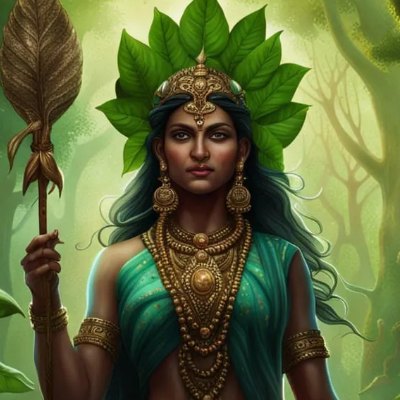
Tulasi is a goddess of the highest standing in the Vaishnava tradition, regarded universally across the Puranic literature as either an incarnation of Lakshmi — the goddess of wealth, fortune, and spiritual grace, and the eternal consort of Vishnu — or as a figure so intimately associated with Vishnu that she is considered dearer to him than all other forms of worship. In her mortal existence, she was the daughter of the king Dharmadhvaja, a descendant of the Shaiva devotee Vrishadhvaja, whose family was affected by a curse from the sun god Surya. After an extraordinary penance at Badarikashrama desiring Vishnu as her husband, she was directed by Brahma to first marry the Danava Shankhachuda — a demon who in his prior birth was Sudama, a cowherd companion of Krishna — before eventually attaining Vishnu. Her unbroken chastity as a devoted wife formed one of the two conditions of Shankhachuda's invincibility. When Vishnu, acting in concert with Shiva, violated her chastity through deception in order to enable Shankhachuda's death, Tulasi cursed Vishnu to become a stone. Her mortal body then dissolved into the sacred river Gandaki, and from her hair grew the Tulasi plant — the holy basil that has become the most sacred plant in Hinduism, required in all worship of Vishnu. A structurally parallel but distinct narrative in the Skanda Purana and Padma Purana presents a figure called Vrinda, wife of the demon Jalandhara rather than Shankhachuda, whose story follows a nearly identical arc. The relationship between these two figures — Tulasi and Vrinda — is treated differently across the primary texts and constitutes one of the most significant textual complexities in the Tulasi tradition. The narrative of Tulasi as wife of Shankhachuda is the principal account of the Devi Bhagavata Purana, the Shiva Purana, and the Brahmavaivarta Purana; the narrative of Vrinda as wife of Jalandhara is the principal account of the Skanda Purana and the Padma Purana.
✦ The Name
The name Tulasi derives from the Sanskrit word tula, meaning a balance or scale, and by extension one who is incomparable or matchless — one who cannot be equalled by any measure. The Puranic Encyclopaedia and various Puranic texts themselves gloss the name as meaning the matchless one, indicating that even at birth the extraordinary nature of the child was immediately apparent. Her epithets in the Vedic and Puranic tradition are numerous: Vaishnavi indicates her belonging to or association with Vishnu; Vishnu Vallabha means the beloved of Vishnu; Haripriya means dear to Hari — one of Vishnu's names; Lakshmi Tulasi and Shri Tulasi identify her with the goddess Lakshmi, Shri being a standard synonym for Lakshmi; and Vrinda — her alternate name in the Jalandhara cycle — derives from a forest name associated with Vrindavana, the sacred grove of Krishna. The sacred plant itself takes its name from the goddess, and in the Vedas the plant is called Vaishnavi, reinforcing the antiquity of the association between Tulasi and the Vaishnava tradition.
✦ Lineage — The Devi Bhagavata Purana and Shiva Purana Account
- Divine identity: An incarnation of Lakshmi — the goddess of prosperity and fortune, eternal consort of Vishnu, who was compelled to take mortal birth through a curse of Sarasvati as narrated in the Devi Bhagavata Purana. Vishnu directed her to be born as the daughter of Dharmadhvaja, foretelling that she would become a plant sacred to all three worlds and that she would eventually be reunited with him.
- Ancestor: Vrishadhvaja — a pious king who was so ardent a devotee of Shiva that he prohibited the worship of all other deities in his kingdom, including Lakshmi and Sarasvati. This exclusivity provoked Surya — the sun god — to curse him that Lakshmi would abandon him and his lineage. As a consequence of this curse, the family of Vrishadhvaja fell into poverty and diminished fortune. Vrishadhvaja and his son — named in some accounts as Rathadhvaja or Hansadhvaja — both died under the shadow of the curse.
- Father: Dharmadhvaja — a grandson of Vrishadhvaja, who together with his brother Kushadhvaja undertook severe penance to propitiate Lakshmi in order to restore the family's lost fortune. Their devotion was rewarded: Lakshmi agreed to be born as their respective daughters.
- Mother: Madhavi — the wife of Dharmadhvaja. The Devi Bhagavata Purana states that Mahalakshmi entered Madhavi's womb and that after a gestation of one hundred years, Madhavi gave birth to Tulasi — who at the very moment of birth appeared already as a grown and beautiful young woman rather than as an infant.
- Paternal uncle: Kushadhvaja — brother of Dharmadhvaja, whose wife Malavati gave birth to Vedavati. Vedavati — born of Lakshmi's grace in the same family — is identified in this tradition with Sita, the wife of Rama, the seventh avatar of Vishnu.
- Husband (mortal): Shankhachuda — the Danava king, son of Dambha, who was in his prior birth the cowherd Sudama, companion of Krishna in Goloka, reborn among the Danavas through the curse of Radha. Shankhachuda married Tulasi after being directed to her by Brahma following his own penance at Pushkara.
✦ The Prior-Birth Cause of Tulasi's Mortal Birth
The Devi Bhagavata Purana provides two layers of explanation for why Lakshmi came to be born as the mortal Tulasi. The surface narrative concerns the family of Vrishadhvaja and the devotion of his grandsons, which invited Lakshmi's descent. But the deeper account, also in the Devi Bhagavata Purana, traces the cause to a dispute among the three divine wives of Vishnu — Lakshmi, Sarasvati, and Ganga. In the version narrated there, Ganga cast an amorous glance at Vishnu, which enraged Sarasvati; a quarrel ensued in which Sarasvati cursed Lakshmi to be born as a plant on earth, Ganga cursed Sarasvati to become a river, and Sarasvati in turn cursed Ganga likewise. Vishnu, presiding over the aftermath, consoled each of the three goddesses and directed that Lakshmi should be born as the daughter of Dharmadhvaja — a birth that would eventually result in her becoming the sacred Tulasi plant, the most beloved of all offerings to Vishnu, and that she would then be eternally reunited with him. This narrative thus frames Tulasi's birth not merely as a response to the Vrishadhvaja family's piety but as the fulfilment of a cosmic necessity arising from events within the divine realm itself.
✦ The Penance at Badarikashrama
Immediately after her birth, Tulasi — despite the counsel of her family and others who urged her to remain at home — gave up all worldly comforts and departed for Badarikashrama, the great sacred site in the Himalayas associated with the forms of Vishnu known as Nara and Narayana. There she undertook one of the most severe penances described in the Puranic tradition. The Devi Bhagavata Purana specifies its duration and austerities in detail: for twenty-four thousand years she practised the panchatapa form of austerity — seated among fires in summer and immersed in water during winter while remaining in the open during the rains; for thirty thousand years she subsisted on leaves alone; for forty thousand years on air alone; and for a final ten thousand years without any sustenance whatsoever. Her sole desire throughout was to obtain Vishnu as her husband.
At the conclusion of these austerities, Brahma appeared before her. He acknowledged her desire but explained that she could not obtain Vishnu as her husband in her current mortal life and must first marry the Danava king Shankhachuda — who was in truth a partial manifestation of Vishnu's own potency in the form of Sudama, a companion of Krishna. After her marriage to and eventual separation from Shankhachuda, she would attain Vishnu and become his eternal consort in the form of the sacred plant that would bear her name.
✦ Marriage to Shankhachuda and the Source of His Invincibility
Shankhachuda, directed to Badarikashrama by Brahma after his own penance at Pushkara, met Tulasi there. He identified himself to her honestly — acknowledging his Danava birth, his prior existence as the cowherd Sudama, and his knowledge of his prior life in Goloka retained through Krishna's grace. The Shiva Purana records the exchange between them at their meeting. They were married according to the Gandharva rite — marriage by mutual consent — and Shankhachuda then returned to his capital with Tulasi. Following his coronation as emperor of the Danavas by Shukracharya, Shankhachuda conquered the three worlds. The conditions of his invincibility were twofold: the divine armour of Krishna given to him by Brahma, and the power of Tulasi's unbroken chastity as a devoted wife. As long as both conditions held, no weapon in the possession of gods, humans, or any other being could harm him.
✦ The Deception by Vishnu and the Death of Shankhachuda
When Shiva agreed to kill Shankhachuda following the gods' appeal for intervention, it became apparent that the demon's invincibility could only be broken by removing both protective conditions simultaneously. Vishnu undertook both tasks: approaching Shankhachuda during the battle in the disguise of a brahmin mendicant, he obtained the divine armour of Krishna as an act of alms — Shankhachuda, known for his liberality, donated it without suspicion. Vishnu then went to Tulasi in the disguise of Shankhachuda, creating a false appearance of the king returning victorious from battle. Tulasi received the disguised Vishnu as her husband and spent time with him in the intimacy of a wife. The Shiva Purana specifies that at the precise moment when the conditions of Tulasi's chastity as Shankhachuda's wife were broken, Shiva hurled his trident at Shankhachuda on the battlefield. The trident struck and consumed the demon.
In a variant account preserved in some retellings, Tulasi herself eventually became suspicious during the encounter and detected that the person with her was not truly her husband — through subtle differences in manner, speech, or bearing. When she confronted the impostor, Vishnu revealed his true form. The Skanda Purana version of the structurally parallel Vrinda episode describes a more elaborate sequence in which the disguised god created an elaborate illusion — including a procession of soldiers celebrating victory — before reaching Vrinda, and in which Vrinda spent several days with him before eventually recognising the deception. The exact moment and manner of recognition varies between the Tulasi (Shankhachuda) and Vrinda (Jalandhara) versions of the narrative and between different recensions of the same Purana.
✦ The Curse of Vishnu and the Origin of the Shalagrama
When Tulasi discovered that she had been deceived by Vishnu — that the person who had broken her chastity was not her husband Shankhachuda but the god himself — she was overwhelmed by grief and rage. She cursed Vishnu to become a stone, declaring that he had acted with the unfeeling hardness of rock in orchestrating her defilement and in causing the death of his own devotee Shankhachuda, despite Shankhachuda being a devotee of Vishnu and despite Tulasi herself being a devotee of Vishnu. Vishnu accepted the curse. He then consoled Tulasi: he reminded her that her long penance at Badarikashrama had been specifically for the purpose of attaining him as her husband, that the entire sequence of events — including the marriage to Shankhachuda and its end — had been the fulfilment of the divine plan set in motion by that penance, and that she would now attain him in a permanent and universally honoured form. As a consequence of Tulasi's curse, Vishnu assumed the form of a sacred stone on the banks of the river Gandaki — worshipped as the Shalagrama or Shaligram — a form in which he is venerated throughout the Vaishnava world to the present day.
✦ The Transformation into the Sacred Plant and River
Having received Vishnu's consolation and the revelation of the divine purpose of her entire mortal existence, Tulasi abandoned her physical body. The mortal body of Tulasi decayed and became the sacred river Gandaki — which flows through what is now Nepal and northern India and is the source of the Shalagrama stones. From Tulasi's hair grew the sacred plant that bears her name — the holy basil, Ocimum tenuiflorum — which has since been the most sacred plant in Hinduism, required in all worship of Vishnu and his avatars. Vishnu declared that the Tulasi plant would be considered equivalent to himself in the matter of receiving worship, that no offering of food or devotion to him would be accepted without a Tulasi leaf, and that Tulasi would remain forever by his side as his most beloved devotee and consort in plant form. This declaration is recorded across the Padma Purana, the Skanda Purana, and the Devi Bhagavata Purana with variations in wording but consistency in substance.
✦ The Vrinda Narrative — A Structurally Parallel but Distinct Account
The Skanda Purana and the Padma Purana present a narrative in which the figure who becomes the Tulasi plant is called Vrinda rather than Tulasi, and her husband is the demon Jalandhara rather than Shankhachuda. Vrinda is described as the daughter of Kalanemi — a powerful Asura — and as a supremely devout worshipper of Vishnu. Jalandhara, born from a burst of divine energy from Shiva's third eye that fell into the ocean, was raised by the ocean and became a formidable demon king. He married Vrinda, whose absolute chastity and Vishnu-devotion provided the same kind of protective spiritual force for him that Tulasi's chastity provided for Shankhachuda. After Jalandhara conquered the three worlds and demanded Parvati from Shiva — an act of supreme transgression — Shiva went to war against him and found him invulnerable. Vishnu, at Shiva's request, again performed the deception of assuming the husband's form to break Vrinda's chastity. Vrinda — in some versions of the Skanda Purana account — eventually discovered the deception through a nightmare and her eventual recognition of the impostor, at which point she cursed Vishnu and self-immolated. From her ashes grew the Tulasi plant. The Padma Purana offers a further variation in which Vrinda's body, after her death, merged with Gauri — a name of Parvati — and Tulasi grew from Gauri's grace. The structural pattern is identical to the Shankhachuda-Tulasi narrative, but the demon, Vrinda's parentage, and several narrative details differ.
The relationship between Tulasi and Vrinda in the tradition is complex. Some texts treat them as the same figure appearing in different demon-husband narrative cycles — parallel incarnations of Lakshmi fulfilling the same cosmic function across two different episodes. Other theological readings within the tradition treat them as distinct figures belonging to entirely separate mythological events. The primary texts do not themselves provide a single authoritative resolution to this question, and it remains a point of genuine textual complexity in the Tulasi tradition.
✦ The Brahmavaivarta Purana Account
The Brahmavaivarta Purana, narrated as a conversation between Vishnu and the sage Narada, offers a third distinct framing of Tulasi's origin. In this account, Vishnu traces the ancestral lineage of Tulasi through a line of kings beginning with a pious Manu named Dakshasavarni, whose descendants across several generations were devoted Vaishnavas until Vrishadhvaja arose and, through his exclusive Shaiva devotion, set in motion the chain of events that eventually led to Lakshmi's birth in that lineage. This Purana also presents the episode involving Sudama and Vrinda — framing the marriage of Shankhachuda and Tulasi as arising from Sudama's desire to be with Vrinda Devi, a divine associate of Radha — which gives the narrative a different theological colouring, locating the cause not in a curse but in a wish of both parties fulfilled through mortal birth. The Brahmavaivarta Purana's version of how Tulasi's chastity is broken — and whether it involves physical intimacy or a more subtle form of deception — is also theologically debated within the tradition, some commentators understanding the episode symbolically rather than literally.
✦ Theological and Iconographic Significance
Tulasi occupies a singular position in the Hindu devotional tradition that is arguably without parallel among sacred plants anywhere in the world. The Skanda Purana, Padma Purana, and Devi Bhagavata Purana all devote extensive passages to the spiritual merits of contact with the Tulasi plant — seeing it, touching it, watering it, circumambulating it, offering it to Vishnu, dying near it, or using its wood for a funeral pyre are all described as conferring extraordinary spiritual benefit. The Padma Purana declares that Vishnu does not accept even elaborate ritual offerings without a Tulasi leaf, and the Skanda Purana identifies Tulasi as the plant in whose presence Vishnu takes up residence.
The annual festival of Tulasi Vivah — the ceremonial marriage of Tulasi to Vishnu — is celebrated on the twelfth day of the bright fortnight of the month of Kartika in the Hindu calendar. In this ceremony, a Tulasi plant is wed to a Shalagrama stone representing Vishnu, enacting in ritual form the divine reunion foretold at the conclusion of Tulasi's mortal existence. This festival marks the beginning of the Hindu wedding season and the end of the four-month sacred period of Chaturmasa. The theology of Tulasi Vivah rests directly on the narrative of Tulasi's penance, her marriage to Shankhachuda, and Vishnu's promise of eternal union with her.
In her capacity as a goddess, Tulasi is specifically described in the Vedas and Upapuranas as Vaishnavi — belonging entirely to the Vaishnava sphere — and as one of the earthly forms of Lakshmi, establishing a doctrinal link between the sacred plant and the supreme goddess of Vaishnavism. The Srimad Bhagavatam mentions Tulasi in the context of Vishnu's adornment, noting that the god garlands himself with Tulasi leaves, marking her as uniquely chosen among all flora.
✦ Textual Variants and Inconsistencies
The Puranic tradition presents at minimum three structurally distinct narrative cycles for the origin of the Tulasi plant and the figure of Tulasi or Vrinda. The Devi Bhagavata Purana presents Tulasi as the daughter of Dharmadhvaja and wife of Shankhachuda, with her origin rooted in the quarrel among Vishnu's divine consorts. The Skanda Purana and Padma Purana present Vrinda as the daughter of Kalanemi and wife of Jalandhara, with no reference to Dharmadhvaja or the three-wives quarrel. The Brahmavaivarta Purana presents yet another framing involving Dakshasavarni's lineage and the desire of Sudama and Vrinda Devi for one another. These are not merely different tellings of the same story with variant details; they involve different characters, different demons, different causes, and different fates for the plant. The scholarly and theological tradition has sought to reconcile them through the principle that they represent different cosmic cycles or different aspects of the same divine figure, but the primary texts themselves do not provide an explicit reconciling statement.
The precise nature of the violation of Tulasi's chastity by the disguised Vishnu is also treated differently across texts and commentators. Some accounts describe a full physical deception over several days; others present a more abbreviated encounter that breaks the protective condition of chastity without full physical consummation; the Brahmavaivarta Purana's account is particularly debated among Vaishnava commentators who prefer symbolic or allegorical interpretations. None of the primary texts provides a single unambiguous resolution, and this episode remains one of the most theologically discussed passages in the Tulasi literature.
✦ Connection to the Wider Genealogy
As an incarnation of Lakshmi, Tulasi is genealogically connected to the highest tier of the Vaishnava divine family: Lakshmi is the eternal consort of Vishnu — one of the three supreme deities of the Hindu Trimurti alongside Brahma the creator and Shiva the destroyer — and the goddess of fortune, prosperity, and spiritual grace. Through her birth in the family of Dharmadhvaja, Tulasi is connected to the lineage of the Shaiva devotee Vrishadhvaja and to his brother Kushadhvaja, whose daughter Vedavati is identified in the same tradition with Sita, wife of Rama, making the Tulasi and Sita birth narratives parallel: both are daughters of Lakshmi born into the same royal family in the same generation. Through her marriage to Shankhachuda, Tulasi connects to the Danava lineage of Kashyapa and Danu through Viprachitta and Dambha, and to the Goloka narrative of Sudama and Radha and Krishna. Her posthumous forms — the river Gandaki and the Tulasi plant — make her a living presence in the material world in permanent association with the Shalagrama stone that Vishnu became through her curse, creating one of the most theologically integrated trios of sacred objects in the Hindu devotional tradition.
✦ References
- Primary Sources
- Devi Bhagavata Purana, Skandha 9: The principal source for the Tulasi-as-daughter-of-Dharmadhvaja narrative — the quarrel of Lakshmi, Sarasvati, and Ganga; Sarasvati's curse on Lakshmi; Vishnu's direction to be born as Tulasi; the family of Vrishadhvaja and Dharmadhvaja; the birth from Madhavi; the penance at Badarikashrama; the marriage to Shankhachuda; the deception by Vishnu; the curse of Vishnu; and the transformation into the Gandaki river and Tulasi plant.
- Shiva Purana, Rudra Samhita, Chapters 27–31: Narrates the birth of Shankhachuda as son of Dambha and his marriage to Tulasi in the context of the Danava's penance and Brahma's instructions; provides the direct speech of Shankhachuda to Tulasi at their meeting at Badarikashrama, including his disclosure of his prior Goloka identity; narrates the battle with Shiva and the mechanisms of Vishnu's deception.
- Skanda Purana, Vaishnava Khanda, Kartikamasa Mahatmya, Chapters 14–23: The principal source for the Vrinda-Jalandhara narrative — Vrinda as daughter of Kalanemi, her marriage to Jalandhara, the invincibility provided by her chastity, Vishnu's deception, her curse of Vishnu, her self-immolation, and the origin of the Tulasi plant from her remains.
- Padma Purana, Uttara Khanda: Contains a parallel version of the Vrinda-Jalandhara episode with some variant details, including the account in which Vrinda's body merges with Gauri and Tulasi grows accordingly; also contains extensive passages on the religious merits of Tulasi worship.
- Brahmavaivarta Purana, Prakriti Khanda: Presents the third major account, tracing Tulasi's lineage through Dakshasavarni's descendants, and framing the Shankhachuda marriage as arising from Sudama and Vrinda Devi's mutual desire for each other in their celestial forms.
- Srimad Bhagavatam (Bhagavata Purana), Canto 4: References Tulasi in the context of Vishnu's adornment, noting his practice of garlanding himself with Tulasi leaves and establishing her pre-eminence among sacred plants.
- Secondary Sources
- Mani, Vettam. Puranic Encyclopaedia. Motilal Banarsidass, 1975. Provides consolidated entries on Tulasi and Vrinda distinguishing the Shankhachuda and Jalandhara narrative cycles and summarising the major Puranic accounts including the Devi Bhagavata Purana account of the three wives' quarrel.
- Wikipedia — Tulasi in Hinduism: Synthesises the major textual traditions for the Tulasi and Vrinda narratives, distinguishing the Devi Bhagavata Purana and Shiva Purana accounts from the Skanda Purana and Padma Purana accounts, with full citation of the relevant primary texts.
- Pragyata.com — The Genetics and History of the Indian Tulsi: Provides a scholarly summary of the three major Puranic accounts of Tulasi's origin with specific chapter references to the Skanda Purana and Padma Purana, and distinguishes the wife-of-Shankhachuda from the wife-of-Jalandhara traditions.