
About
Dharmadhvaja — King and Father of the Goddess Tulasi
Dharmadhvaja · Dharma-dhvaja
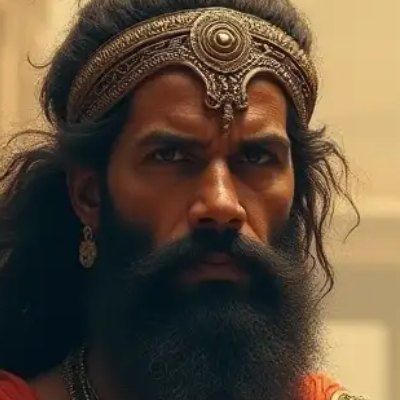
Dharmadhvaja is a king who appears in the Devi Bhagavata Purana and the Shiva Purana principally as the father of the goddess Tulasi — the incarnation of Mahalakshmi who became the sacred basil plant held as the holiest of all plants in the Vaishnava tradition. He is the grandson of Vrishadhvaja, a devout Shaiva king whose exclusive devotion to Shiva and prohibition of Lakshmi worship in his kingdom provoked the sun god Surya to curse the family with the withdrawal of Lakshmi's grace. Dharmadhvaja and his brother Kushadhvaja — both grandchildren of Vrishadhvaja — undertook severe penance to propitiate Lakshmi and restore the family's spiritual fortune. In response to this penance, Lakshmi agreed to descend into their family as their daughters: she was born as Tulasi to Dharmadhvaja's wife Madhavi, and as Vedavati to Kushadhvaja's wife Malavati. Vedavati is identified in the tradition with Sita, the wife of Rama, the seventh avatar of Vishnu. Dharmadhvaja's role in the textual tradition is confined to this genealogical and narrative context; no independent exploits or separately developed episodes are recorded for him in the primary sources.
✦ The Name
The name Dharmadhvaja is a Sanskrit compound of dharma — meaning righteousness, duty, cosmic order, and right conduct — and dhvaja, meaning banner or flag. The name thus carries the sense of one whose banner is dharma, or one who upholds righteousness as his standard. The use of dhvaja as a name-component is characteristic of the royal lineage to which Dharmadhvaja belongs: his grandfather is Vrishadhvaja — whose banner is the bull — and his brother is Kushadhvaja — whose banner is the kusa grass. The naming convention reflects a hereditary practice within this family rather than an individual epithet.
✦ Lineage
- Remote ancestor (Brahmavaivarta Purana account): Dakshasavarni — identified in the Brahmavaivarta Purana as the progenitor of this lineage, a pious Manu and partial manifestation of Vishnu. The Brahmavaivarta Purana traces Tulasi's ancestry through a line of his descendants named Dharmasavarni, Vishnusavarni, Devasavarni, and Rajasavarni, all of whom were devoted Vaishnavas, until the line reached Vrishadhvaja.
- Grandfather: Vrishadhvaja — a king who was a supremely ardent devotee of Shiva, the destroyer among the Hindu trinity, and who in his exclusive devotion prohibited the worship of all other deities within his kingdom, including the rites of Lakshmi and Sarasvati. This act provoked the sun god Surya to curse him with the permanent withdrawal of Lakshmi's favour. Angered, Shiva pursued Surya, who fled to Vishnu for sanctuary. By the time Shiva arrived at Vishnu's abode, Vishnu informed the assembled deities that the temporal world had moved forward greatly and that Vrishadhvaja was already dead.
- Father (primary account — Devi Bhagavata Purana and Puranic Encyclopaedia): Rathadhvaja — the son of Vrishadhvaja and the father of both Dharmadhvaja and Kushadhvaja. Vishnu, in the Puranic Encyclopaedia account, informs the gods that both Vrishadhvaja and his son Rathadhvaja have already died under the influence of time and that the grandsons Dharmadhvaja and Kushadhvaja are now engaged in penance to Lakshmi.
- Father (variant — Brahmavaivarta Purana): Hansadhvaja — this account names the son of Vrishadhvaja as Hansadhvaja rather than Rathadhvaja, describing him as having also died stripped of his divine fortune before the grandsons undertook their penance. The two accounts agree on the essential structure of three generations — Vrishadhvaja, intermediate son, and then Dharmadhvaja and Kushadhvaja — but disagree on the intermediate son's name.
- Brother: Kushadhvaja — who performed penance alongside Dharmadhvaja to propitiate Lakshmi. Kushadhvaja's wife was Malavati, and their daughter was Vedavati, who is identified in this tradition with Sita, the wife of Rama.
- Wife: Madhavi — in whose womb Mahalakshmi took up residence as an embryo for a period of one hundred years, after which Madhavi gave birth to Tulasi. Madhavi is the mother through whom the descent of Lakshmi into mortal birth was accomplished.
- Daughter: Tulasi — born to Madhavi as the mortal incarnation of Mahalakshmi, the goddess of fortune and eternal consort of Vishnu. Tulasi grew up in Dharmadhvaja's household, immediately after birth left for Badarikashrama in the Himalayas to perform severe penance desiring Vishnu as her husband, and was subsequently directed by Brahma to marry the Danava Shankhachuda before ultimately attaining Vishnu and being transformed into the sacred plant and river that bear her name.
✦ The Penance and Lakshmi's Descent
The Devi Bhagavata Purana narrates that after the deaths of Vrishadhvaja and his son, the two grandsons Dharmadhvaja and Kushadhvaja found themselves in a state of diminished fortune — reduced in spiritual brightness and prosperity as a direct consequence of the Surya curse still operating on the family line. Understanding the source of their difficulty, they turned to the worship of Mahalakshmi with great sincerity and sustained devotion. The goddess, pleased by the intensity and genuine repentance of their penance, agreed to take birth in their family as their daughters in order to restore what had been withdrawn from the lineage. Vishnu himself had directed Lakshmi — following the quarrel with Sarasvati in the divine realm — to be born specifically as the daughter of Dharmadhvaja. The penance of Dharmadhvaja and Kushadhvaja thus served as the earthly mechanism by which a prior divine decision was put into effect.
✦ Textual Variants and Inconsistencies
The Brahmavaivarta Purana's account of Tulasi's ancestry — tracing the lineage through Dakshasavarni and his Vaishnava descendants — differs in scope and framing from the Devi Bhagavata Purana's account, though both place Dharmadhvaja and Kushadhvaja in the same generational position as grandsons of Vrishadhvaja. The name of the intermediate generation — the son of Vrishadhvaja and father of the two brothers — is Rathadhvaja in the Puranic Encyclopaedia's summary of the Devi Bhagavata Purana, and Hansadhvaja in the Brahmavaivarta Purana as summarised by the Gopal Chandra source. The difference is not resolved in the primary texts themselves and represents a genuine textual variant.
A further complication exists in the broader Puranic genealogical tradition: the name Dharmadhvaja appears in the Bhagavata Purana (9.13.19) as a son of a different Kushadhvaja — the Kushadhvaja who was a son of Siradhvaja (Janaka) in the Videha lineage of the Ramayana tradition. This Dharmadhvaja of the Bhagavata Purana had sons named Kritadhvaja and Mitadhvaja, and is a figure in an entirely different genealogical context — the royal Kshatriya lineage of the Videha kings — with no connection to the Tulasi narrative. The two figures named Dharmadhvaja must not be conflated: the one in the Tulasi narrative is the grandson of Vrishadhvaja and father of Tulasi; the one in the Bhagavata Purana 9.13 is a son of a different Kushadhvaja in the Janaka family tree.
✦ Connection to the Wider Genealogy
Dharmadhvaja's lineage, as set out in the Brahmavaivarta Purana, descends from Dakshasavarni — the ninth Manu of the cosmic chronological system, identified as a son of Varuna, the Vedic god of the cosmic waters and celestial order. The family thus carries a lineage of cosmic authority, and the Brahmavaivarta Purana underlines the Vaishnava devotion of all intermediate ancestors until Vrishadhvaja turned exclusively to Shaivism. Through his daughter Tulasi, Dharmadhvaja is connected to Vishnu — one of the three supreme deities of the Hindu Trimurti — through the Tulasi plant that became the most sacred of all offerings to Vishnu. Through his brother Kushadhvaja's daughter Vedavati-Sita, the family is connected to Rama, the seventh avatar of Vishnu, and to the narrative cycle of the Ramayana.
✦ References
- Primary Sources
- Devi Bhagavata Purana, Skandha 9: The principal source for the Dharmadhvaja narrative — the lineage of Vrishadhvaja, Surya's curse, the death of Rathadhvaja, the penance of Dharmadhvaja and Kushadhvaja, and the birth of Tulasi from Dharmadhvaja's wife Madhavi.
- Shiva Purana, Rudra Samhita, Chapter 28: Refers to Tulasi as the daughter of Dharmadhvaja in the context of Brahma directing Shankhachuda to Badarikashrama to marry her; confirms Dharmadhvaja as her father without elaborating his own biography.
- Brahmavaivarta Purana, Prakriti Khanda: Traces the ancestral lineage through Dakshasavarni and names Hansadhvaja as the intermediate son of Vrishadhvaja; provides the extended genealogical account of successive Vaishnava kings leading to Vrishadhvaja.
- Bhagavata Purana, Canto 9, Chapter 13, Verse 19: Records a separate Dharmadhvaja — son of a different Kushadhvaja in the Videha lineage — with sons named Kritadhvaja and Mitadhvaja; this figure is genealogically unrelated to the Dharmadhvaja of the Tulasi narrative and must not be conflated with him.
- Secondary Sources
- Mani, Vettam. Puranic Encyclopaedia. Motilal Banarsidass, 1975. Provides the consolidated narrative of Dharmadhvaja's family context within the Tulasi birth episode, naming Rathadhvaja as the intermediate generation between Vrishadhvaja and the two brothers.
- Wisdomlib.org — definition entry on Dharmadhvaja: Distinguishes the two figures named Dharmadhvaja in the Puranic tradition — the father of Tulasi in the Shiva Purana and Devi Bhagavata context, and the son of Kushadhvaja of the Videha lineage in the Bhagavata Purana.