
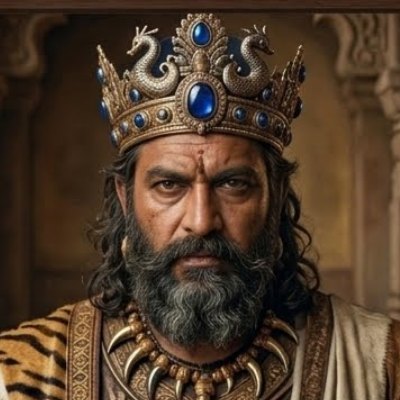
About
Bharmyashva — King of Panchala, Father of Mudgala, Ancestor of the Moudgalya Line
Bharmyashva · Bhamyasva · Bharmyasva · Bharma
Bharmyashva is a king of the Panchala kingdom belonging to the Lunar dynasty — the great royal line descended from the moon god Soma through Pururavas, Nahusha, and Yayati — whose primary significance in the canonical tradition is as the father of the rajarishi Mudgala. Mudgala is the ascetic sage-king celebrated in the Mahabharata's Vana Parvan for his practice of Unchavritti, his legendary hospitality and patience, and his ultimate renunciation of the offer of heaven in his physical body — and is the eponymous patriarch of the Moudgalya brahmin gotra, one of the major brahmin lineage groups of the tradition. Bharmyashva is attested in the Mahabharata's genealogical passages concerning the Panchala royal succession and in the Bhagavata Purana's ninth skandha, which contains the most systematically organised Puranic account of the Panchala dynastic line. He does not appear as the protagonist of any independent narrative episode in the primary texts, and his profile is accordingly brief, reflecting the limited but genuine textual base the evidence supports. His significance in this genealogical reference system is as the connecting node between the Panchala royal tradition and the lineage that produces Mudgala, Divodasa, Sudas, and the subsequent figures of this branch of the tree.
✦ The Name
The name Bharmyashva is a Sanskrit compound whose precise etymology is not transparently rendered in the scholarly apparatus. The element ashva means horse — one of the most common components of royal and noble names in the Vedic and Puranic tradition, where the horse is the supreme symbol of royal power, sacrifice, and military prowess. The Ashvamedha — the horse sacrifice — was the paramount royal sacrifice of the Vedic tradition, and names incorporating ashva are characteristic of the Kshatriya warrior class to which Bharmyashva belongs. The first element bharmya is less transparently etymologised and does not yield a single universally accepted Sanskrit derivation from the available scholarly apparatus. The name appears in variant transliterations — Bhamyasva, Bharmyasva, and occasionally Bharma in abbreviated form — across different editions of the Mahabharata and the Puranas, reflecting the normal variation in manuscript transmission for a minor dynastic name that did not attract extensive commentarial attention.
✦ Lineage
- Dynastic position: Haryyashva belongs to the Nila sub-line of the Panchala branch of the Chandravamsha, descending through Puru, Bharata Daushyanti, Bhumanyu, Suhotra, Hastin, Ajamidha, Nila, Shanti, Sushanti, Purujanu, and Chakshu to Haryyashva himself
- Father: Chakshu — son of Purujanu son of Sushanti son of Shanti son of Nila son of Ajamidha; called Arka in the Bhagavata Purana, Riksha in the Vayu Purana, and Prithu in the Matsya Purana; omitted entirely in the Vishnu Purana, which names Purujanu directly as Haryyashva's father in a compressed account
- Sons — the five Panchala princes (Vishnu Purana): Mudgala, Srinjaya, Vrihadishu, Yavinara or Pravira, and Kampilya — the five sons to whom Haryyashva declared these my five sons are able to protect the countries, thereby constituting them as the Panchalas and giving the confederation its name; it is from this declaration that all five and their descendants bear the Panchala designation
- Sons — the five Panchala princes (Bhagavata Purana variant): Mudgala, Yavinara, Brihadvishva, Kampilya, and Sanjaya — the Bhagavata Purana's version of the same five sons with variant names at positions two, three, and five; Mudgala and Kampilya are consistent across both texts
- Principal son: Mudgala — the most narratively prominent of the five brothers; a rajarishi who attained Brahminical rank through spiritual merit; celebrated in the Mahabharata Vana Parva for his practice of Unchavritti, supreme hospitality under repeated trial, and his renunciation of the physical ascent to heaven; eponymous patriarch of the Maudgalya Brahmin gotra
- Through Mudgala: Bahvashrva — son of Mudgala; father of the twin children Divodasa and Ahalya; it is through this two-generation descent — Haryyashva → Mudgala → Bahvashrva — that Haryyashva is the great-grandfather of Divodasa, not the grandfather as some secondary sources state; the Harivamsha inserts an additional figure Indrasena making the descent three generations from Mudgala to Divodasa in that tradition
- Through Mudgala's daughter (certain traditions): Ahalya — twin sister of Divodasa born of Bahvashrva; wife of the sage Gautama son of Sharadvan; mother of Shatananda who became the family priest of King Janaka of Videha; this Brahminical branch connects the Panchala royal line to the Gautama lineage
✦ Textual Limitations
Bharmyashva has no independent narrative episode in the Mahabharata, the Ramayana, or any of the eighteen Mahapuranas that can be confirmed from the primary sources available through the scholarly apparatus. He appears in the primary texts exclusively as a name in the Panchala dynastic succession — the father of Mudgala in the genealogical lists — without any accompanying story, achievement, or characterisation of his own. This is a genuine feature of the textual record rather than a gap to be filled, and the profile reflects it honestly. His significance is entirely genealogical: as the king from whom Mudgala was born, he is the node through which the Panchala royal tradition connects to the brahminical Moudgalya lineage and to the extended narrative world that Mudgala's own story opens up across the Mahabharata and the Puranic tradition.
✦ Connection to the Wider Genealogy
Bharmyashva stands as the uppermost confirmed genealogical node of the Mudgala branch of the Panchala Lunar dynasty in this reference series. Through his son Mudgala he connects the royal Panchala tradition to the brahminical Moudgalya gotra — representing the tradition's understanding of how a royal family can generate both a continuing line of kings and a founding brahmin lineage through a single rajarishi son. Through the secondary genealogical tradition that identifies a daughter of Mudgala as the wife of Gautama Maharishi, Bharmyashva is the great-grandfather of the Vedic seers Vamadeva and Nodhas — figures whose profiles appear elsewhere in this genealogical series — and the great-great-grandfather of Brihaduktha Vamadevya. Through Mudgala's other descendants — Divodasa, Sudas, and Saudasa Kalmashapada — Bharmyashva is the ancestor of one of the most dramatically documented royal sequences in the Mahabharata and Puranic tradition. His own place in the record is modest and purely structural, but the lineage he anchors is among the most richly documented in this genealogical reference system.
✦ References
Primary Sources
- Mahabharata, Adi Parvan: Contains the genealogical passages on the Panchala royal succession within which Bharmyashva is named as the father of Mudgala.
- Bhagavata Purana, Skandha IX, Chapter 21: The most systematically organised Puranic account of the Panchala dynastic line, containing the statement that the Maudgalya brahmin clan originated from Mudgala and providing the genealogical context within which Bharmyashva's position as Mudgala's father is recorded.
Modern Reference Works
- Pargiter, F.E. Ancient Indian Historical Tradition. Oxford University Press, 1922: The genealogical reconstruction placing Bharmyashva within the Panchala dynastic sequence as the father of Mudgala, derived from the Mahabharata and Puranic genealogical passages.
- Mani, Vettam. Puranic Encyclopaedia. Motilal Banarsidass, 1975: Notes Bharmyashva in the context of the Panchala royal genealogy and his identification as Mudgala's father across the primary textual sources.