
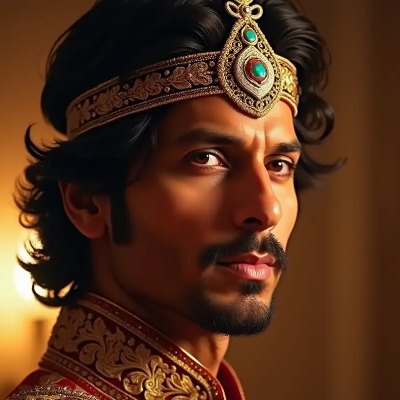
About
Kushadhvaja — King, Grandson of Vrishadhvaja, Brother of Dharmadhvaja, Father of Vedavati
Kushadhvaja · Kusadhvaja · Kushadvaja · Kushadhwaja
Kushadhvaja is a king who appears in the Devi Bhagavata Purana and the Brahmavaivarta Purana as the grandson of Vrishadhvaja — a Shaiva devotee whose exclusive worship of Shiva provoked the sun god Surya to curse the family with the withdrawal of Lakshmi's grace — and as the brother of Dharmadhvaja. Together, Kushadhvaja and Dharmadhvaja undertook severe penance to propitiate Mahalakshmi in order to restore their family's lost prosperity and divine favour. In response, Lakshmi agreed to be born in both their households: as Tulasi to Dharmadhvaja's wife Madhavi, and as Vedavati to Kushadhvaja's wife Malavati. Vedavati — who chanted Vedic hymns at the moment of her birth — is identified in the tradition as a partial incarnation of Lakshmi and as the prior birth of Sita, wife of Rama, the seventh avatar of Vishnu. This Kushadhvaja is a figure of the royal lineage descending from Vrishadhvaja and must be carefully distinguished from two other figures of the same name who appear in entirely separate genealogical contexts in the Puranic and epic tradition: the Brahmarishi Kushadhvaja who is identified in the Valmiki Ramayana as the son of Brihaspati and father of Vedavati through a separate lineage, and the royal Kushadhvaja who is the younger brother of King Janaka of Mithila in the Ramayana's Bala Kanda, father of Mandavi and Shrutakirti.
✦ The Name
The name Kushadhvaja is a Sanskrit compound of kusha — the sacred grass used in Vedic ritual, regarded as highly auspicious and employed in sacrificial and purificatory ceremonies — and dhvaja, meaning banner or standard. The name thus signifies one whose banner is the sacred kusha grass, identifying him as a figure who upholds the standard of the Vedic ritual and moral order. This name places him within the family naming convention shared by his grandfather Vrishadhvaja — whose banner was Shiva's bull — and his brother Dharmadhvaja — whose banner is dharma or righteousness. All three names follow the dhvaja compound pattern characteristic of this royal lineage.
✦ Lineage
- Grandfather: Vrishadhvaja — a king of intense Shaiva devotion who prohibited all forms of worship other than that of Shiva within his kingdom, thereby provoking the sun god Surya to curse the family with the withdrawal of Lakshmi's grace. Vrishadhvaja died with the curse still in effect.
- Father (Brahmavaivarta Purana account): Hamsadhvaja — son of Vrishadhvaja, who also died under the diminished fortune caused by the Surya curse before the grandsons were able to remedy it through penance.
- Father (Puranic Encyclopaedia account drawing on Devi Bhagavata Purana): Rathadhvaja — the same intermediate figure named differently across the two primary textual traditions. The Puranic Encyclopaedia summary records this son of Vrishadhvaja as Rathadhvaja.
- Brother: Dharmadhvaja — who performed the penance to propitiate Mahalakshmi alongside Kushadhvaja; whose wife Madhavi gave birth to Tulasi — the mortal incarnation of Mahalakshmi who later married the Danava Shankhachuda, was transformed after his death into the sacred Tulasi plant and the river Gandaki, and is worshipped throughout the Vaishnava tradition as the most sacred of all plants.
- Wife: Malavati — in whose womb Mahalakshmi entered as a subtle partial incarnation, and who gave birth to Vedavati after the goddess had thus taken up residence within her. The Devi Bhagavata Purana's primary text names her Malavatī.
- Daughter: Vedavati — born as a partial incarnation of Mahalakshmi, who chanted Vedic hymns at the very moment of her birth. She devoted her entire mortal life to penance desiring Vishnu as her husband, was violated and dishonoured by Ravana — the ten-headed king of Lanka — self-immolated with a curse of his doom, and was subsequently reborn as Sita, wife of Rama, through whom Ravana's destruction was accomplished.
✦ The Penance and Lakshmi's Birth in His Family
Following the deaths of Vrishadhvaja and his son under the Surya curse, the two grandsons — Kushadhvaja and Dharmadhvaja — found themselves afflicted with diminished prosperity and spiritual brightness, the direct consequence of the curse still operating on the family line. Understanding the cause of their situation, they undertook sustained and intense penance directed at Mahalakshmi, praying for the restoration of her grace and for the boon of having her be born as their daughter. The Bihar Lokmanch source, drawing on the Puranic account, records that when Lakshmi appeared before them, the brothers prayed both for the return of their kingdom and for the divine grace of her birth in their households. Lakshmi granted both requests. She entered the womb of Malavati, the wife of Kushadhvaja, in a subtle form and in due time was born as Vedavati.
The Devi Bhagavata Purana's chapter 9.16 states that Malavati delivered one daughter born of the parts of Kamala — Kamala being one of Lakshmi's names, meaning the lotus-born. The child, even at the moment of birth, began chanting Vedic hymns clearly. The four Vedas were said in the primary text to reign incarnate on the lips of the newborn. The learned men of the household accordingly named her Vedavati — she who embodies or possesses the Vedas.
✦ An Important Textual Complexity — The Conflation with the Brahmarishi Kushadhvaja
The name Kushadhvaja is shared by at least three distinct figures in the Puranic and epic tradition, and the Kushadhvaja of this profile — the royal grandson of Vrishadhvaja and brother of Dharmadhvaja — must be carefully separated from both of the others. The Valmiki Ramayana Uttara Kanda independently identifies the father of Vedavati as a figure named Kushadhvaja who is a Brahmarishi and son of Brihaspati, the preceptor of the gods — a lineage entirely unrelated to the royal family of Vrishadhvaja. The remarkable fact that both figures share the name Kushadhvaja, both have a wife named Malavati, and both have a daughter named Vedavati has led many secondary sources — and some aspects of the devotional retelling tradition — to treat them as one person. The primary texts, however, do not provide an explicit bridge between the two: the Devi Bhagavata Purana situates Kushadhvaja within the lineage of Vrishadhvaja with no mention of Brihaspati, while the Valmiki Ramayana's Uttara Kanda identifies its Kushadhvaja as a Brahmarishi son of Brihaspati with no mention of Vrishadhvaja or the Surya curse. Whether the tradition has gradually merged two originally separate figures, or whether the Brahmarishi Kushadhvaja of the Ramayana and the royal Kushadhvaja of the Devi Bhagavata Purana are genuinely the same person whose two affiliations arise from his combined royal and ascetic standing, cannot be settled from the primary texts alone. Both identities must be stated and the ambiguity acknowledged.
✦ The Third Kushadhvaja — Janaka's Brother
An entirely unrelated third figure of this name appears in the Valmiki Ramayana's Bala Kanda and in the Bhagavata Purana (9.13.19) as the younger brother of King Janaka of Mithila — also known as Siradhvaja — who ruled the city of Samkasya. This Kushadhvaja was the father of Mandavi and Shrutakirti, who became the wives of Bharata and Shatrughna, the younger brothers of Rama. He belongs to the royal Videha lineage of Mithila and has no narrative or genealogical connection whatsoever to the Vrishadhvaja family or to the Brahmarishi Kushadhvaja. His presence in the tradition represents a third independent use of the same name in an entirely separate genealogical context.
✦ Connection to the Wider Genealogy
Kushadhvaja stands within the lineage of Vrishadhvaja, which the Brahmavaivarta Purana connects through Rajasavarni and his ancestors to Dakshasavarni Manu — the ninth Manu, born of Varuna, the Vedic lord of cosmic waters. Through his penance alongside his brother Dharmadhvaja, Kushadhvaja is the figure through whom Mahalakshmi's second mortal birth in this narrative cycle was accomplished. Through his daughter Vedavati — and her subsequent rebirth as Sita — he is the mortal ancestor whose family supplied the human lineage through which the divine consort of Vishnu appeared as the wife of Rama in the Treta Yuga. Through his brother Dharmadhvaja's daughter Tulasi, he is connected to the Shankhachuda narrative of the Shiva Purana and to the devotional theology of the sacred basil plant. His family thus occupies a unique position in the Puranic genealogical tradition as the royal household chosen to receive two simultaneous incarnations of the same goddess in a single generation.
✦ References
- Primary Sources
- Devi Bhagavata Purana, Skandha 9, Chapter 16: The principal primary source for this Kushadhvaja — his penance alongside Dharmadhvaja, the birth of Vedavati from Malavati as a partial incarnation of Kamala-Lakshmi, and the chanting of Vedic hymns at birth. The Wisdomlib English translation of this chapter names him as the brother of Dharmadhvaja and names his wife as Malavatī.
- Devi Bhagavata Purana, Skandha 9, Chapter 15: Establishes the genealogical context — the curse of Vrishadhvaja, the deaths of Vrishadhvaja and his son, and the statement by Vishnu that the grandsons Dharmadhvaja and Kushadhvaja are now engaged in penance to Lakshmi.
- Brahmavaivarta Purana, Prakriti Khanda: Names Kushadhvaja within the extended genealogy descending from Dakshasavarni Manu through Vrishadhvaja and Hamsadhvaja; corroborates his role as one of the two penance-performing grandsons.
- Secondary Sources
- Mani, Vettam. Puranic Encyclopaedia. Motilal Banarsidass, 1975. Records Kushadhvaja's role in the Tulasi-Vedavati birth narrative as the brother of Dharmadhvaja, names Malavati as his wife and Vedavati as his daughter, and records the Devi Bhagavata Purana as the source.
- Wisdomlib.org — definition entry on Kushadhvaja: Identifies the multiple distinct figures bearing this name across the tradition, separating the brother of Dharmadhvaja in the Tulasi narrative from the Brahmarishi son of Brihaspati in the Ramayana tradition and from the Videha royal Kushadhvaja brother of Janaka.
- Bihar Lokmanch — About Lakshmi and Her Various Avatars: Draws on the Puranic account to record that the father of Vedavati was Kushadhvaja the son of Rathadhvaja — explicitly placing him within the Vrishadhvaja lineage — and names Malavati as his wife, providing corroboration for the genealogical framing of the Devi Bhagavata Purana account.
- Wikipedia — Tulasi in Hinduism and Vedavati articles: Summarise the Devi Bhagavata Purana account of Kushadhvaja and Dharmadhvaja's parallel penance and Lakshmi's birth as their daughters, and note the conflation between the Puranic royal Kushadhvaja and the Brahmarishi Kushadhvaja of the Ramayana tradition.