
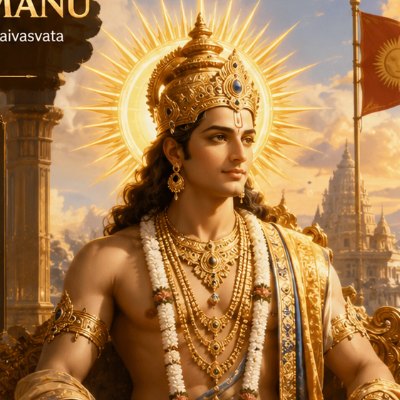
About
Daksha Savarni Manu — The Ninth Manu, Presiding Sovereign of the Ninth Cosmic Age
Daksha Savarni · Dakshasavarnika · The Ninth Manu
Daksha Savarni Manu is the figure designated as the presiding Manu of the ninth Manvantara, the ninth great cosmic age within the current Kalpa — the day of Brahma — as enumerated in Puranic cosmological literature. The title Manu denotes the progenitor and lawgiver appointed to govern humanity during a given cosmic period, each such period being an immense span of time presided over by its own Manu, its own king of the gods, its own divine hosts, and its own council of seven great sages. His father is identified in the Bhagavata Purana as Varuna, the sovereign deity of the cosmic waters and of moral order. His figure appears chiefly in the eighth book of the Bhagavata Purana and in the Vishnu Purana, where the succession of fourteen Manus governing successive cosmic ages is systematically enumerated. The ninth Manvantara, over which he presides, lies in the future of the present cosmic cycle, as the current age belongs to the seventh Manvantara under Vaivasvata Manu.
✦ The Name
The name Daksha Savarni is a compound epithet. Daksha, meaning "the capable one" or "the skilful one," is the name of the celebrated Prajapati Daksha — the great lord of created beings, a foremost progenitor-patriarch of the Puranic tradition born of Brahma the creator and charged with the peopling of the cosmos. Savarni, derived from a Sanskrit root meaning "of the same class" or "of the same nature," is an epithet applied in its strictest sense to children or close associates of Chhaya, the shadow-form of Samjna, the wife of Vivasvat the sun deity. In its broader Puranic usage, however, Savarni has come to function as a generic title for a series of five future Manus — the eighth through the twelfth in most recensions — who are prophesied to share a particular character or cosmic role, and who are distinguished from the earlier Manus of direct solar or lunar dynastic descent.
✦ Naming Insight
A notable tension exists between this Manu's name and his recorded parentage. The Bhagavata Purana explicitly identifies his father as Varuna, the deity of the cosmic waters, cosmic order, and moral law — not as Daksha the Prajapati. Yet his name, Daksha Savarni, carries the unmistakable imprint of Daksha. This tension is characteristic of the Savarni Manu series as a whole, where the Savarni epithet functions as a typological or prophetic designation rather than a strict statement of biological descent. The term connects this Manu to the creative and generative lineage of the great Prajapatis — of whom Daksha is the most eminent — without necessarily asserting direct biological filiation. Daksha Savarni is therefore best understood as spiritually or typologically affiliated with the Prajapati order of creation while being, in the genealogical record of the Bhagavata Purana, the biological son of Varuna.
✦ Lineage
- Father: Varuna — the great Vedic and Puranic deity of the cosmic waters, of the night sky, and of rita, the principle of cosmic and moral order. Varuna is among the most ancient and authoritative of the Vedic Adityas, the sons of Aditi, and in the Puranic tradition he governs the oceans and the realm of the dead alongside Yama.
- Sons: The Bhagavata Purana records the sons of Daksha Savarni as the ruling princes of his Manvantara. Names given in various recensions include Dhritaketu and others, though the precise list varies between Puranic manuscripts.
✦ The Ninth Manvantara
The present cosmic age is the seventh Manvantara, presided over by Vaivasvata Manu, the son of the sun deity Vivasvat. The ninth Manvantara of Daksha Savarni therefore lies two cosmic ages into the future of the current cycle, following the completion of the eighth Manvantara governed by Savarni Manu — also known as Surya Savarni — whose age will itself unfold after the present one concludes.
The Bhagavata Purana records that the presiding Indra of the ninth Manvantara will be a being named Adbhuta, meaning "the wondrous one," who will hold sovereignty over the three worlds during that cosmic period. The divine avatar of Vishnu — the preserver deity who manifests in each Manvantara to sustain the cosmic order — associated with the ninth age is Rishabha, a form connected in the Puranic tradition with the principle of supreme detachment and the teaching of liberation.
✦ The Gods, Indra, and Sages of His Age
The divine hosts of the ninth Manvantara will be drawn from groups identified in Puranic sources as the Paras and related divine classes. The seven great sages — the Saptarishis — who will guide the world during Daksha Savarni's reign are named in various recensions as Medhatithi, Vasu, Satya, Jyotishmana, Dyutimana, Savana, and Havana, though these names are subject to variation across manuscripts and Puranic lineages. Each of these sages fulfils the traditional role of the Saptarishis as custodians and transmitters of Vedic knowledge and dharmic order from one cosmic age to the next.
✦ Textual Variants and Inconsistencies
The Bhagavata Purana and the Vishnu Purana agree on Daksha Savarni's position as the ninth Manu but diverge in finer details regarding the names of his sons, the specific divine groups of his age, and the names of the Saptarishis. The Markandeya Purana, the Brahmanda Purana, and the Vayu Purana each present their own enumerations that do not uniformly correspond in every particular with the Bhagavata's account. These divergences are characteristic of the Puranic tradition as a whole, where the same cosmological framework is transmitted through differing regional and sectarian recensions.
✦ Theological Significance
Daksha Savarni Manu functions within the Puranic tradition primarily as a cosmological and genealogical marker, his significance lying in his place within the vast architecture of cyclical time rather than in any major independent narrative. His descent from Varuna — the deity most closely associated with cosmic law, moral order, and the binding power of oaths — lends a particular quality to his Manvantara, suggesting that the ninth age will be presided over by a figure whose inheritance is that of righteous governance and the upholding of universal order. The associated avatar of Vishnu, Rishabha, reinforces a theological emphasis on liberation and the transcendence of worldly attachment as defining spiritual themes of the ninth cosmic age.
✦ Connection to the Wider Genealogy
Daksha Savarni is the ninth in the sequence of fourteen Manus spanning the current Kalpa. He is preceded by Savarni Manu — the eighth Manu, of solar lineage — and followed by Brahma Savarni Manu, the tenth, whose father is Upashloka, himself identified in certain Vaishnava commentarial traditions as a son of Kartikeya, the war deity and son of Shiva. The first Manu of the entire sequence is Svayambhuva, the self-born, who emerges directly from Brahma at the commencement of creation. Daksha Savarni's lineage through Varuna traces upward to Aditi — the mother of the Adityas — and through her to the cosmic creative order, placing him within a divine genealogy of great antiquity even as his Manvantara remains a future dispensation within the present cosmic day.
✦ References
- Primary Sources:
- Bhagavata Purana, Skandha 8, Chapter 13, verses 18–20: The principal source identifying Daksha Savarni as the ninth Manu, naming Varuna as his father, Adbhuta as the Indra of his age, and providing details of the divine hosts and sages of the ninth Manvantara.
- Vishnu Purana, Book 3, Chapter 2: Confirms Daksha Savarni's position as the ninth Manu within its own enumeration and provides comparative cosmological details.
- Markandeya Purana, Manvantara chapters: Presents an independent enumeration of the Manus and their associated figures, offering comparative data on the ninth Manvantara.
- Brahmanda Purana, Manvantara sections: A parallel Puranic account of the Manu sequence including details relevant to the ninth Manvantara.
- Vayu Purana, Manvantara sections: An early Puranic source enumerating the Manus in sequence with additional comparative data.
- Secondary Sources:
- A. C. Bhaktivedanta Swami Prabhupada, Srimad Bhagavatam, Canto 8, Chapter 13, purport: Provides commentary identifying Varuna as the father of Daksha Savarni and discussing the typological significance of the Savarni epithet.
- Vettam Mani, Puranic Encyclopaedia (1975): Compiled reference entry drawing on multiple Puranic sources for the fourteen Manus and their associated cosmological details.
- Ludo Rocher, The Puranas, in A History of Indian Literature, Vol. II (1986): Scholarly context for the Puranic Manvantara framework and the nature of variation between recensions.