
About
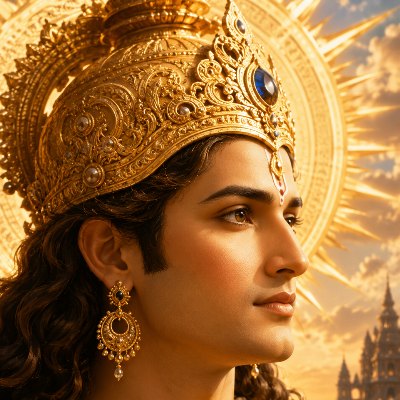
Brahma Savarni Manu — The Tenth Manu, Presiding Sovereign of the Tenth Cosmic Age
Brahma Savarni · Brahmasavarnika · The Tenth Manu
Brahma Savarni Manu is the figure designated as the presiding Manu of the tenth Manvantara, the tenth great cosmic age within the current Kalpa — the day of Brahma — as enumerated in Puranic cosmological literature. The title Manu denotes the progenitor and lawgiver appointed to govern humanity during a given cosmic period, each such period being an immense span of time presided over by its own Manu, its own king of the gods, its own divine hosts, and its own council of seven great sages. His father is identified as Upashloka, a figure who in certain Vaishnava commentarial traditions is held to be a son of Kartikeya — the war deity, son of Shiva and Parvati, also known as Skanda or Murugan. Brahma Savarni belongs to the Savarni class of Manus and his figure appears chiefly in the eighth book of the Bhagavata Purana and in the Vishnu Purana. The tenth Manvantara over which he presides lies in the future of the present cosmic cycle.
✦ The Name
The name Brahma Savarni is a compound designating both the figure's affiliation and his class among the Manus. Brahma refers to Brahma, the four-faced creator deity of the Puranic tradition — the first being to emerge in each cycle of creation, from whom the Prajapatis and the primordial sages are born and through whom the created order is set in motion. Savarni, in its strictest sense, denotes children or close associates of Chhaya, the shadow-form of the sun deity's wife, but in its broader Puranic usage it functions as a generic title for a series of future Manus — the eighth through the twelfth — who share a particular prophesied character. As applied to this Manu, Brahma Savarni indicates a typological or spiritual affiliation with Brahma as creative source, distinguishing him from those Savarni Manus whose names invoke other great Prajapatis or deities.
✦ Lineage
- Father: Upashloka — a figure identified in Gaudiya Vaishnava commentarial literature, specifically in Bhaktisiddhanta Sarasvati Thakura's Anubhashya commentary on the Bhagavata Purana, as a son of Kartikeya, the war deity also known as Skanda or Murugan, who is himself the son of Shiva and Parvati. General Puranic lists such as those in the Matsya Purana name Upashloka as the father of Brahma Savarni without further specifying Upashloka's own parentage. An alternative view found in some Puranic sources identifies Brahma Savarni as a son of Daksha Savarni, the ninth Manu, rather than of a separate figure named Upashloka.
- Sons: The Bhagavata Purana records the sons of Brahma Savarni as the ruling princes of his Manvantara, with names given in various recensions including Sukshetra and others, the precise list varying between manuscripts.
✦ The Tenth Manvantara
The present cosmic age is the seventh Manvantara, presided over by Vaivasvata Manu, the son of the sun deity Vivasvat. The tenth Manvantara of Brahma Savarni therefore lies three cosmic ages into the future of the present cycle, following the completion of the eighth Manvantara of Savarni Manu and the ninth Manvantara of Daksha Savarni, whose father is Varuna, the deity of the cosmic waters.
The Bhagavata Purana records that the presiding Indra of the tenth Manvantara will be a being named Shambhu — or in some recensions Shanti — who will hold sovereignty over the three worlds during that cosmic period. This Shambhu is a distinct being from the deity Shambhu, which is a well-known epithet of Shiva, and his name in this context denotes the appointed divine king of the gods for the tenth age. The divine avatar of Vishnu associated with the tenth Manvantara is Vishvaksena, a form whose name means "he whose army pervades all directions," associated in some traditions with the role of Vishnu as the all-pervasive sustainer of cosmic order.
✦ The Gods, Indra, and Sages of His Age
The divine hosts of the tenth Manvantara will be drawn from groups identified in Puranic sources as the Sukhoshakas and related divine classes. The seven great sages — the Saptarishis — who will guide the world during Brahma Savarni's reign are named in various recensions, though the precise list is subject to variation across manuscripts and Puranic lineages. Each of the Saptarishis of his age will fulfil the traditional role of custodian and transmitter of Vedic knowledge and dharmic order, carrying the sacred tradition forward from the ninth into the tenth cosmic age.
✦ Textual Variants and Inconsistencies
The sources present several points of variation regarding Brahma Savarni. The name of the Indra of his age is given as Shambhu in most recensions of the Bhagavata Purana but appears as Shanti in some manuscript traditions. The paternal lineage of Brahma Savarni is given differently across sources: the Bhagavata Purana names his father as Upashloka, the Matsya Purana concurs in naming Upashloka without elaborating on Upashloka's own parentage, while Bhaktisiddhanta Sarasvati Thakura's Anubhashya commentary on the Bhagavata Purana identifies Upashloka as a son of Kartikeya. A further variant found in some Puranic sources identifies Brahma Savarni not as the son of a figure named Upashloka but as the son of Daksha Savarni, the ninth Manu, which would make successive Manvantaras a matter of direct paternal succession — a view not universally supported across the Puranic corpus. The Vishnu Purana, the Markandeya Purana, the Brahmanda Purana, and the Vayu Purana each present their own enumerations that diverge in finer details of the sons, sages, and divine hosts of the tenth age.
✦ Theological Significance
Brahma Savarni Manu functions within the Puranic tradition primarily as a cosmological marker, his significance lying in his position within the recurring architecture of cosmic time. His name's association with Brahma — the creator — lends the tenth age a quality of creative primacy, suggesting a Manvantara whose presiding figure carries an especially direct connection to the generative source of the cosmos. The lineage through Upashloka to Kartikeya — if the Vaishnava commentarial tradition is followed — places Brahma Savarni within a martial and divine genealogy of great distinction, as Kartikeya is the supreme commander of the divine armies and a son of Shiva himself. The associated avatar of Vishnu, Vishvaksena, whose name evokes universal pervasion and all-directional sovereignty, reinforces the theological character of the tenth age as one of expansive divine governance.
✦ Connection to the Wider Genealogy
Brahma Savarni is the tenth in the sequence of fourteen Manus spanning the current Kalpa. He is preceded by Daksha Savarni Manu — the ninth Manu, son of Varuna, the deity of the cosmic waters — and followed by Dharma Savarni Manu, the eleventh. The first Manu of the entire sequence is Svayambhuva, the self-born, who emerges directly from Brahma at the commencement of creation and from whom the earliest human lineages descend. If the Kartikeya lineage recorded in the Vaishnava commentarial tradition is accepted, Brahma Savarni's genealogy ascends through Upashloka to Kartikeya, then to Shiva and Parvati, and through them into the highest order of the divine hierarchy — a lineage of remarkable theological depth for a figure whose primary function in the texts is cosmological rather than narrative.
✦ References
- Primary Sources:
- Bhagavata Purana, Skandha 8, Chapter 13: The principal source identifying Brahma Savarni as the tenth Manu, naming Upashloka as his father, Shambhu as the Indra of his age, Vishvaksena as the associated Vishnu avatar, and providing details of the divine hosts and sages of the tenth Manvantara.
- Vishnu Purana, Book 3, Chapter 2: Confirms Brahma Savarni's position as the tenth Manu and provides comparative cosmological details.
- Matsya Purana, Manvantara sections: Names Upashloka as the father of Brahma Savarni without specifying Upashloka's own parentage, providing a point of comparison with the Bhagavata's account.
- Markandeya Purana, Manvantara chapters: Independent enumeration of the Manus and their associated figures offering comparative data on the tenth Manvantara.
- Brahmanda Purana and Vayu Purana, Manvantara sections: Parallel Puranic accounts of the Manu sequence including details relevant to the tenth Manvantara.
- Secondary Sources:
- Bhaktisiddhanta Sarasvati Thakura, Anubhashya commentary on the Srimad Bhagavatam: Identifies Upashloka as a son of Kartikeya, providing the genealogical link between Brahma Savarni and the lineage of Skanda that is not explicit in the root Puranic texts.
- A. C. Bhaktivedanta Swami Prabhupada, Srimad Bhagavatam, Canto 8, Chapter 13, purport: Discusses the identity and significance of Brahma Savarni within the Gaudiya Vaishnava interpretive tradition.
- Vettam Mani, Puranic Encyclopaedia (1975): Compiled reference entry drawing on multiple Puranic sources for the fourteen Manus and their associated cosmological details.
- Ludo Rocher, The Puranas, in A History of Indian Literature, Vol. II (1986): Scholarly context for the Puranic Manvantara framework and the nature of variation between recensions.