
About
Dharma Savarni Manu — The Eleventh Manu, Future Sovereign of the Eleventh Cosmic Age
Dharma Savarni · Dharmasavarnika · The Eleventh Manu · Son of Ruci
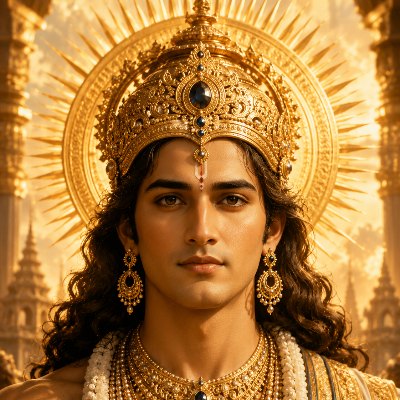
Dharma Savarni Manu is the figure designated as the presiding Manu of the eleventh Manvantara, the eleventh great cosmic age within the current Kalpa — the day of Brahma — as enumerated in Puranic cosmological literature. The title Manu denotes the progenitor and lawgiver appointed to govern humanity during a given cosmic period, each such period being an immense span of time presided over by its own Manu, its own king of the gods, its own divine hosts, and its own council of seven great sages. His father is identified in the Bhagavata Purana as Ruci, a figure of the Puranic tradition associated with spiritual luminosity and righteousness. Dharma Savarni is described in the Bhagavata Purana's eighth book, at the twenty-fourth verse of its thirteenth chapter, as exceptionally learned in spiritual knowledge, a characterisation that marks him as a Manu whose reign will be distinguished above all by the depth of his wisdom and his mastery of dharma — the principle of righteous order that underlies the cosmos. He belongs to the Savarni class of Manus, a group encompassing the eighth through the twelfth in most Puranic recensions, all of whom preside over future Manvantaras within the current cosmic cycle. The eleventh Manvantara over which Dharma Savarni will preside lies four cosmic ages beyond the present seventh age of Vaivasvata Manu.
✦ The Name
The name Dharma Savarni is a compound of two Sanskrit elements. Dharma denotes righteousness, moral and cosmic order, duty, and the foundational principle by which the universe is sustained in right relationship — it is one of the most comprehensive and central concepts of Hindu philosophical and religious thought. Savarni, in its broadest Puranic usage, functions as a generic title for a series of future Manus — the eighth through the twelfth — distinguished from the earlier Manus of direct solar or lunar dynastic descent. Unlike the naming tensions observable in Daksha Savarni — the ninth Manu, whose name invokes the Prajapati Daksha though his father is in fact Varuna — or Brahma Savarni — the tenth Manu, whose name invokes Brahma though his father is Upashloka — the name Dharma Savarni does not carry a comparable genealogical ambiguity. Here the Dharma element functions as a direct descriptor of the Manu's essential spiritual character and cosmological role: he is the Savarni Manu who is the embodiment and master of dharma, the lawgiver whose reign will be defined by righteousness. Some interpretive traditions additionally describe him as the son of the Satya Yuga — the age of truth and perfection — an honorific designation indicating the quality of his spiritual standing rather than a literal genealogical claim.
✦ Lineage
- Father: Ruci — a figure of the Puranic tradition whose name derives from the Sanskrit root meaning brightness, luminosity, and spiritual radiance. Ruci is associated in the broader Puranic genealogical framework with the qualities of purity and sacred light, and his fatherhood of Dharma Savarni situates the eleventh Manu within a lineage defined by spiritual brilliance rather than by martial or political power.
- Sons: The Bhagavata Purana records that Dharma Savarni will have ten sons as the ruling princes of his Manvantara. These sons are led by Satyadharma — whose name means "one whose dharma is truth" — with the remaining nine named in various Puranic recensions, though the full list is subject to variation across manuscripts.
✦ The Eleventh Manvantara
The present cosmic age is the seventh Manvantara, presided over by Vaivasvata Manu, the son of the sun deity Vivasvat. The eleventh Manvantara of Dharma Savarni therefore lies four cosmic ages into the future of the present cycle, following the completion of the eighth Manvantara of Savarni Manu, the ninth of Daksha Savarni — son of Varuna — the tenth of Brahma Savarni — son of Upashloka — and only then the eleventh age belonging to Dharma Savarni himself.
The Bhagavata Purana records that the presiding Indra of the eleventh Manvantara will be a being named Vaidhrita, who will hold sovereignty over the three worlds during that cosmic period. The divine avatar of Vishnu — the preserver deity who manifests in each Manvantara to sustain the cosmic order — associated with the eleventh age is Dharmasetu, meaning "the bridge of dharma" or "the upholder of righteous order." The Bhagavata Purana specifies that Dharmasetu will be born to Vaidhrita — the Indra of that age — and a figure named Aryaka, making this avatar's birth intimately connected to the ruling divine order of the eleventh Manvantara itself.
✦ The Gods, Indra, and Sages of His Age
The divine hosts of the eleventh Manvantara will be drawn from three groups identified in the Bhagavata Purana as the Vihangamas, the Kamagamas, and the Nirvanagatis. These divine classes will together comprise the celestial population of the eleventh age, fulfilling the functions of sustaining the cosmic order, presiding over the natural world, and maintaining the divine governance of the three realms under the authority of the Indra Vaidhrita.
The seven great sages — the Saptarishis — who will serve as the custodians and transmitters of Vedic knowledge and dharmic order during Dharma Savarni's reign are named in the Bhagavata Purana as Aruna, Nishchara, Agnitejas, Vapushmana, Vishnu, Aruni, and Anagha. Each of these sages carries a name of considerable significance: Agnitejas means "one whose radiance is like fire," Anagha means "the sinless one," and Vishnu in this context denotes not the preserver deity but a sage who bears that name. Together they will guide the world through the eleventh cosmic age, preserving the sacred traditions across the vast span of time that constitutes a single Manvantara.
✦ The Avatar Dharmasetu
The Vishnu avatar of the eleventh Manvantara, Dharmasetu, is notable among the Manvantara avatars in that his parentage is specified with unusual precision in the Bhagavata Purana. He will be born to Vaidhrita — the Indra of the eleventh age — and Aryaka. This specificity is significant: it links the avatar's manifestation directly to the ruling divine household of the eleventh Manvantara rather than to a sage's lineage or to the cosmic waters as in some other Manvantara avatar accounts. His name, Dharmasetu — bridge or upholder of dharma — resonates with the essential character of Dharma Savarni's own name and reign, suggesting that the eleventh age will be one in which the principle of righteous order receives its most direct and sustained divine endorsement, with both the Manu and the avatar of that age defined by their relationship to dharma.
✦ Textual Variants and Inconsistencies
The Bhagavata Purana is the most detailed source for the eleventh Manvantara and provides the core account of Dharma Savarni's lineage, sons, Indra, divine hosts, sages, and Vishnu avatar. The Vishnu Purana confirms Dharma Savarni's position as the eleventh Manu in its own enumeration but does not always concur in every particular with the Bhagavata's account of the associated sages and divine groups. The Markandeya Purana, the Brahmanda Purana, and the Vayu Purana each present their own enumerations of the Manus and their Manvantaras, and these may diverge from the Bhagavata's list of the Saptarishis and divine hosts of the eleventh age. The name of the Indra of this age is given as Vaidhrita in the Bhagavata Purana but may appear in variant forms in other recensions. These divergences are characteristic of the Puranic manuscript tradition and should be understood as reflecting different regional and sectarian lineages of transmission rather than as fundamental contradictions in the cosmological framework.
✦ Theological Significance
Dharma Savarni Manu carries a theological weight that is encoded directly in his name. Where earlier Manus derive their names from dynastic or genealogical affiliations — Vaivasvata from Vivasvat the sun, Daksha Savarni from Daksha the Prajapati, Brahma Savarni from Brahma the creator — Dharma Savarni's name is a statement of principle rather than of lineage. He is the Manu of dharma itself, the lawgiver whose entire cosmic function is encapsulated in the central organising concept of Hindu religious and philosophical thought. The description of him in the Bhagavata Purana as exceptionally learned in spiritual knowledge reinforces this character: his qualification for the office of Manu is not primarily martial, dynastic, or genealogical but intellectual and spiritual, rooted in a mastery of sacred wisdom that makes him the fitting progenitor and governor of an age defined by righteousness. The Vishnu avatar of his age, Dharmasetu — the bridge of dharma — mirrors and amplifies this theme, suggesting that the eleventh Manvantara will be a cosmic period in which the principle of righteous order reaches its fullest institutional and divine expression.
✦ Connection to the Wider Genealogy
Dharma Savarni is the eleventh in the sequence of fourteen Manus spanning the current Kalpa. He is preceded by Brahma Savarni — the tenth Manu, son of Upashloka, who in Gaudiya Vaishnava commentarial tradition is identified as a son of Kartikeya the war deity — and followed by Rudra Savarni, the twelfth Manu, who completes the Savarni group of future Manus. The first Manu of the entire sequence is Svayambhuva, the self-born, who emerges directly from Brahma at the commencement of creation. Dharma Savarni's own lineage through his father Ruci — whose name denotes spiritual radiance — places him within a genealogy defined by sacred luminosity, and his position as the embodiment of dharma among the Savarni Manus gives him a distinctive theological identity within the cosmological sequence: where other Manus are primarily defined by their ancestral connections to great deities or Prajapatis, Dharma Savarni is defined by his relationship to a principle.
✦ References
- Primary Sources:
- Bhagavata Purana, Skandha 8, Chapter 13, verse 24: The principal source identifying Dharma Savarni as the eleventh Manu, describing him as exceptionally learned in spiritual knowledge, naming Ruci as his father, Vaidhrita as the Indra of his age, the Vihangamas, Kamagamas, and Nirvanagatis as the divine hosts, the seven sages of his age, Dharmasetu as the Vishnu avatar born to Vaidhrita and Aryaka, and Satyadharma as the foremost of his ten sons.
- Vishnu Purana, Book 3, Chapter 2: Confirms Dharma Savarni's position as the eleventh Manu within its own enumeration of the fourteen Manus and provides comparative cosmological details.
- Markandeya Purana, Manvantara chapters: Independent enumeration of the Manus and their associated figures offering comparative data on the eleventh Manvantara.
- Brahmanda Purana and Vayu Purana, Manvantara sections: Parallel Puranic accounts of the Manu sequence including details relevant to the eleventh Manvantara, useful for comparison with the Bhagavata's account.
- Secondary Sources:
- A. C. Bhaktivedanta Swami Prabhupada, Srimad Bhagavatam, Canto 8, Chapter 13, purport: Provides Gaudiya Vaishnava commentary on the identity and significance of Dharma Savarni and the details of the eleventh Manvantara.
- Vettam Mani, Puranic Encyclopaedia (1975): Compiled reference entry drawing on multiple Puranic sources for the fourteen Manus and their associated cosmological details.
- Ludo Rocher, The Puranas, in A History of Indian Literature, Vol. II (1986): Scholarly context for the Puranic Manvantara framework and the nature of variation between Puranic recensions on cosmological lists.
- A. A. Macdonell and A. B. Keith, Vedic Index of Names and Subjects (1912): Background on the concept of dharma and its Vedic antecedents relevant to understanding the theological significance of this Manu's name.