
About
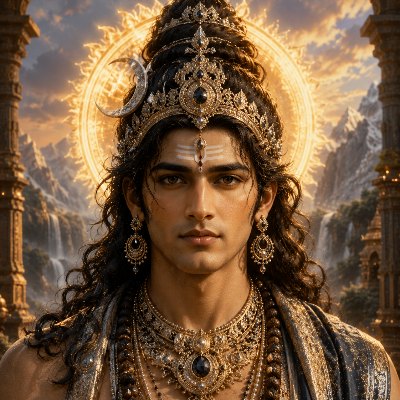
Rudra Savarni Manu — The Twelfth Manu, Future Sovereign of the Twelfth Cosmic Age
Rudra Savarni · Rudrasavarnika · Rudraputra · The Twelfth Manu · Son of Rudra
Rudra Savarni Manu is the figure designated as the presiding Manu of the twelfth Manvantara, the twelfth great cosmic age within the current Kalpa — the day of Brahma — as enumerated in Puranic cosmological literature. The title Manu denotes the progenitor and lawgiver appointed to govern humanity during a given cosmic period, each such period being an immense span of time presided over by its own Manu, its own king of the gods, its own divine hosts, and its own council of seven great sages. He is traditionally identified as the son of Rudra — the fierce, transformative aspect of Shiva, the great deity of destruction and regeneration who stands among the highest of the Puranic divine triad — and in certain textual traditions his mother is identified as Parvati, the consort of Shiva and goddess of power and auspiciousness. His figure appears in the eighth book of the Bhagavata Purana within the systematic enumeration of the fourteen Manus, and his Manvantara is characterised by a distinctive concentration of tapas — ascetic spiritual heat and power — among the sages of his age. He is also the last of the Savarni group of Manus, completing the series that runs from the eighth through the twelfth position in the cosmological sequence. The twelfth Manvantara over which he will preside lies five cosmic ages beyond the present seventh age of Vaivasvata Manu.
✦ The Name
The name Rudra Savarni is a compound of two Sanskrit elements. Rudra is one of the most ancient and powerful names in the Hindu theological lexicon, appearing already in the Rigveda as the name of the fierce storm deity associated with destruction, healing, and the wild forces of nature, and identified in later Puranic tradition with Shiva, the great lord of transformation and liberation. The name Rudra carries connotations of howling, roaring, and terrifying power, yet also of profound compassion and the capacity for radical renewal that follows destruction. Savarni, in its broadest Puranic application, is the generic title for the series of future Manus from the eighth through the twelfth, distinguishing them from the earlier Manus of solar or lunar dynastic descent. As applied to this Manu, the compound Rudra Savarni functions simultaneously as a statement of parentage — he is the son of Rudra — and as a statement of spiritual character, indicating a Manu whose nature and authority are inseparable from the fierce, purifying, and regenerative power of Shiva. He is also referred to in some traditions as Rudraputra, meaning simply "son of Rudra," which makes explicit the genealogical claim that the compound name implies. Unlike the naming tensions present in Daksha Savarni — the ninth Manu, whose name invokes Daksha the Prajapati though his father is Varuna — the name Rudra Savarni carries no comparable genealogical ambiguity: the Rudra element is a direct and consistent statement of his divine parentage.
✦ Lineage
- Father: Rudra — the fierce and transformative aspect of Shiva, the great Puranic deity of dissolution and regeneration, associated with the power of tapas, with the destruction of ignorance, and with the ultimate liberation of souls. Rudra is among the oldest named deities of the Vedic tradition and in the Puranic order stands as one of the three supreme deities alongside Brahma the creator and Vishnu the preserver.
- Mother: Parvati — the consort of Shiva, daughter of the mountain deity Himavat and the goddess Mena, goddess of power, auspiciousness, and devotion. Her identification as the mother of Rudra Savarni is recorded in certain textual traditions including the Manava Purana, giving the twelfth Manu a divine parentage of the highest order on both sides.
- Sons: The Bhagavata Purana records the sons of Rudra Savarni as the ruling princes of his Manvantara. His eldest son is Devavan, whose name means "he who has the gods" or "endowed with the divine." Other notable sons named in the tradition include Upadeva, meaning "the secondary deity" or "one near the gods," and Devashrestha, meaning "the best among the divine." The full list of his sons varies between Puranic recensions.
✦ The Twelfth Manvantara
The present cosmic age is the seventh Manvantara, presided over by Vaivasvata Manu, the son of the sun deity Vivasvat. The twelfth Manvantara of Rudra Savarni lies five cosmic ages into the future of the present cycle, following the completion of the eighth Manvantara of Savarni Manu, the ninth of Daksha Savarni — son of Varuna — the tenth of Brahma Savarni — son of Upashloka — the eleventh of Dharma Savarni — son of Ruci — and only then the twelfth age belonging to Rudra Savarni.
The Bhagavata Purana records that the presiding Indra of the twelfth Manvantara will be a being named Ritadhama — whose name means "he whose abode is rita," the principle of cosmic truth and order — who will hold sovereignty over the three worlds during that period. The divine avatar of Vishnu associated with the twelfth age is Sudhama, also rendered in some recensions as Svadhama, meaning "one whose abode is self-luminous" or "one who dwells in his own divine nature." The Bhagavata Purana specifies that this avatar will be born to Satyasaha and Sunrita, linking the manifestation of Vishnu in the twelfth age to a specific divine household of that Manvantara.
✦ The Gods, Indra, and Sages of His Age
The divine hosts of the twelfth Manvantara will be drawn from five classes identified in the Bhagavata Purana as the Haritas, the Rohitas, the Sumnas, the Sukarmas, and the Suragas. These five divine groups will together comprise the celestial population of the twelfth age, sustaining the cosmic order and the governance of the three realms under the authority of the Indra Ritadhama.
The seven great sages — the Saptarishis — who will serve as custodians and transmitters of Vedic knowledge during Rudra Savarni's reign are named in the Bhagavata Purana as Tapasvi, Sutapa, Tapomurti, Taporati, Tapoghriti, Tapodyuti, and Tapodhan. The names of all seven sages share the prefix tapas — the Sanskrit term for ascetic heat, spiritual austerity, and the purifying inner fire that burns away ignorance and impurity. This extraordinary uniformity of naming is unique among the Saptarishi lists of the fourteen Manvantaras and marks the twelfth age as one whose sacred tradition will be carried forward by sages defined in their very identity by the power of austerity. The concentration of tapas as both name and principle among the sages of Rudra Savarni's age coheres powerfully with his own parentage from Rudra-Shiva, the supreme deity of tapas in the Puranic tradition.
✦ The Vilva Tree and Ancestral Worship
In certain regional traditions, Rudra Savarni is uniquely associated with the Vilva tree — the Bael tree, known botanically as Aegle marmelos — which in Shaiva religious practice is among the most sacred of all trees, its trifoliate leaves being the primary offering made to Shiva in worship across the Hindu world. Rudra Savarni is credited in these traditions with establishing and spreading the spiritual significance of the Vilva tree and with founding specific procedures of tharpanam — the ritual offering of water and sesame to ancestral spirits — to be performed under Vilva trees. This association reinforces the deep Shaiva character of his figure: as the son of Shiva, he is the Manu who perpetuates and institutionalises the sacred symbolism of the tree most intimately connected with his divine father, embedding it within the ancestral ritual practices that sustain the relationship between the living and the dead across generations.
✦ Worship and Auspicious Days
In Southern Indian tradition, the third day of the Tamil month of Panguni — falling in the period of mid-March to mid-April — is observed as the appearance day of Rudra Savarni Manu, commemorating his avatara, or descent into the manifest world. This observance is particular to the southern devotional tradition and reflects the regional importance of the Manvantara Manus as figures of active religious veneration rather than purely cosmological abstraction. The connection of this observance to the month of Panguni is significant, as Panguni is itself a month of considerable religious importance in the Tamil calendar, associated with several major festival observances in both Shaiva and Vaishnava traditions.
✦ Textual Variants and Inconsistencies
The Bhagavata Purana and the Vishnu Purana agree on Rudra Savarni's position as the twelfth Manu and on his divine parentage from Rudra-Shiva, but diverge in finer details regarding the names of his sons and the specific attributes of the divine groups of his age. The name of the Vishnu avatar of the twelfth Manvantara is given as Sudhama in some recensions and as Svadhama in others, a variation that reflects the characteristic instability of proper names across Puranic manuscript traditions. The identification of Parvati as Rudra Savarni's mother appears in the Manava Purana but is not uniformly attested across all Puranic sources, and should be understood as a tradition specific to certain textual lineages rather than as a universally established fact. The Markandeya Purana, Brahmanda Purana, and Vayu Purana each present their own enumerations of the sages, divine hosts, and sons of the twelfth Manvantara that do not uniformly correspond with the Bhagavata's account in every particular.
✦ Theological Significance
Rudra Savarni Manu occupies a position of distinctive theological weight within the sequence of fourteen Manus. As the son of Rudra-Shiva — the deity of destruction, transformation, and ultimate liberation — he is the only Manu in the standard Puranic enumeration whose parentage is directly traced to the principle of cosmic dissolution itself. Where other Manus derive their authority from solar lineages, from Prajapati progenitors, from Brahma the creator, or from Varuna the lord of order, Rudra Savarni's authority flows from the god who ends worlds. This gives the twelfth Manvantara a distinctive theological colouring: it is an age presided over by a figure whose very existence is a manifestation of Shiva's generative power, and whose Saptarishis — all named for tapas, the fire of austerity — mirror in their collective identity the ascetic supremacy of their Manu's divine father. The Vilva tree association further deepens this Shaiva character, connecting the twelfth Manu to the living ritual world of Shiva worship through the most emblematic of all Shaiva sacred plants. He is simultaneously the last of the Savarni Manus and the most directly divine in parentage among them, marking the conclusion of the Savarni series with a figure whose cosmic authority rests on the highest possible Shaiva genealogical foundation.
✦ Connection to the Wider Genealogy
Rudra Savarni is the twelfth in the sequence of fourteen Manus spanning the current Kalpa and the last of the Savarni group that runs from the eighth through the twelfth position. He is preceded by Dharma Savarni — the eleventh Manu, son of Ruci, whose age is defined by the principle of righteous order — and followed by Deva Savarni, the thirteenth Manu, with whom the post-Savarni phase of the fourteen-Manu sequence begins. The first Manu of the entire sequence is Svayambhuva, the self-born, who emerges directly from Brahma at the commencement of creation. Through his father Rudra-Shiva and, in certain traditions, his mother Parvati, Rudra Savarni's lineage ascends into the highest tier of the Puranic divine order, placing the twelfth Manvantara's human progenitor within a genealogy that connects directly to the principle of cosmic transformation itself.
✦ References
- Primary Sources:
- Bhagavata Purana, Skandha 8, Chapter 13: The principal source identifying Rudra Savarni as the twelfth Manu, naming Shiva as his father, Ritadhama as the Indra of his age, the five divine classes of his Manvantara, the seven tapas-named sages, Sudhama or Svadhama as the Vishnu avatar born to Satyasaha and Sunrita, and Devavan as the foremost of his sons.
- Vishnu Purana, Book 3, Chapter 2: Confirms Rudra Savarni's position as the twelfth Manu within its own enumeration and provides comparative cosmological details.
- Manava Purana: Identifies Parvati as the mother of Rudra Savarni, providing the maternal side of his divine parentage not universally attested in other Puranic sources.
- Markandeya Purana, Manvantara chapters: Independent enumeration of the Manus and their associated figures offering comparative data on the twelfth Manvantara.
- Brahmanda Purana and Vayu Purana, Manvantara sections: Parallel Puranic accounts of the Manu sequence including details relevant to the twelfth Manvantara, useful for comparison with the Bhagavata's account.
- Secondary Sources:
- A. C. Bhaktivedanta Swami Prabhupada, Srimad Bhagavatam, Canto 8, Chapter 13, purport: Provides Gaudiya Vaishnava commentary on the identity and significance of Rudra Savarni and the details of the twelfth Manvantara.
- Vettam Mani, Puranic Encyclopaedia (1975): Compiled reference entry drawing on multiple Puranic sources for the fourteen Manus and their associated cosmological details.
- Ludo Rocher, The Puranas, in A History of Indian Literature, Vol. II (1986): Scholarly context for the Puranic Manvantara framework and the nature of variation between Puranic recensions on cosmological lists.
- David Shulman, Tamil Temple Myths (1980): Provides context for the southern regional traditions of Manu veneration and the significance of Tamil calendar observances connected to Puranic figures such as Rudra Savarni.