
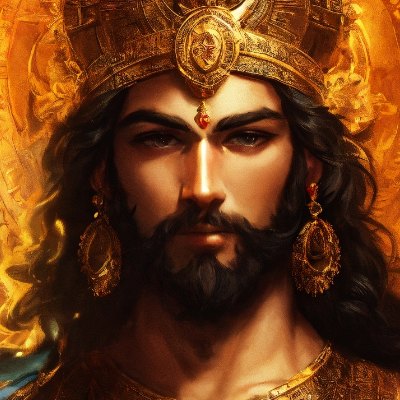
About
Pushkara — Son of Varuna, Celestial Figure of the Puranic and Epic Tradition
Pushkara · Son of Varuna · Pushkara Varunasuta · Varuna's High-Souled Son
Pushkara is a figure of the Puranic and epic tradition identified as a son of Varuna — the great Vedic and Puranic deity of the cosmic waters, of moral order, and of the binding power of oaths, counted among the Adityas, the solar sons of the goddess Aditi. His identity in this profile is treated in its personal and genealogical dimension, as a figure of divine lineage whose significance lies in his position within a genealogical chain of considerable cosmological consequence. Two distinct unions define his genealogical record: his marriage to Jyotsnakali — the daughter of Soma the moon god — recorded in the Udyoga Parva of the Mahabharata, and his union with the Apsara Pramlocha, through which his daughter Malini was born, as recorded in the Markandeya Purana. Pushkara is distinct from Daksha Savarni — the future ninth Manu, who is also a son of Varuna — and the two represent separate lines of descent from the same divine father. Through his daughter Malini's marriage to the Prajapati Ruci, Pushkara's lineage connects to the broader Manvantara genealogical order.
✦ The Name
The name Pushkara derives from the Sanskrit root push, meaning to nourish, to cause to thrive, or to make flourish, with the suffix kara indicating one who makes or causes. The compound thus carries the sense of "one who nourishes" or "the flourishing one," and by extension is associated with abundance, vitality, and the blue lotus flower — the pushkara in botanical nomenclature — which is a symbol of purity, prosperity, and divine beauty in the Hindu iconographic tradition. The name is borne by several distinct figures and places in the Puranic and epic corpus, including the celebrated sacred tirtha of Pushkara in Rajasthan, one of the most ancient pilgrimage sites in the Hindu tradition associated with Brahma the creator. The Pushkara who is the subject of this profile is a personal figure of divine lineage, the son of Varuna, and is to be understood as distinct from the sacred site and from all other figures of the same name appearing elsewhere in the tradition. The Markandeya Purana refers to him with the honorific "high-souled son of Varuna," indicating his standing as a figure of spiritual and genealogical distinction within his father's lineage.
✦ Lineage
- Father: Varuna — the great Vedic deity of the cosmic waters, of the night sky, and of rita, the principle of cosmic and moral order. Among the most ancient and authoritative of the Adityas, the sons of the goddess Aditi, Varuna governs the oceans and holds sovereignty over the moral law that binds gods and humans alike. He is also the father of Daksha Savarni — the future ninth Manu — through a separate and distinct line of descent.
- Principal wife: Jyotsnakali — the daughter of Soma the moon god, celebrated in the Udyoga Parva of the Mahabharata for her divine beauty and virtue, and chosen as the fitting bride for Pushkara. She is the matriarch of Pushkara's household but is not recorded as the birth mother of Malini.
- Union with Pramlocha: Pramlocha — a celebrated Apsara, one of the celestial nymphs of the divine realm. The Markandeya Purana records that Malini was born of the union between Pushkara and Pramlocha, with Pramlocha rising from a river to offer their daughter to the sage Ruci.
- Daughter: Malini — born of Pushkara and the Apsara Pramlocha, who became the wife of Ruci, one of the Prajapatis. Through this marriage Pushkara's lineage connects to the Prajapati order of creation and to the genealogical tradition of the Manvantara sequence.
✦ The Two Unions and Their Significance
Pushkara's genealogical record is defined by two distinct unions attested in different primary sources. The Mahabharata's Udyoga Parva records his formal marriage to Jyotsnakali, the daughter of Soma the moon god, a union that joins the lineage of Varuna with that of Soma — two of the most ancient and authoritative powers of the Vedic divine order. This marriage establishes Jyotsnakali as the principal wife and matriarch of Pushkara's household. The Markandeya Purana records a separate union with the Apsara Pramlocha, through which Malini was born. The two sources thus attest to different dimensions of Pushkara's genealogical life: the Mahabharata to his formal spousal alliance with the lunar divine lineage, the Markandeya Purana to the birth of his daughter through a celestial union with an Apsara. These two accounts are not in direct contradiction but represent complementary aspects of a figure whose lineage intersects with multiple strands of the divine genealogical order.
✦ Connection to the Wider Genealogy
Pushkara stands at a remarkable genealogical confluence within the Puranic and epic tradition. Through his father Varuna he belongs to the Aditya divine lineage and shares a father with Daksha Savarni, the future ninth Manu who will preside over the ninth great cosmic age. Through his formal marriage to Jyotsnakali he is allied with the lunar lineage of Soma, whose great dynasty encompasses many of the most celebrated figures of the Mahabharata. And through his daughter Malini — born of the Apsara Pramlocha — his lineage enters the Prajapati order of creation through Malini's marriage to Ruci, positioning Pushkara's descendants within the genealogical framework connected to the eleventh Manvantara. He thus functions as a genealogical bridge between the Vedic divine order of Varuna and Soma, the celestial realm of the Apsaras, and the creative-generative order of the Prajapatis.
✦ References
- Primary Sources:
- Mahabharata, Udyoga Parva, section 1.4 (older numbering verse 3534): Records Pushkara's formal marriage to Jyotsnakali, the daughter of Soma, establishing his principal spousal alliance and his connection to the lunar divine lineage.
- Markandeya Purana, Canto 98: Records Pushkara's union with the Apsara Pramlocha and the birth of their daughter Malini, who was subsequently presented to the Prajapati Ruci, establishing the connection between Pushkara's lineage and the Prajapati order. Refers to Pushkara explicitly as the high-souled son of Varuna.
- Secondary Sources:
- Vettam Mani, Puranic Encyclopaedia (1975): Compiled reference entry drawing on multiple Puranic and epic sources relevant to figures of Varuna's lineage and their genealogical connections.
- Wisdomlib, definition of Malini and related entries: Provides textual cross-references connecting the Markandeya Purana account of Malini's birth to the broader genealogical tradition.
- V. S. Apte, The Student's Sanskrit-English Dictionary (1890): Provides etymological analysis of the name Pushkara and its range of meanings in classical Sanskrit usage.