
About
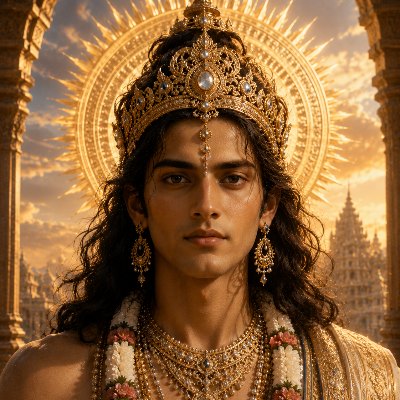
Rauchya Manu — The Thirteenth Manu, Penultimate Sovereign of the Current Cosmic Cycle
Rauchya · Rouchya · Son of Ruci · Rauchya Manu · Child of the Pitrs' Grace
Rauchya Manu is the figure designated as the presiding Manu of the thirteenth Manvantara, the thirteenth great cosmic age within the current Kalpa — the day of Brahma — as enumerated in Puranic cosmological literature. His era is the penultimate period of the current cosmic cycle, preceding only the fourteenth and final Manvantara before the dissolution and renewal of the created order. The title Manu denotes the progenitor and lawgiver appointed to govern humanity during a given cosmic period, each such period being an immense span of time presided over by its own Manu, its own king of the gods, its own divine hosts, and its own council of seven great sages. His father is the Prajapati Ruci — one of the progenitor-lords of the created order, whose name means radiance or spiritual luminosity — and his mother is Malini, also known as Manini, the daughter of Pushkara the son of Varuna and of the Apsara Pramlocha. Rauchya's very existence is the direct consequence of his father's devotional hymn to the ancestral spirits, the Pitrs, whose intervention arranged the union from which he was born and whose grace destined him for the supreme office of Manu. His figure appears in the eighth book of the Bhagavata Purana and in the Markandeya Purana, within the systematic enumeration of the fourteen Manus and their associated cosmic ages.
✦ The Name
The name Rauchya is a patronymic derived directly from his father's name. Ruci — the Prajapati — bears a name meaning radiance, luminosity, and spiritual brightness in Sanskrit. The suffix ya in the patronymic construction transforms Ruci into Rauchya, meaning "he who is of Ruci" or "the son of Ruci." This form of naming by patronymic is common in the Puranic tradition for figures whose identity is understood to be inseparable from their paternal lineage. The name thus carries no independent symbolic meaning beyond its function as a statement of filial identity: Rauchya is, in his very name, the son of Ruci. Variant renderings of the name include Rouchya, which reflects a slight difference in transliteration convention from Sanskrit to English but denotes the same figure. Unlike several of the other Savarni-group Manus whose names invoke great deities or cosmic principles — such as Dharma Savarni, whose name invokes the principle of righteous order, or Rudra Savarni, whose name invokes the god Shiva — Rauchya's name is simply and directly genealogical, rooting his identity in his human and Prajapati paternal lineage rather than in any broader theological designation.
✦ Lineage
- Father: Ruci — one of the Prajapatis, the progenitor-lords of the Puranic tradition charged with the creative and generative governance of the cosmos. His name means radiance or spiritual luminosity in Sanskrit. Ruci is the figure who, through his devout chanting of the hymn to the Pitrs known as the Ruchi-Krita Pitr Stotram, set in motion the divine arrangement that produced Rauchya. He is also the father of Dharma Savarni, the eleventh Manu, whose mother among Ruci's wives is placed by the tradition under Akuti, Ruci's other wife.
- Mother: Malini — also known in some recensions as Manini — the daughter of Pushkara, the high-souled son of Varuna the deity of the cosmic waters and moral order, and of the Apsara Pramlocha. Malini's birth and her subsequent presentation to the Prajapati Ruci are recorded in the Markandeya Purana, establishing her as the wife of Ruci and thereby as the mother of Rauchya. Through her father Pushkara, Malini's lineage connects to Varuna; through her birth mother Pramlocha, it connects to the celestial realm of the Apsaras.
- Paternal grandfather: Varuna — reached through two generational steps: Ruci is Rauchya's father, and Malini's father Pushkara is the son of Varuna, making Varuna Rauchya's maternal great-grandfather. Varuna is also the father of Daksha Savarni, the ninth Manu, giving the lineage of Varuna a dual presence in the Manvantara sequence through both the ninth and the thirteenth Manus.
- Sons: The tradition records the sons of Rauchya as the ruling princes of his Manvantara. His lineage in the thirteenth age will be headed by Chitrasena — whose name means "he whose army is brilliant" or "one with a distinguished host" — and Vichitra — meaning "the wonderful one" or "the variegated one." The full list of his sons varies between Puranic recensions.
✦ The Legend of His Birth — The Ruchi-Krita Pitr Stotram
The narrative of Rauchya's birth is among the most distinctive origin accounts in the entire sequence of fourteen Manus, setting him apart from all others by making his very existence the direct consequence of a devotional act performed by his father and the responsive grace of the ancestral spirits. The Prajapati Ruci was in his earlier life a devoted ascetic who refused to marry or father children, regarding the life of detachment and spiritual austerity as his proper path. His ancestors — the Pitrs, the spirits of the departed who dwell in the ancestral realm and whose continued spiritual progress depends upon the offerings and filial duties of their living descendants — appeared before him and warned him that his refusal to produce offspring was causing them harm. In the cosmological understanding of the Puranic tradition, the Pitrs require the performance of shraddha rites and the continuation of the family line by their living descendants in order to sustain their own spiritual journey through the ancestral realm. Ruci's celibacy, however sincere as an act of personal renunciation, threatened to sever this chain of obligation.
Moved by the appeal of his ancestors, Ruci composed and chanted the Ruchi-Krita Pitr Stotram — the hymn to the Pitrs attributed to Ruci — a devotional composition addressed to the ancestral spirits. Pleased by this act of filial devotion and by the quality of his penance, the Pitrs intervened directly in arranging his marriage. They caused the Apsara Pramlocha to bring her daughter Malini to Ruci as his wife. The child born of this union was Rauchya — a being whose birth was not merely a biological event but a cosmic arrangement, willed and enacted by the ancestral realm in response to a devotional act of exceptional quality. Rauchya was thus destined from before his birth to hold the office of Manu, the presiding sovereign and progenitor of an entire cosmic age, as the ultimate fruit of his father's devotion to the ancestral obligations that bind the living to the dead across generations.
✦ The Thirteenth Manvantara
The present cosmic age is the seventh Manvantara, presided over by Vaivasvata Manu, the son of the sun deity Vivasvat. The thirteenth Manvantara of Rauchya therefore lies six cosmic ages into the future of the present cycle, following in succession the eighth Manvantara of Savarni Manu, the ninth of Daksha Savarni — son of Varuna — the tenth of Brahma Savarni — son of Upashloka — the eleventh of Dharma Savarni — son of Ruci and his wife Akuti — the twelfth of Rudra Savarni — son of Shiva and Parvati — and only then the thirteenth age belonging to Rauchya. As the penultimate Manvantara of the current Kalpa, Rauchya's age precedes only the fourteenth and final cosmic period before the dissolution of the present day of Brahma and the commencement of the night of cosmic rest.
The Bhagavata Purana records that the presiding Indra of the thirteenth Manvantara will be a being named Divaspati — whose name means "lord of the sky" or "sovereign of the heavens" — who will hold sovereignty over the three worlds during that cosmic period. The divine avatar of Vishnu associated with the thirteenth age is Yogeshvara — meaning "the lord of yoga" or "the master of divine union" — who will be born to Devahotra and Brihati, linking the manifestation of the preserver deity in the thirteenth age to a specific divine parentage within that Manvantara.
✦ The Gods, Indra, and Sages of His Age
The divine hosts of the thirteenth Manvantara will be drawn from three classes identified in the Puranic sources as the Sudharmas, the Sukarmas, and the Susharmas — names that each carry the prefix su, meaning good, auspicious, or excellent, and that together suggest a divine population defined by their adherence to righteous action, meritorious conduct, and auspicious practice. This emphasis on virtue and right action among the divine hosts of the thirteenth age coheres with the broader spiritual character of Rauchya's own birth, which was itself a consequence of his father's meritorious devotion to ancestral duty.
The seven great sages — the Saptarishis — who will serve as custodians and transmitters of Vedic knowledge during Rauchya's reign are named in the Bhagavata Purana as Nirmoha, Tattvadarshi, Nishprakampa, Nirutsuka, Dhritiman, Avyaya, and Sutapa. The names of these sages are of considerable philosophical and spiritual resonance. Nirmoha means "free from delusion," Tattvadarshi means "one who sees the truth of reality," Nishprakampa means "the unshakeable one," Nirutsuka means "one free from agitation or craving," Dhritiman means "possessed of steadfastness," Avyaya means "the imperishable one," and Sutapa means "one of excellent austerity." Together these seven names compose a portrait of the ideal sage: one who is free from delusion, sees reality clearly, remains unshaken by circumstance, is without craving, is steadfast, imperishable in spirit, and sustained by the power of tapas. The Saptarishis of the thirteenth age are thus defined in their very names by the qualities of jnana — spiritual knowledge — and vairagya — detachment — that mark the highest order of the Puranic sage tradition.
✦ The Avatar Yogeshvara
The Vishnu avatar of the thirteenth Manvantara, Yogeshvara — the lord of yoga — will be born to Devahotra and Brihati during the reign of Rauchya. The name Yogeshvara is among the most theologically resonant of all the Manvantara avatar names, invoking the supreme capacity for divine union, meditative mastery, and the integration of the individual consciousness with the universal. In the broader Puranic and Vaishnava tradition, Yogeshvara is an epithet most commonly associated with Krishna — the eighth avatar of Vishnu as teacher of the Bhagavad Gita — where it denotes his sovereignty over the entire domain of yogic practice and spiritual discipline. Its use as the name of the thirteenth Manvantara's avatar signals an age in which the supreme teaching of yoga and divine union will be made accessible through a fresh manifestation of the preserver deity, complementing the philosophical character of the Saptarishis of that age — those seers of truth, free from delusion and craving — with an avatar whose very name embodies the goal toward which their wisdom points.
✦ Theological and Spiritual Significance
Rauchya Manu occupies a position of distinctive spiritual significance within the sequence of fourteen Manus, not primarily because of the theological weight of his name or the divine grandeur of his parentage — as is the case with Rudra Savarni, son of Shiva — but because of the mechanism of his birth. He is the only Manu in the standard Puranic enumeration whose very existence is narrated as the direct and intended consequence of a devotional act performed by his father in response to the appeals of the ancestral spirits. This gives Rauchya a uniquely relational origin: he is born not through the spontaneous generative power of a great deity, not through the creative force of cosmic austerity alone, but through the loving obligation that binds the living to the dead through the chain of filial duty and ancestral devotion.
Because of this origin, the thirteenth Manvantara is considered in the tradition to be particularly auspicious for ancestral worship and the performance of shraddha rites — the ritual offerings of food, water, and reverence made to the departed. The chanting of the Ruchi-Krita Pitr Stotram, the hymn that his father composed and through which the Pitrs were moved to arrange Rauchya's birth, is held to confer great merit when performed in anticipation of or in connection with the thirteenth Manvantara. Rauchya thus stands as the Manu most intimately connected with the ancestral obligations of the living — a fitting resonance for the penultimate Manu of the current cosmic cycle, in whose age the accumulated weight of all the preceding Manvantaras' ancestral chains draws toward its conclusion before the great dissolution.
✦ Connection to the Wider Genealogy
Rauchya is the thirteenth in the sequence of fourteen Manus spanning the current Kalpa. He is preceded by Rudra Savarni — the twelfth Manu, son of Shiva and Parvati, who completes the Savarni group — and followed by Bhautya Manu, the fourteenth and final Manu of the current cosmic cycle. The first Manu of the entire sequence is Svayambhuva, the self-born, who emerges directly from Brahma at the commencement of creation. Rauchya's genealogy is of exceptional depth and complexity: through his father Ruci he connects to the Prajapati order of creation; through his mother Malini he connects to Pushkara the son of Varuna — giving him Varuna as a maternal great-grandfather — and through Pushkara's household to the lunar lineage of Soma through Jyotsnakali, Pushkara's principal wife; through his birth mother Pramlocha he connects to the celestial realm of the Apsaras; and through the Pitrs whose grace arranged his birth he connects to the ancestral realm itself. No other Manu in the sequence can claim so many distinct strands of divine, semi-divine, celestial, and ancestral lineage converging in a single birth.
✦ References
- Primary Sources:
- Bhagavata Purana, Skandha 8, Chapter 13: The principal source identifying Rauchya as the thirteenth Manu, recording the details of his Manvantara including Divaspati as the Indra of his age, the three divine classes, the seven sages, Yogeshvara as the Vishnu avatar born to Devahotra and Brihati, and Chitrasena and Vichitra among his sons.
- Markandeya Purana, Canto 98: Records the narrative of Ruci's penance, his composition of the Pitr Stotram, the intervention of the Pitrs, the presentation of Malini by the Apsara Pramlocha to Ruci, and the birth of Rauchya as the direct fruit of this devotional and ancestral arrangement. Confirms Malini as the mother of Rauchya.
- Vishnu Purana, Book 3, Chapter 2: Confirms Rauchya's position as the thirteenth Manu within its own enumeration of the fourteen Manus and provides comparative cosmological details.
- Brahmanda Purana and Vayu Purana, Manvantara sections: Parallel Puranic accounts of the Manu sequence including details relevant to the thirteenth Manvantara, useful for comparison with the Bhagavata's account.
- Secondary Sources:
- A. C. Bhaktivedanta Swami Prabhupada, Srimad Bhagavatam, Canto 8, Chapter 13, purport: Provides Gaudiya Vaishnava commentary on the identity and significance of Rauchya Manu and the details of the thirteenth Manvantara.
- Vettam Mani, Puranic Encyclopaedia (1975): Compiled reference entry drawing on multiple Puranic sources for the fourteen Manus and their associated cosmological and genealogical details.
- Ludo Rocher, The Puranas, in A History of Indian Literature, Vol. II (1986): Scholarly context for the Puranic Manvantara framework, the role of the Pitrs in Puranic genealogical narratives, and the nature of variation between Puranic recensions.
- Patrick Olivelle, The Dharmasutras (1999): Provides scholarly context for the Puranic and Dharmashastra understanding of Pitr obligations, shraddha rites, and the ancestral duties that form the theological backdrop to the narrative of Rauchya's birth.