
About
Upashtambha — Vedic Sage of the Angiras Line and Father of the Fourteenth Manu
Bhuti · Upashtambha
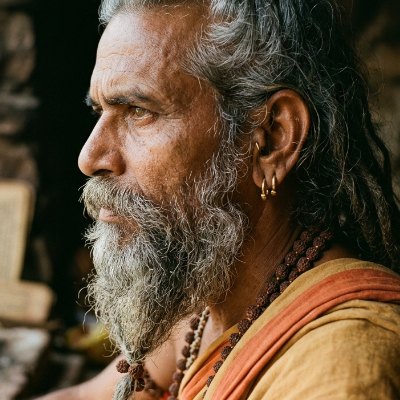
Upashtambha is a Vedic sage belonging to the lineage of Angiras, one of the seven great primordial sages revered across the Vedic and Puranic traditions as a mind-born son of Brahma and the progenitor of a vast spiritual and priestly lineage. Upashtambha is best known as the father of Bhautya, the fourteenth and final Manu of the present Kalpa — the great cosmic cycle of time. His significance lies at the very end of the current world-age, making him a pivotal figure in the Puranic scheme of cosmic succession. He is also known by the name Bhuti, under which he appears in the Markandeya Purana. His character is defined by extraordinary ascetic intensity, mastery over elemental forces, and a singular act of devotion to the Sun God Surya that secured the birth of the final Manu.
✦ The Name
The name Upashtambha derives from the Sanskrit roots upa (near, secondary, or supportive) and stambha (pillar, support, or post), conveying the sense of one who serves as a sustaining prop or foundation — an apt designation for a sage whose offspring would uphold the final age of the cosmic cycle. His alternate name Bhuti comes from the Sanskrit bhuti, meaning existence, being, prosperity, or spiritual power. This epithet appears consistently in the Markandeya Purana and reflects the sage's formidable spiritual presence and the potency of his accumulated tapas.
✦ Lineage
- Patrilineal ancestor: Angiras — one of the Saptarishis, the seven great primordial seers, regarded as a mind-born son of Brahma and the founding patriarch of the Angirasa gotra. Upashtambha descends from or belongs to the spiritual lineage of Angiras, and is placed within the Atharvavedic branch of that tradition.
- Son: Bhautya — the fourteenth Manu, the final lawgiver and progenitor of mankind for the last of the fourteen Manvantaras (Manu-epochs) within the present Kalpa. Bhautya was born as a direct boon from Surya, the Sun God, granted to Upashtambha in recognition of his austerities, and is described in the Markandeya Purana as a repository of all virtues, free from his father's wrathful temperament.
✦ The Legend of the Irascible Sage and the Boon of Surya
The Markandeya Purana preserves the principal narrative associated with Upashtambha. The sage was renowned — and feared — for the extraordinary ferocity of his spiritual temperament. His accumulated austerities and the power of his tapas had reached such a pitch that the presiding deities of the natural elements — wind, water, and fire — are described as obeying his will not from affection or duty but from fear of his wrath. This quality of intense, almost violent ascetic energy set him apart as a figure of formidable and somewhat dangerous spiritual potency.
Wishing to produce a spiritual heir who would carry on his legacy and serve as the final Manu of the cosmic cycle, Upashtambha undertook a rigorous sacrifice and prolonged penance directed toward Surya, the Sun God. His worship was devoted and disciplined, and Surya, pleased with the intensity and sincerity of his devotion, appeared before him and granted a boon. The boon took the form of a son — a child who would inherit none of his father's fearsome anger but would instead embody all virtuous qualities. This son was Bhautya, who duly became the fourteenth Manu and the presiding human patriarch of the final Manvantara of the present Kalpa.
✦ Theological and Cosmological Significance
Within the Puranic scheme of cosmic time, the present Kalpa is divided into fourteen Manvantaras, each presided over by a Manu who serves as the progenitor and lawgiver of humanity during that epoch. Upashtambha's role as the father of the fourteenth and final Manu places him at the closing bracket of this immense temporal structure. His story is thus not merely biographical but cosmological: it accounts for the origin of the being who will oversee the last chapter of the present world-age before the Kalpa draws to its end.
The contrast drawn between father and son is also theologically significant. Upashtambha's wrath, though the source of his power, is presented as a quality that must be transcended in the final Manu. The boon of Surya effectively produces a figure purified of the father's excess — a lawgiver suitable to govern the concluding age in righteousness and virtue. This narrative mirrors broader Puranic themes in which great ascetics, despite their power, require divine mediation to produce heirs fit for cosmic roles.
✦ Connection to the Wider Genealogy
Upashtambha belongs to the Angirasa lineage, one of the most extensive and important of all Vedic gotra traditions, ultimately tracing back to the sage Angiras whose descendants include numerous celebrated seers, priests, and lawgivers across the Vedic and Puranic corpus. Within this lineage Upashtambha stands as the immediate progenitor of Bhautya Manu, making him the patrilineal ancestor of all humanity as reckoned under the fourteenth Manvantara. Through Bhautya, his line connects directly to the concluding phase of the present Kalpa's human succession.
✦ References
- Markandeya Purana — the principal primary source for Upashtambha, giving his alternate name Bhuti, his wrathful temperament, his penance to Surya, and the birth of Bhautya as the fourteenth Manu.
- Atharvaveda, Angirasa tradition — establishes the broader Angirasa lineage within which Upashtambha is classified, providing the priestly and spiritual context for his gotra affiliation.
- Puranic Encyclopaedia by Vettam Mani — provides a condensed reference entry identifying Upashtambha as father of Bhautya Manu and noting his placement within the Angiras lineage.