
About
Shambhu — Daitya King and Antagonist in the Vedavati Narrative
Shambhu · Asura Shambhu · Daitya Shambhu
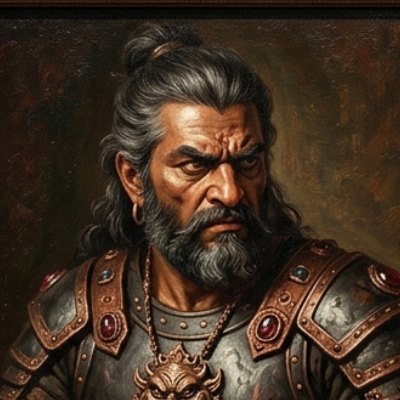
Shambhu is a Daitya king who appears in the Uttara Kanda of the Valmiki Ramayana as the primary villain in the early life-narrative of Vedavati, the ascetic woman revered in Puranic tradition as a previous incarnation of Sita, the consort of the god Vishnu in his Rama avatara. Shambhu belongs to the race of Daityas — powerful cosmic beings born of the primordial sage Kashyapa and his wife Diti — and is defined within the tradition principally by his violent desire for Vedavati and his murder of her father, the sage Kushadhvaja. His role in the narrative, though brief, carries significant consequences for the subsequent arc of the Ramayana tradition, as Vedavati's curse and her vow of rebirth are directly precipitated by his crime.
✦ The Name
The name Shambhu derives from the Sanskrit root sham, relating to welfare, auspiciousness, or peace, combined with the suffix bhu denoting existence or being. The name is shared with one of the most widely used epithets of the god Shiva and carries connotations of beneficence and auspicious power. Its application to a Daitya king creates a pointed irony within the narrative, as the bearer of a name evoking peace and welfare is made the agent of violent murder and transgression.
✦ Lineage
Note on placement in this genealogical record: The primary texts do not specify which immediate son or grandson of Kashyapa and Diti was Shambhu's direct ancestor. He is placed in this lineage tree as a descendant of Kashyapa and Diti — not as their direct son — reflecting his established identity as a Daitya and the textual absence of any named intermediate generation.
- Patrilineal progenitor: Kashyapa — one of the Saptarishis, the seven great primordial sages, and a mind-born son of Brahma. Kashyapa is the common progenitor of both the Devas and the Daityas through his unions with different wives, making him the ultimate cosmic ancestor of all the major races of beings in the Puranic world-order.
- Matrilineal progenitor: Diti — one of the daughters of the progenitor Daksha and a wife of Kashyapa. The Daitya race as a whole takes its name from her. Through her union with Kashyapa she became the mother of the Daityas, the great clan of powerful beings who frequently stand in opposition to the Devas in Puranic and epic narratives.
- Race: Daitya — a specific lineage of cosmic beings descended from Diti and Kashyapa, distinguished in the Puranic scheme from the Danavas (descended from Kashyapa's wife Danu) and from the Asuras more broadly construed. Daityas are characterised in the texts by immense physical and spiritual power and by their recurring conflict with the gods over sovereignty of the three worlds.
✦ The Vedavati Episode
The narrative in which Shambhu plays his defining role is recounted in the Uttara Kanda of the Valmiki Ramayana. Vedavati was the daughter of the sage Kushadhvaja, who is identified in the text as a son of Brihaspati — the preceptor of the gods — making her of distinguished brahminical birth. From childhood Vedavati had been dedicated by her father entirely to Vishnu, whom she regarded as her destined lord. Kushadhvaja, moved by deep devotion, refused all suitors who came seeking her hand, regardless of their power or status. Among those who sought to marry her were powerful beings of various races, including Nagas and Gandharvas, all of whom were turned away.
Shambhu was among these rejected suitors. Proud of his strength and consumed by desire, he was unable to accept the refusal. In an act of murderous fury he killed Kushadhvaja while the sage lay asleep — a crime that compounded the gravity of his transgression, as the slaying of a sleeping brahmin sage carried the severest ritual and moral consequences in the tradition. The murder left Vedavati without her father and protector.
Following her father's murder, accounts vary regarding Shambhu's precise fate. In certain versions of the narrative, Vedavati, overwhelmed by grief and drawing upon the spiritual power accumulated through her own austerities, reduced Shambhu to ashes through a curse before undertaking her final penance. The primary texts do not elaborate further on Shambhu's story beyond this point, and he has no subsequent narrative presence in the Ramayana or the major Puranas.
✦ Textual Variants and Inconsistencies
The Vedavati episode as found in the Uttara Kanda of the Valmiki Ramayana is the principal source for Shambhu's narrative. Later Puranic retellings of the Vedavati story do not always include Shambhu by name, and some versions condense or omit the account of the father's murder entirely, focusing instead on Vedavati's penance and her eventual rebirth. The specific claim that Shambhu was reduced to ashes by Vedavati's curse is not uniformly attested across all recensions and should be understood as belonging to particular versions of the narrative rather than a universally fixed element of the tradition. The primary texts do not record Shambhu's immediate parentage or specify which generation of the Daitya lineage he belongs to.
✦ Connection to the Wider Genealogy
As a Daitya, Shambhu belongs to one of the great cosmic races of the Puranic world, ultimately tracing back through the Daitya lineage to Kashyapa and Diti. Kashyapa, as the progenitor of both Devas and Daityas, stands at the root of virtually all the principal races of beings in the Puranic scheme. Through Diti, the Daitya line produced numerous powerful kings and warriors who figure across the epics and Puranas. Shambhu's place within this vast genealogy is that of a Daitya king of unspecified generational remove from the founding ancestors, identified by his race and his actions rather than by a detailed recorded pedigree.
✦ References
- Valmiki Ramayana, Uttara Kanda — the primary source for the Vedavati narrative, naming Shambhu as a Daitya suitor, recounting his murder of Kushadhvaja, and providing the context for Vedavati's curse and subsequent penance.
- Vishnu Purana — provides the foundational genealogical account of Kashyapa, Diti, and the origin of the Daitya race, establishing the lineage within which Shambhu belongs.
- Bhagavata Purana, Sixth Skandha — elaborates the Kashyapa-Diti lineage and the nature of the Daitya race within the broader Puranic cosmological framework.
- Puranic Encyclopaedia by Vettam Mani — provides a reference entry on Vedavati and the associated narrative, including the role of the Daitya antagonist in the episode.