
About
Dharmanetra — Early Haihaya King and Son of the Dynastic Founder
Dharmanetra
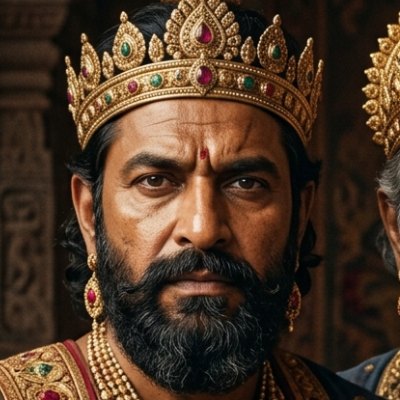
Dharmanetra is an early king of the Haihaya dynasty, the son of Haihaya — the eponymous founder of the dynasty and great-grandson of Yadu, the legendary patriarch of the Yaduvamsha — and the father of Kunti, also known in certain texts as Karta or Kuni. He is named in the Bhagavata Purana and the Vishnu Purana as a vital generational link in the Sahasrajit branch of the Lunar Dynasty, connecting the dynasty's founding figure to the line of kings who eventually established Mahishmati as the great Haihaya capital. The primary texts assign him no extended personal narrative, and his significance is primarily genealogical — he belongs to the period when the Haihaya clan was first consolidating itself as a distinct royal power in central India, separate from the other branches of the Yadu lineage.
✦ The Name
The name Dharmanetra is a Sanskrit compound of dharma — the cosmic and moral order, righteousness, duty — and netra, meaning eye or that which guides and leads. The compound conveys the meaning of one whose eyes are fixed upon dharma, or one who is guided by righteousness. It is a name befitting a king of the early Haihaya line, before the dynasty's later association with the arrogance and transgression most prominently represented by Kartavirya Arjuna. No further etymological discussion of the name is offered in the primary texts.
✦ Lineage
- Remote patrilineal ancestor: Yadu — the eldest son of King Yayati of the Lunar Dynasty and his wife Devayani, daughter of the sage Shukracharya. Yadu is the founding patriarch of the Yaduvamsha. Though the eldest of Yayati's sons, Yadu was cursed by his father and excluded from inheriting the principal throne of the Lunar Dynasty, leading his descendants to establish independent kingdoms.
- Remote patrilineal ancestor: Sahasrajit — the eldest son of Yadu, whose name means victor over thousands, and the progenitor of the branch of the Yadu lineage that produced the Haihaya dynasty.
- Remote patrilineal ancestor: Shatajit — son of Sahasrajit, whose name means victor over hundreds, and the father of Haihaya, Renuhaya, and Mahahaya. He is the direct patrilineal link between Sahasrajit and the Haihaya dynastic line.
- Father: Haihaya — son of Shatajit and eponymous founder of the Haihaya dynasty. The clan and the entire dynastic confederation take their name from him. Through his line the dynasty eventually produced the five sub-clans of the Haihaya confederation — the Vitihotra, Sharyata, Bhoja, Avanti, and Tundikera — and the celebrated warrior-king Kartavirya Arjuna.
- Son: Kunti — also referred to in certain textual recensions as Karta or Kuni. Kunti is the next generational link in the Haihaya dynastic sequence after Dharmanetra, and his own line leads forward to Sahanja and thence to Mahishmant, the king associated with the establishment of Mahishmati as the dynastic capital.
✦ Role in the Dynasty
Dharmanetra ruled during the formative period of the Haihaya clan's emergence as a distinct royal power in central India. The Puranas do not credit him with specific military campaigns, miraculous episodes, or individual acts of renown. His place in the tradition is that of a consolidating ruler in the generation immediately following the dynasty's eponymous founder, belonging to the era when the Haihayas were first defining their territorial identity and separating themselves as a distinct lineage from the other sons of Yadu. The meaning of his name — one guided by righteousness — reflects the early character attributed to this branch of the Yadava people before the dynasty's later trajectory toward the pride and transgression associated with Kartavirya Arjuna.
✦ Textual Variants and Inconsistencies
The name of Dharmanetra's son varies across recensions of the Puranas, appearing as Kunti, Karta, or Kuni in different manuscript traditions. These variants likely reflect scribal and regional differences in transmission rather than distinct genealogical claims. The Bhagavata Purana and the Vishnu Purana agree on Dharmanetra's position in the dynastic sequence — son of Haihaya and father of the next link in the line — though the level of detail provided for this portion of the genealogy is minimal in both texts. No narrative episode specific to Dharmanetra is preserved in any primary source consulted.
✦ Connection to the Wider Genealogy
Dharmanetra occupies a precise and necessary position in the Haihaya dynastic sequence. His patrilineal ancestry runs upward through Haihaya, Shatajit, and Sahasrajit to Yadu, and thence through Yayati and Nahusha to the divine origins of the Lunar Dynasty. Downward, his line continues through Kunti to Sahanja and Mahishmant — the king whose name is etymologically associated with the great Haihaya capital of Mahishmati on the Narmada — and further forward through the dynasty to Kritavirya and ultimately Kartavirya Arjuna, the most celebrated and narratively prominent king of the entire Haihaya line. Dharmanetra thus stands as an early but indispensable link in the chain connecting the dynasty's founding ancestor to its greatest and most consequential ruler.
✦ References
- Bhagavata Purana, Ninth Skandha — names Dharmanetra within the genealogical sequence of the Haihaya line as the son of Haihaya and father of Kunti.
- Vishnu Purana — corroborates Dharmanetra's placement in the Haihaya dynastic sequence within the broader Yadu lineage genealogy.
- Puranic Encyclopaedia by Vettam Mani — provides a consolidated genealogical reference for the Haihaya line including Dharmanetra's position.
- Wisdomlib, Puranic Encyclopaedia online — secondary reference compiling Puranic genealogical data relevant to the early Haihaya kings including Dharmanetra.