
About
Mahishmant — Haihaya King and Founder of Mahishmati
Mahishmant · Mahishmat · Mahishmanta
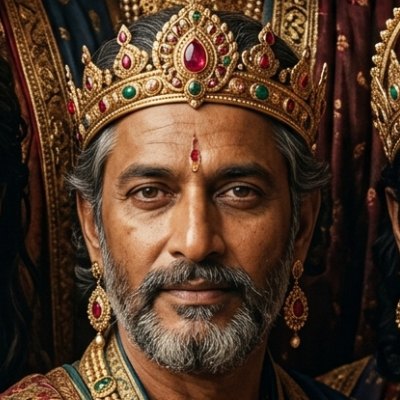
Mahishmant is a king of the Haihaya dynasty and the figure credited in the Harivamsha Purana and related Puranic texts with founding the ancient city of Mahishmati on the banks of the Narmada River in central India — the city that would become the most celebrated royal capital of the Haihaya confederation and that bears his name. He is the son of Sahanja, also rendered Sohanji or Sahajit in variant recensions, and the father of Bhadrasrenaka, also known as Bhadrasena. His patrilineal ancestry traces through Sahanja, Karta, Dharmanetra, Haihaya, Shatajit, and Sahasrajit to Yadu, the eldest son of King Yayati of the Lunar Dynasty. Through his son Bhadrasrenaka and the subsequent Haihaya kings, his line leads forward several generations to Kritavirya and his celebrated son Kartavirya Arjuna — the thousand-armed Chakravartin whose reign at Mahishmati represents the pinnacle of Haihaya power. Mahishmant thus occupies a pivotal place in the Haihaya dynastic tradition as the king who established the territorial and institutional foundation upon which the dynasty's later greatness was built.
✦ The Name
The name Mahishmant is directly etymologically connected to the city of Mahishmati, which bears a feminised form of the same root. The name derives from the Sanskrit mahisha, meaning buffalo or great one — a term that also carries connotations of power and sovereign authority — combined with the suffix mant or mat, indicating possession of or association with the quality named. Mahishmant may thus be understood as one possessed of greatness or lord of the buffalo — the latter reading connecting to the topographical or totemic character of the Narmada region over which he held sway. The city name Mahishmati is the feminised derivative of his name, formed in the standard Sanskrit manner, and the etymological bond between the king's name and the city's name is itself evidence of the foundational tradition preserved in the Harivamsha.
✦ Lineage
- Remote patrilineal ancestor: Yadu — the eldest son of King Yayati of the Lunar Dynasty and his wife Devayani, daughter of the sage Shukracharya. Yadu is the founding patriarch of the Yaduvamsha. Though the eldest of Yayati's sons, Yadu was cursed by his father and excluded from inheriting the principal throne of the Lunar Dynasty, leading his descendants to establish independent kingdoms.
- Remote patrilineal ancestor: Sahasrajit — the eldest son of Yadu, whose name means victor over thousands, and the progenitor of the branch of the Yadu lineage that produced the Haihaya dynasty.
- Remote patrilineal ancestor: Shatajit — son of Sahasrajit, whose name means victor over hundreds, and the father of Haihaya, Renuhaya, and Mahahaya.
- Remote patrilineal ancestor: Haihaya — son of Shatajit and eponymous founder of the Haihaya dynasty, from whom the entire dynastic confederation takes its name.
- Remote patrilineal ancestor: Dharmanetra — son of Haihaya and an early Haihaya king whose name means one guided by righteousness.
- Remote patrilineal ancestor: Karta — also rendered Kunti or Kuni in different recensions. Son of Dharmanetra and an early Haihaya king belonging to the formative period of the dynasty's development.
- Father: Sahanja — also rendered Sohanji, Sahajit, or Sahatjit in different Puranic recensions. Son of Karta and an early Haihaya king who governed during the period of dynastic consolidation immediately preceding the founding of Mahishmati. The primary texts preserve no personal narrative for Sahanja beyond his genealogical role.
- Son: Bhadrasrenaka — also known as Bhadrasena in certain recensions. The Puranic texts note that Bhadrasrenaka extended Haihaya power further, including campaigns toward the kingdom of Kasi. Through Bhadrasrenaka the dynastic line continues forward toward Kritavirya and ultimately Kartavirya Arjuna.
✦ The Founding of Mahishmati
The Harivamsha Purana credits Mahishmant with the founding of Mahishmati, the city on the Narmada River that became the defining symbol of Haihaya royal power. The city was situated in the Narmada valley in the region known in ancient texts as Anupa — a fertile and strategically significant territory in central India. Its location on or near the Narmada provided both natural defensive advantages and access to the river as a commercial and cultural artery. By establishing Mahishmati, Mahishmant effectively shifted the centre of Haihaya power southward and westward from the traditional northern territories of the Lunar Dynasty into the Narmada basin, a move that positioned the dynasty to grow into one of the dominant forces of central India over the following generations.
The city Mahishmati is identified by several scholars with the modern town of Maheshwar in Madhya Pradesh on the Narmada, though some traditions associate it instead with the island of Mandhata further along the same river. The city's fame in the Puranic tradition far outlasted Mahishmant himself; it is most prominently associated in the later texts with Kartavirya Arjuna, the thousand-armed Haihaya emperor who made it the seat of his universal sovereignty several generations after its founding, and it is in connection with Kartavirya Arjuna that Mahishmati receives its most extensive Puranic description.
✦ Textual Variants and Inconsistencies
While the Harivamsha Purana is the principal text crediting Mahishmant with the founding of Mahishmati, this attribution is not universally shared across all texts that mention the city. Certain sources attribute the city's founding to a figure named Mahisha, whose name shares the same Sanskrit root, suggesting either a confusion between two distinct traditions or a variant of the same foundational legend. Other traditions associate the founding or early prominence of Mahishmati with Muchukunda, an ancestor of Rama from the Solar Dynasty — a claim that reflects the city's importance as a site contested between multiple dynastic traditions in the Puranic world. The Harivamsha's attribution to Mahishmant is the most directly supported by the genealogical evidence of the Haihaya dynastic lists, but the competing claims should be noted as reflecting genuine textual disagreement rather than scribal error.
✦ Connection to the Wider Genealogy
Mahishmant stands as the seventh generation of the Haihaya dynastic line counting from Yadu. His patrilineal ancestry runs upward through Sahanja, Karta, Dharmanetra, Haihaya, Shatajit, and Sahasrajit to Yadu, and thence through Yayati and Nahusha to the divine origins of the Lunar Dynasty. Downward, his line continues through Bhadrasrenaka and the subsequent Haihaya kings toward Kritavirya and his son Kartavirya Arjuna — making Mahishmant a remote but direct patrilineal ancestor of the dynasty's most celebrated ruler. His act of founding Mahishmati gave the Haihaya line its most enduring geographical and institutional identity, and the city his name created remained the dynastic capital through all the subsequent generations of Haihaya rule, including the era of Kartavirya Arjuna's universal sovereignty.
✦ References
- Harivamsha Purana — the principal source crediting Mahishmant with the founding of Mahishmati and placing him within the Haihaya genealogical sequence as son of Sahanja and father of Bhadrasrenaka.
- Bhagavata Purana, Ninth Skandha — records Mahishmant within the broader Haihaya dynastic genealogy and the Sahasrajit branch of the Yadu lineage.
- Vishnu Purana — provides the broader Yadu dynastic framework within which Mahishmant's position in the Haihaya sequence is established.
- Matsya Purana — corroborates the genealogical placement of Mahishmant within the early Haihaya succession and references Mahishmati as the Haihaya capital.
- Puranic Encyclopaedia by Vettam Mani — provides a consolidated reference entry on Mahishmant and the founding tradition of Mahishmati.
- Wisdomlib — secondary reference compiling Puranic data on Mahishmant and the city of Mahishmati, including discussion of competing foundational attributions.