
About
Bhadrasrenaka — Haihaya Conqueror and Precursor to the Dynasty's Imperial Age
Bhadrasrenaka · Bhadrasena
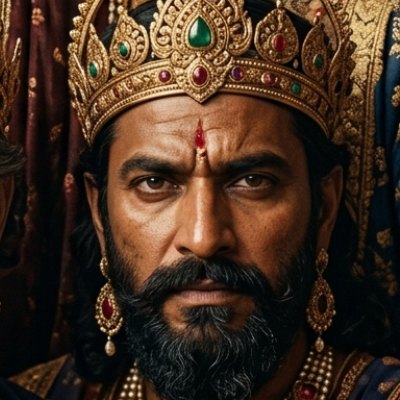
Bhadrasrenaka, also known as Bhadrasena, is a king of the Haihaya dynasty and one of its earliest rulers credited with active military expansion beyond the Narmada valley. He is the son of Mahishmant — the Haihaya king who founded the great capital of Mahishmati on the Narmada River — and the father of Durdama, through whom the dynastic line continued toward its imperial zenith. His patrilineal ancestry traces through Mahishmant, Sahanja, Karta, Dharmanetra, Haihaya, Shatajit, and Sahasrajit to Yadu, the eldest son of King Yayati of the Lunar Dynasty. Bhadrasrenaka is particularly noted in the Puranic tradition for his conquest of the kingdom of Kasi and his defeat of its king Haryyaswa — the first major Haihaya military projection into the Gangetic plain — which established the dynasty as a power capable of challenging the settled kingdoms of northern India. He is named in the Puranic genealogical lists as the remote patrilineal ancestor of Kartavirya Arjuna, standing five generations before the dynasty's most celebrated ruler.
✦ The Name
The name Bhadrasrenaka is a Sanskrit compound of bhadra, meaning auspicious, good, or noble, and srena or shrenaka, meaning a troop, rank, or ordered line — particularly of soldiers or warriors. The name may therefore be understood as one who leads an auspicious rank or noble troop, a designation with clear martial connotations appropriate for a king noted for military expansion. The shorter variant Bhadrasena, by which he is also known, replaces shrenaka with sena, the common Sanskrit word for army, yielding the meaning one with a noble or auspicious army. Both forms are attested in the Puranic tradition and refer to the same figure.
✦ Lineage
- Remote patrilineal ancestor: Yadu — the eldest son of King Yayati of the Lunar Dynasty and his wife Devayani, daughter of the sage Shukracharya. Yadu is the founding patriarch of the Yaduvamsha. Though the eldest of Yayati's sons, Yadu was cursed by his father and excluded from inheriting the principal throne of the Lunar Dynasty, leading his descendants to establish independent kingdoms.
- Remote patrilineal ancestor: Sahasrajit — the eldest son of Yadu, whose name means victor over thousands, and the progenitor of the branch of the Yadu lineage that produced the Haihaya dynasty.
- Remote patrilineal ancestor: Shatajit — son of Sahasrajit and father of Haihaya, Renuhaya, and Mahahaya. The direct patrilineal link between Sahasrajit and the Haihaya dynastic line.
- Remote patrilineal ancestor: Haihaya — son of Shatajit and eponymous founder of the Haihaya dynasty, from whom the entire dynastic confederation takes its name.
- Remote patrilineal ancestor: Dharmanetra — son of Haihaya and early Haihaya king whose name means one guided by righteousness.
- Remote patrilineal ancestor: Karta — also rendered Kunti or Kuni in different recensions. Son of Dharmanetra and an early Haihaya king of the dynasty's formative period.
- Remote patrilineal ancestor: Sahanja — also rendered Sohanji, Sahajit, or Sahatjit. Son of Karta and father of Mahishmant, governing during the consolidation period immediately preceding the founding of Mahishmati.
- Father: Mahishmant — the Haihaya king credited in the Harivamsha Purana with founding Mahishmati on the Narmada River, the great capital of the Haihaya confederation whose name is etymologically derived from his own. Mahishmant's founding of the capital represented the dynasty's decisive establishment of a territorial power base in central India.
- Son: Durdama — the next generational link in the Haihaya dynastic sequence after Bhadrasrenaka, through whom the line continued its expansion. Durdama's own line leads forward through Kanaka and Dhanaka to Kritavirya and ultimately Kartavirya Arjuna.
✦ The Conquest of Kasi
The most significant episode associated with Bhadrasrenaka in the Puranic tradition is his military campaign against the kingdom of Kasi — the ancient and sacred city on the Ganges known in later times as Varanasi — which represented the first major Haihaya push into the Gangetic plain. The texts record that Bhadrasrenaka launched a large-scale invasion into the territory between the Ganges and Yamuna rivers, the fertile heartland of northern India that had long been the domain of established Lunar Dynasty kingdoms. In the course of this campaign he defeated Haryyaswa, the reigning king of Kasi, and succeeded in capturing the city itself.
The Haihaya occupation of Kasi under Bhadrasrenaka initiated a prolonged conflict between the Haihaya dynasty and the kings of Kasi that extended across several generations. The displaced Kasi rulers did not permanently accept their expulsion, and the contest for Kasi continued until the Kasi king Divodasa — a figure celebrated in the Puranas and in Vedic literature as a great royal patron — eventually succeeded in reclaiming the ancestral capital and restoring Kasi to the Kasi royal line. This cycle of Haihaya conquest and eventual Kasi restoration is recorded across several Puranic texts and forms one of the more historically layered narratives associated with the Haihaya dynasty prior to the era of Kartavirya Arjuna.
✦ Historical Significance
Bhadrasrenaka marks a decisive transition in the character of the Haihaya dynasty. Where the kings before him — Mahishmant, Sahanja, Karta, and Dharmanetra — belong to the period of internal consolidation and the establishment of the Narmada valley power base, Bhadrasrenaka is the first Haihaya king associated with outward military projection on a significant scale. His conquest of Kasi transformed the Haihayas from a regional power confined to the Narmada basin into a dynasty capable of projecting force into the Gangetic heartland and challenging kingdoms of the first rank. In this sense his reign constitutes the beginning of the dynasty's expansion from a local to a broader imperial ambition — an ambition that would reach its ultimate expression several generations later under Kartavirya Arjuna's claimed universal sovereignty.
✦ Textual Variants and Inconsistencies
The name of this figure appears as Bhadrasrenaka in certain Puranic texts and as Bhadrasena in others, with both forms referring to the same king. The genealogical sequence placing him as son of Mahishmant and father of Durdama is consistent across the principal sources that record this portion of the Haihaya dynastic list. The narrative of the Kasi conquest and the defeat of Haryyaswa is preserved in Puranic accounts of the Kasi royal lineage as well as in the Haihaya dynastic tradition, though the precise details and the duration of the Haihaya occupation of Kasi vary in their elaboration across different texts.
✦ Connection to the Wider Genealogy
Bhadrasrenaka stands as the eighth generation of the Haihaya dynastic line counting from Yadu. His patrilineal ancestry runs upward through Mahishmant, Sahanja, Karta, Dharmanetra, Haihaya, Shatajit, and Sahasrajit to Yadu, and thence through Yayati and Nahusha to the divine origins of the Lunar Dynasty. Downward, his line continues through Durdama, Kanaka, and Dhanaka to Kritavirya and his celebrated son Kartavirya Arjuna — making him a direct patrilineal ancestor five generations removed from the dynasty's most famous ruler. His conquest of Kasi also connects him to one of the major parallel narrative threads of the Puranic tradition — the story of the Kasi kingdom and the eventual restoration of Divodasa — demonstrating that the Haihaya dynastic history intersects with the histories of several other major Puranic royal lines.
✦ References
- Harivamsha Purana — places Bhadrasrenaka within the Haihaya genealogical sequence as son of Mahishmant and records his military activities including the campaign toward Kasi.
- Bhagavata Purana, Ninth Skandha — records Bhadrasrenaka within the broader Haihaya dynastic genealogy and the Sahasrajit branch of the Yadu lineage.
- Matsya Purana — corroborates the genealogical placement of Bhadrasrenaka and provides additional detail on the Haihaya dynastic sequence leading toward Kartavirya Arjuna.
- Vishnu Purana — provides the broader Yadu dynastic framework within which Bhadrasrenaka's position in the Haihaya sequence is established, and records related material on the Kasi royal lineage and the conflict with the Haihayas.
- Brahma Purana — provides supplementary genealogical data on the Haihaya dynastic sequence including Bhadrasrenaka's placement.
- Puranic Encyclopaedia by Vettam Mani — provides a consolidated reference entry on Bhadrasrenaka and his role in the early expansion of the Haihaya dynasty.
- Wisdomlib — secondary reference compiling Puranic genealogical and narrative data relevant to Bhadrasrenaka and the Kasi conflict.