
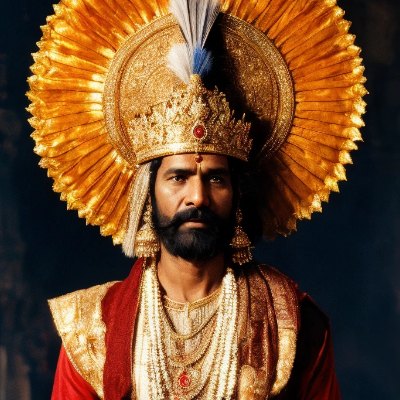
About
Vitihotra — Eldest Son of Talajangha, Eponymous Head of the Vitihotra Clan
Vitihotra · Vītihotra · Vitahotra · Vitahvya · Vitikottiran (Tamil rendering)
Vitihotra was the eldest son of Talajangha and the great-grandson of Kartavirya Arjuna, the celebrated thousand-armed Haihaya emperor. He is the eponymous progenitor of the Vitihotra clan, the most dominant of the five constituent ganas of the Haihaya confederacy, which in subsequent generations came to be known collectively by his name. He figures directly in the narrative of Parashurama's campaigns against the Haihaya lineage, and his line is recorded as having ruled in the Avanti region for many generations until the usurpation by the minister Pulika at Ujjayini ended the dynasty. He appears principally in the Brahmanda Purana, the Vishnu Purana, the Bhagavata Purana, the Matsya Purana, and the Vayu Purana. He is also mentioned in secondary form in the Harivamsha Purana, the Saurapurana, and the Narada Purana.
✦ The Name
The name Vitihotra is a Sanskrit compound. The element viti carries the sense of enjoyment, satisfaction, or that which has been enjoyed or consumed, particularly in the context of ritual fire and oblation. The element hotra derives from hu, meaning to offer into fire, and refers to the act or office of the sacrificial oblation. The compound therefore suggests a figure associated with the rite of fire-offering or the sacrificial flame that has consumed its oblation — a name carrying connotations of ritual propriety and Vedic observance appropriate to a ruling lineage. The Narada Purana explicitly notes that Vitihotra and the Talajangha line were Yadavas, emphasising their descent from Yadu of the lunar dynasty. The name was subsequently applied to the entire clan of his descendants and, by extension, became the dominant label for the Haihaya confederacy in its later phase.
✦ Lineage
- Paternal great-great-grandfather: Yadu, eldest son of King Yayati of the lunar Chandravamsha, and the eponymous ancestor of all Yadava lineages. From Yadu descended Sahasrajit, then Haihaya, and through subsequent generations the Haihaya kings of Mahishmati on the Narmada.
- Paternal great-grandfather: Kartavirya Arjuna, also known as Sahasrabahu, the thousand-armed emperor of Mahishmati. He was a Chakravartin of the Haihaya lineage, the most celebrated king of his dynasty, and was killed by the sage Parashurama in retribution for the murder of Parashurama's father Jamadagni.
- Paternal grandfather: Jayadhvaja, son of Kartavirya Arjuna who succeeded his father to the Haihaya throne. The Brahmanda Purana identifies him as the fifth son of Kartavirya Arjuna.
- Father: Talajangha, son of Jayadhvaja, who fathered a hundred sons collectively known as the Talajanghas. He was the king under whose leadership the Haihaya confederacy attacked and drove the Ikshvaku king Bahu from Ayodhya. The Brahmanda Purana records that during the flight from Parashurama's assault, Talajangha was struck by an arrow on his back and fell senseless; it was Vitihotra who took him into his chariot and carried him to safety.
- Son (principal succession): The Bhagavata Purana (IX.23.29) and the Wisdomlib Puranic glossary, drawing on multiple Puranas, record Vitihotra's son as Ananta. The Encyclopaedia of Hinduism entry drawing on the Puranic tradition names the son as Anarta, with Anarta's son being Durjeya. The Saurapurana, an Upapurana, gives a different succession, naming Vishruta as the son of Vitihotra and specifying that Vishruta's wife was named Pativrata. These three successions — Ananta, Anarta, and Vishruta — represent variant traditions in different texts and cannot be harmonised without suppressing one or more sources.
✦ The Flight from Parashurama and the Himalayan Exile
The Brahmanda Purana (Chapter 46) provides a detailed account of the moment Parashurama burned Mahishmati with a fire missile. On seeing the city consumed by fire, Vitihotra became frightened and fled quickly to save his own life. In Chapter 47 of the same text, a fuller picture emerges: the senior Talajangha lived for a long time in the Himalayan forests together with his sons, including Vitihotra, along with the other Haihaya and allied kings. The text records that during their flight, Talajangha had been struck on his back by an arrow from Parashurama and fell to the ground senseless; it was Vitihotra who, finding his father collapsed, took him into his chariot and bore him away speedily, enabling the survival of the senior king. All of them lived in the Himalayas, afflicted by great fear, subsisting on greens, roots, and fruits. Only after Parashurama had retired from active campaigning and turned his mind to penance did Talajangha and his sons, including Vitihotra, return to reclaim their kingdom.
The Wisdomlib Puranic glossary entry for Vitihotra, citing the Bhagavata Purana (IX.23.29) and the Brahmanda Purana, states plainly that he escaped to the Himalayas from Parashurama's attack. This is consistent with the Brahmanda Purana narrative summarised above.
✦ The Vitihotra Clan and the Haihaya Confederacy
The Vishnu Purana (IV.11) names all five Haihaya ganas collectively as the Talajanghas, listing Vitihotra, Sharyata, Bhoja, Avanti, and Tundikera as the five clans. The Harivamsha Purana gives a partially different list, naming Vitihotra, Sujata, Bhoja, Avanti, and Toundika. Across all versions, Vitihotra is consistently placed first and identified as the eldest. According to the Puranas, the Haihaya territory expanded northward into the mid-Gangetic valley under the later Vitihotra rulers, and the whole Avanti region ultimately developed into two realms divided by the Vindhya mountains, with the northern part centred at Ujjayini and the southern part at Mahishmati. Over time, the entire Haihaya confederacy came to be known by the name of the most dominant clan among them — the Vitihotras.
The Wisdomlib Puranic glossary entry notes, citing the Brahmanda Purana and the Matsya Purana, that twenty kings of the Vitihotra line ruled from Avanti, contemporaneous with ten kings of the Shishunaga dynasty. This provides a rough synchronism with the historical Shishunaga dynasty of Magadha, placing the end of the Vitihotra line in the period broadly associated with the early Mahajanapada era.
✦ The End of the Vitihotra Line: Ripunjaya and the Rise of Pradyota
The Matsya Purana (5.37) records that Ripunjaya, the last Vitihotra king of Ujjayini, was killed by one of his ministers named Pulika, who then placed his own son Pradyota on the throne of Avanti. This event, attested also in secondary accounts drawing on the Puranas, marks the end of the Vitihotra line's direct rule over Avanti. The dynasty founded by Pradyota is known in subsequent tradition as the Pradyota dynasty; its founder Chanda Pradyota Mahasena is identified in Buddhist sources as a contemporary of Bimbisara, king of Magadha. The Vayu Purana records a verse predicting that Shishunaga would destroy the prestige of the Pradyotas, confirming the Pradyotas as the dynasty that succeeded and eventually succumbed to the Shishunaga kings.
A textual complexity surrounds the identity of the king whom Pulika overthrew. The Wikipedia article on the Pradyota dynasty and the Handwiki article both record that some sources identify the king killed by Pulika not as a Vitihotra ruler but as Ripunjaya of the Brihadratha dynasty. This is a genuine discrepancy across the secondary sources. The Matsya Purana version, which names Ripunjaya as the last Vitihotra ruler, is the more widely attested form in Puranic scholarship.
✦ Textual Variants and Inconsistencies
Vitihotra's son and successor: The Bhagavata Purana gives Ananta as the son of Vitihotra. The Encyclopaedia of Hinduism entry drawing on the Puranic tradition names him Anarta, with Durjeya as Anarta's son. The Saurapurana gives Vishruta. The user's supplied notes record the name as "Ananta (or Madhu in some variations)" — the source for the Madhu variant has not been confirmed in any primary text examined, and it may reflect conflation with Madhu, a figure associated with the broader Yadava genealogy through a separate line. The discrepancy between Ananta and Anarta may reflect scribal variation between the two similar-sounding names across different recensions.
The five clan names: As noted in relation to Talajangha, the Vishnu Purana lists Vitihotra, Sharyata, Bhoja, Avanti, and Tundikera as the five Haihaya ganas. The Harivamsha substitutes Sujata for Sharyata. An Encyclopaedia of Hinduism entry drawing on Puranic texts substitutes Kuntikeya for Tundikera. These variations persist across different sources.
The Saurapurana lineage: The Saurapurana, a tenth-century Upapurana, states that Vitihotra was born in the line of Jayadhvaja as one of the hundred sons of Kartavirya Arjuna, which places him a generation higher than the standard Puranic genealogy that makes him a son of Talajangha and thus a great-grandson of Kartavirya Arjuna. This appears to be a compression or variant tradition particular to that Upapurana.
The dynastic affiliation of Ripunjaya: The Matsya Purana identifies Ripunjaya as the last Vitihotra ruler. Some secondary sources associate him instead with the Brihadratha dynasty of Magadha, representing a distinct tradition that may reflect a confusion between the Avanti and Magadha political situations in the period immediately before the rise of the Mahajanapadas.
✦ Connection to the Wider Genealogy
Vitihotra stands at the head of the most prominent branch of the Haihaya-Talajangha tree. Through his father Talajangha he is connected to the entire network of Haihaya clans descending from Yadu of the lunar dynasty. His descendants maintained rule over Avanti — the region of modern-day Malwa in western Madhya Pradesh — for a long succession of rulers. The Puranas record that twenty Vitihotra kings were contemporary with ten Shishunaga kings, framing the dynasty as a major political presence through the early Mahajanapada period. The Mahagovindasuttanta of the Dighanikaya, a Buddhist text, mentions an Avanti king named Vessabhu with his capital at Mahissati, who is tentatively identified in Puranic scholarship as a Vitihotra ruler, providing a potential point of contact between the Puranic genealogy and early Buddhist historical memory. The dynasty's end with Ripunjaya and the rise of Pradyota connects the Vitihotra line directly to the historical emergence of the Avanti kingdom as one of the sixteen Mahajanapadas of the sixth century BCE.
✦ References
Primary Sources
- Brahmanda Purana, III.46.26; III.47.67–73; III.69.53 (Wisdomlib translation) — The richest single source for Vitihotra's direct narrative: records him as eldest son of Talajangha; describes his flight from the burning of Mahishmati by Parashurama in Chapter 46; records his rescue of the wounded Talajangha during the Himalayan flight in Chapter 47; attests the survival of the line through Himalayan exile and subsequent return to the kingdom.
- Bhagavata Purana, IX.23.29 — Attests Vitihotra as eldest son of Talajangha and names Ananta as his son; records his escape to the Himalayas from Parashurama's attack. One of the core primary citations for the Wisdomlib definition entry.
- Vishnu Purana, IV.11.24 — Names all five Haihaya clans as Talajanghas with Vitihotra listed first and identified as the great-grandson of Kartavirya Arjuna and eldest son of Talajangha. One of the five primary texts cited by Wisdomlib for this figure.
- Matsya Purana, 43.48–49; 5.37 — Identifies Vitihotra as one of the five Haihaya ganas; records that Ripunjaya, the last Vitihotra ruler of Ujjayini, was killed by his minister Pulika, who installed his son Pradyota on the throne.
- Vayu Purana, 45.134 — Attests Vitihotra as one of the five Haihaya ganas; the verse predicting Shishunaga's destruction of the Pradyotas connects the end of the Vitihotra-Pradyota sequence to the Shishunaga dynasty.
- Saurapurana (Upapurana), Vamsanucarita section — Gives a variant lineage placing Vitihotra in the line of Jayadhvaja among the hundred sons of Kartavirya Arjuna, representing a generational compression distinct from the Mahapurana accounts; names Vishruta as the son of Vitihotra.
- Harivamsha Purana, Adi Parva, Chapter 33 — Names Vitihotra first among the sons of Talajangha; gives the five-clan list with Sujata in place of Sharyata.
Secondary and Reference Sources
- Wisdomlib — "Vitihotra: 12 definitions" (wisdomlib.org/definition/vitihotra) — Compiles attestations across the Bhagavata Purana, Brahmanda Purana, Matsya Purana, Vishnu Purana, Vayu Purana, and Saurapurana; records the synchronism of twenty Vitihotra kings with ten Shishunaga kings; identifies alternate Vitihotra figures in the Bhagavata Purana distinct from the Talajangha line.
- Wisdomlib — Brahmanda Purana, Chapter 46 and Chapter 47 (wisdomlib.org) — Provides the translated Brahmanda Purana passages describing Vitihotra's flight from Parashurama's fire and his rescue of the injured Talajangha.
- Wikipedia — "Haihaya kingdom" (en.wikipedia.org/wiki/Haihaya_kingdom) — Summarises the Vitihotra succession, the division of Avanti between Mahishmati and Ujjayini, and the end of the line under Ripunjaya.
- Wikipedia — "Avanti (region)" (en.wikipedia.org/wiki/Avanti_(region)) — Attests the Haihayas as earliest rulers of Avanti, the eventual Vitihotra dominance, and the Matsya Purana account of Pulika and Pradyota.
- Wikipedia — "Pradyota dynasty" (en.wikipedia.org/wiki/Pradyota_dynasty) — Records the founding of the Pradyota dynasty by Chanda Pradyota; notes the alternative identification of Ripunjaya with the Brihadratha dynasty rather than the Vitihotra line.
- Wisdomlib — Encyclopaedia of Hinduism, "Avanti" (wisdomlib.org/shop) — Names Anarta as son of Vitihotra and Durjeya as son of Anarta, providing a variant succession to the Bhagavata Purana's Ananta.
- Cestlaviepriya.wordpress.com — "Magadha and Avanti: The End of the House of Pradyotas" — Discusses the Puranic synchronism of the Vitihotra and Shishunaga dynasties and the textual complexities around the Pulika episode.