
About
Ushana — The Hundred-Sacrifice King of the Kroshtu Line
Ushana · Uśana · Ushanas · Yat
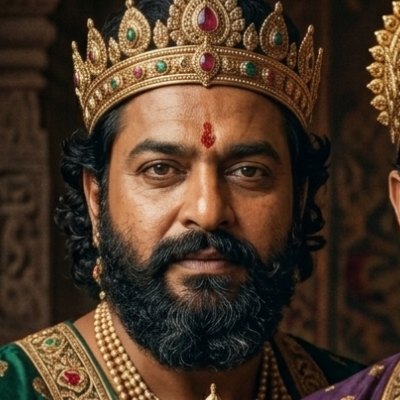
Ushana is a king of the Kroshtu branch of the Lunar Dynasty, recorded in the Vishnu Purana and corroborated in the Bhagavata Purana as the most celebrated monarch in the early succession following the great chakravartin Shashabindu. He is distinguished in the primary sources by a single but weighty achievement: the performance of one hundred Ashvamedha — horse sacrifices — a feat that placed him among the rarest class of sovereigns in Puranic tradition. His position in the lineage is as the fifth king after Shashabindu, reached through the intermediate kings Prithushrava, Antara, Suyajna, and Tamas. He is the son of a king named Tamas, according to the Vishnu Purana, and his son and successor is Shiteyus, also rendered Sineyu or Rukmakavacha in different textual sequences. The lineage running through Ushana is the same line that, many generations later, produces Vidarbha, Dasharha, Madhu, and ultimately Satvata, the patriarch of the great Satvata clans from which Krishna descended.
✦ The Name
The name Ushana derives from a Sanskrit root connected with desire, ardour, and striving. It carries connotations of one who burns with aspiration or sacred purpose. A secondary form, Ushanas, is also attested and is shared with the name of the Vedic sage Shukracharya, preceptor of the Asuras, though the king Ushana of the Yadava line is an entirely distinct figure. Some later traditions record that his title or epithetic name Yat was derived from his extraordinary accomplishments in sacrifice, and certain commentaries suggest this epithet became the origin of a clan designation. The Vishnu Purana's translators from the early modern period render his name as Ushanas in keeping with the Sanskrit declensional form found in manuscript.
✦ Lineage
- Remote ancestor: Shashabindu — the great chakravartin, universal sovereign of the Kroshtu line, whose immense power and wealth are described across multiple Puranas; Ushana's lineage descends directly from him through four intervening kings.
- Intermediary kings from Shashabindu: Prithushrava (most prominent of Shashabindu's sons, from whom this sub-line descends), then Antara, then Suyajna, then Tamas — four kings standing between Shashabindu and Ushana in the Vishnu Purana's sequence.
- Father: Tamas — son of Suyajna; attested in the Vishnu Purana as the immediate predecessor of Ushana in the dynastic sequence; no independent narrative is recorded of him.
- Son: Shiteyus (also Sineyu, Siteyu, or Rukmakavacha in variant texts) — Ushana's immediate successor; in the Vishnu Purana the name given is Shiteyus, while in the Bhagavata Purana the sequence at this position uses Rukmakavacha as the next name, indicating a recension-level divergence.
✦ The Hundred Ashvamedha Sacrifices
The Ashvamedha, the royal horse sacrifice, was the most demanding and prestigious of all Vedic sacrificial rites. A king who performed it once demonstrated sovereignty over all territories traversed by the released horse without challenge. To perform it a hundred times was an achievement attributed only to the greatest sovereigns in the Puranic tradition — figures such as Mandhata of the Solar dynasty, Emperor Bharata, and a handful of others. The Vishnu Purana states plainly that Ushana celebrated a hundred such horse sacrifices, placing him in this exceptional category within the Yadava lineage. No specific narrative details of these rites — their occasions, recipients, or territorial scope — are preserved in the surviving texts. The characterisation is commemorative rather than narrative, functioning within the dynastic list as a marker of royal and ritual greatness.
✦ Textual Variants and Inconsistencies
The Vishnu Purana (Book 4, Chapter 12) is the clearest primary source for Ushana's position. It gives the sequence as Prithushrava — Tamas — Ushanas — Shiteyus — Rukmakavacha, and attributes the hundred Ashvamedhas to Ushanas. The Bhagavata Purana (Ninth Canto, Chapter 23) lists this section of the lineage with some variation in names at adjacent positions, using forms such as Shineyu, Siteyu, and Rukmakavacha interchangeably across different manuscript traditions. The Brahma Purana's dynastic data inserts the name Marutta at a nearby position and extends the sequence differently. These variants are characteristic of Puranic genealogical lists for intermediate kings and do not affect Ushana's own identification or his central characterisation as the performer of a hundred horse sacrifices, which is consistent across sources.
✦ Connection to the Wider Genealogy
Ushana stands five generations below Shashabindu in the Kroshtu line, which itself derives from Kroshtu, the younger son of the patriarch Yadu. The line continuing from Ushana through Shiteyus runs forward through Rukmakavacha and then Paravrit, whose son Jyamagha is the figure who eventually takes a young woman home and from whom the king Vidarbha is born — the founder of the famous Vidarbha kingdom. That southern branch then traces back northward through many kings to Dasharha, Madhu, and Satvata. Ushana thus sits at a crucial intermediate point in the genealogical bridge between the great Shashabindu era and the later Satvata clans from which Krishna ultimately descended.
✦ References
Primary Sources
- Vishnu Purana, Book 4, Chapter 12: The principal source; names Ushanas as son of Tamas and attributes to him the performance of a hundred horse sacrifices; gives the sequence through Shiteyus and Rukmakavacha down to Jyamagha and Vidarbha.
- Bhagavata Purana, Ninth Canto, Chapter 23: Corroborates the genealogical position of Ushana within the Kroshtu line, though with variant names at adjacent positions in the sequence.
Secondary and Reference Works
- Wikipedia, "Ushana" article: Summarises the Vishnu Purana attestation and notes the epithetic name Yat associated with him in later tradition.
- Wisdomlib.org, "Ushana: Significance and symbolism": Compiles references across Puranic sources identifying Ushana as a descendant notable for horse sacrifices and as the offspring of Suyajnaka in some readings.
- Wikipedia, "Ashvamedha" article: Contextualises the significance of performing a hundred horse sacrifices within the broader Puranic tradition of royal ritual achievement.
- Scriptures.redzambala.com, Vishnu Purana Book 4 Chapter 12 translation: Provides the full translated dynastic sequence confirming Ushana's position and the attribution of the hundred sacrifices.