
About
Kratha — Elder Son of Vidarbha, Progenitor of the Main Dynastic Line
Kratha · Kraatha · Progenitor of the Krathas
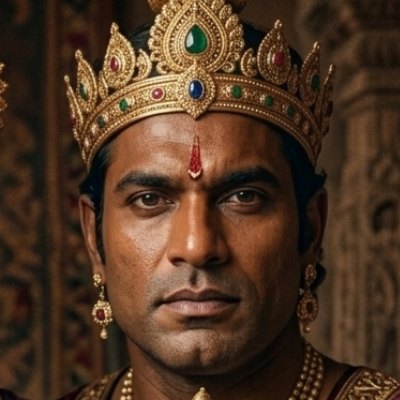
Kratha is a king of the Vidarbha branch of the Kroshtu–Yadava lineage, recorded in the Bhagavata Purana, the Vishnu Purana, the Matsya Purana, the Linga Purana, and the Harivamsha as the eldest son of Vidarbha — the founding king of the Vidarbha kingdom — and the progenitor of the main dynastic line that runs forward through many generations to Dasharha, Madhu, and ultimately Satvata. His significance in the tradition is entirely genealogical: it is through Kratha's line, not through his brothers', that the ancestors of Krishna descended. No independent narrative episode is recorded for Kratha in any of the primary sources; he appears solely as a lineage anchor, a critical dynastic node from which the most consequential branch of the Yadava tree grew. The Harivamsha further attests that in the later Mahabharata period a king called Kratha who ruled the Kaishika territory was present at events connected with Krishna's life in Vidarbha, though whether this is a descendant carrying the same name or a direct reference to the original Kratha is not clarified in the text.
✦ The Name
The Sanskrit name Kratha is derived from a root meaning to struggle, to shake, or to be in violent motion, associated with martial power and forceful action. It is a name attested consistently across all primary genealogical sources in this lineage without significant variant spellings, making it one of the more stable names in the Vidarbha genealogy. The Harivamsha uses the name both as a personal name for Vidarbha's son and as a regional designation — the Krathas — for the people of the territory he governed, following the common Puranic pattern of eponymous naming.
✦ Lineage
- Father: Vidarbha — son of Jyamagha and Shaivya, founder of the Vidarbha kingdom in the southern region corresponding to modern eastern Maharashtra; himself descended from Shashabindu through Prithushrava, Antara, Suyajna, Tamas, Ushana, Shiteyus, Rukmakavacha, Paravrit, and Jyamagha.
- Brothers: Kaishika (also Kausika) — second son of Vidarbha, progenitor of the Chedi branch; and Romapada (also Lomapada) — the third son, profiled separately, who was adopted by the king of Anga and became a figure of significance in the Ramayana tradition.
- Son: Kunti — Kratha's immediate successor in the Bhagavata Purana (9.24.3) and the Vishnu Purana (4.12); a king distinct from the later and more famous Kunti who was the mother of the Pandavas. The Matsya Purana gives the name of Kratha's son as Kuntī in the same position. The Linga Purana gives the sequence as Kratha — Kunti — Dhrishta — Nirvriti, which matches the Vishnu Purana's sequence closely.
The line from Kratha through Kunti continues through Vrishni (an early Yadava king, distinct from the more famous later Vrishni of Satvata's line), then Nirvriti, then Dasharha — the founder of the Dasharha clan and the ancestor whose name became one of Krishna's epithets — then Vyoman, Jimuta, Vikriti, Bhimaratha, Navaratha, Dasharatha (a separate Yadava king), Shakuni, Karambhi, Devarata, Devakshetra, and Madhu, whose name gave the Madhava epithet to Krishna.
✦ Textual Variants
The Bhagavata Purana (9.24.1–3) gives Vidarbha's three sons as Kusha, Kratha, and Romapada, in that order, naming Kusha first. The Vishnu Purana (4.12) gives the three sons as Kratha, Kaishika, and Romapada, naming Kratha first. These represent two distinct orderings, with the Bhagavata Purana inserting Kusha as the eldest rather than Kaishika as the second son. Despite this difference in listing order and the substitution of Kusha for Kaishika in the first position, both texts agree that Kratha is the son from whom the main genealogical line — leading to Kunti, Vrishni, and ultimately Krishna's ancestors — descends. The Linga Purana tradition recorded in the Dharmavidya compilation gives the same Kratha–Kunti–Dhrishta–Nirvriti sequence as the Vishnu Purana. The Harivamsha names the son born in Kratha's line as Anshuman rather than Kunti at this position in a Quora-based secondary summary, though this may reflect a different sub-branch rather than a direct contradiction.
✦ Connection to the Wider Genealogy
Kratha is the eldest son of Vidarbha and the progenitor of the line that carries the Yadava heritage forward from Vidarbha's southern kingdom back into the genealogical sequence that leads to Satvata and Krishna. His brothers Kaishika and Romapada each founded separate lineages — Kaishika's line producing the Chedi kings and eventually Shishupala, one of Krishna's most famous enemies, and Romapada's line extending into the kings of Anga as narrated in the Ramayana. Kratha's own line, by contrast, maintained the unbroken ancestral chain through which Krishna's paternal descent is counted. Every time the genealogy of the Yadavas is traced from Vidarbha onward, it is Kratha's line that is followed.
✦ References
Primary Sources
- Bhagavata Purana, Ninth Canto, Chapter 24, verses 1–3: Names Vidarbha's three sons as Kusha, Kratha, and Romapada; traces the line from Kratha through Kunti, Vrishni, Nirvriti, and Dasharha.
- Vishnu Purana, Book 4, Chapter 12: Names Vidarbha's three sons as Kratha, Kaishika, and Romapada; gives the line from Kratha through Kunti, Vrishni, Nirvriti, and Dasharha.
- Matsya Purana, Yadava Dynasty section: Gives Kratha as son of Vidarbha and Kuntī as son of Kratha, consistent with the Vishnu Purana sequence.
- Linga Purana, Chapter 68 (Genealogy of King Yadu): Corroborates the Kratha–Kunti–Dhrishta–Nirvriti sequence and identifies Kratha as one of the sons of Vidarbha by name in the Sanskrit verse preserved at the Dharmavidya compilation.
- Harivamsha: Names Kratha as son of Vidarbha and notes the Kratha territorial designation for the region he governed; a later Kratha appears at events in Vidarbha in the Mahabharata-era narrative.
Secondary and Reference Works
- Wisdomlib.org, "Kratha: Significance and symbolism": Identifies Kratha as son of Vidarbha and notes his genealogical role within the Puranic narrative framework.
- Wikipedia, "Yadava" article: Situates the Kratha line within the broader Yadava confederacy and confirms the Chedi descent from Kaishika as a parallel branch.
- Dharmavidya.com, Linga Purana Chapter 68: Provides the Sanskrit verse and English translation confirming Kratha as son of Vidarbha and Kunti as son of Kratha.