
About
Kaishika — Son of Vidarbha, Progenitor of the Chedi Royal Line
Kaishika · Kausika · Kaishika · Kaisika
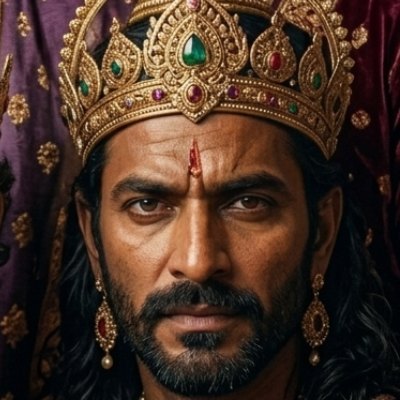
Kaishika is a son of Vidarbha, the founder of the Vidarbha kingdom, and the progenitor of the royal line that established itself in the territory of Chedi, one of the most prominent and ancient kingdoms of the Mahabharata era. He is recorded in the Vishnu Purana and the Yadava article on Wikipedia as the second son of Vidarbha, and across multiple Puranic sources his son Chedi (also rendered as Chidi or Cidi) is identified as the eponymous founder of the Chedi people — the Chaidyas — whose kingdom occupied a central Indian territory. The Chedi line from Kaishika eventually produced some of the most famous figures of the Mahabharata period, including the redoubtable king Shishupala, the sworn enemy of Krishna. Kaishika's position in the tree thus makes him the ancestor not merely of a separate Yadava branch but of the very dynasty that stands in open opposition to Krishna in the great epic.
✦ The Name
Kaishika is a Sanskrit name related to the root kesha, meaning hair, with the suffix -ika suggesting a quality or affiliation connected to that root. It is also attested in the form Kausika — a similar but distinct Sanskrit word meaning belonging to the Kushika lineage — and this similarity has led to confusion between the two forms in manuscript traditions. The Jadaun history sketch explicitly notes that Kaisika is often misread as Kausika in genealogical texts, and that the two must be distinguished. Both forms are found in different Puranic recensions for the same figure; within this profile Kaishika is used as the primary form following the Vishnu Purana's standard.
✦ Lineage
- Father: Vidarbha — son of Jyamagha and Shaivya, the founder of the Vidarbha kingdom; himself descended through the early Kroshtu–Shashabindu line of the Yadavamsha.
- Brothers: Kratha — the eldest son of Vidarbha and progenitor of the main dynastic line leading to Dasharha, Madhu, and Satvata; and Romapada (Lomapada) — the youngest son, who became King of Anga through adoption and features in the Ramayana narrative.
- Son: Chedi (also Chidi, Cidi) — named explicitly in the Vishnu Purana (4.12) as the son of Kaishika and the eponymous founder of the Chedi people and their royal line. The Wisdomlib entry on Chedi kings confirms the lineage is traced back to Kaishika. The Wikipedia article on the Yadavas states that according to the Puranas the Chedis were descendants of Chidi, son of Kaishika, grandson of Vidarbha.
The Bhagavata Purana (9.24.1–2) gives a somewhat different sequence for this branch. It names the line from Romapada as running through Babhru, Krti, Usika, and then Cedi — placing the Chedi eponym several generations further down and attributing it to Romapada's line rather than Kaishika's. The Vishnu Purana, however, places Chedi directly as Kaishika's son. These two accounts are in genuine tension and represent a recension-level disagreement about which of Vidarbha's sons is the direct ancestor of the Chedi dynasty.
✦ The Chedi Kingdom and Shishupala
The kingdom of Chedi, founded by or named after Kaishika's son, occupied a significant territory in the central Indian region. It appears in the Rigveda — where a king named Kashu Chaidya is mentioned — and across the Mahabharata, where the Chedi kings are a recurrent presence. The most famous Chedi king in the Mahabharata era is Shishupala, the son of Damaghosha and a cousin of Krishna through Krishna's mother Devaki, who was Shishupala's paternal aunt. Shishupala was an inveterate enemy of Krishna and was ultimately slain by Krishna's Sudarshana Chakra at the Rajasuya sacrifice of Yudhishthira after delivering a hundred insults — an episode narrated in the Sabha Parva of the Mahabharata. Thus the dynasty that began with Kaishika's son Chedi reached its most celebrated and most violently terminated point in Shishupala, making Kaishika the root ancestor of one of the most dramatically significant royal houses in the entire epic tradition.
The Harivamsha records that in the later period, at the time of the events surrounding the Rukmini abduction episode, a king associated with the Kaishika territory was present at Vidarbha's capital Kundinapuri and offered hospitality to Krishna and the Vrishnis who had come to the city — a detail that preserves the name Kaishika as a territorial designation long after the founding ancestor.
✦ Textual Variants and Inconsistencies
The principal inconsistency in this genealogy is whether the Chedi line descends from Kaishika (Vishnu Purana) or from Romapada through the sequence Romapada — Babhru — Krti — Usika — Cedi (Bhagavata Purana 9.24.2). The Yadava article on Wikipedia reconciles this by citing the Puranas as uniformly attributing Chedi descent to Kaishika, grandson of Vidarbha — which aligns with the Vishnu Purana version. The Padma Purana, through the Wisdomlib Lomapada entry, gives yet another variant, stating that from Lomapada came Babhru, then Heti, then Kaishika, then Cidi — making Kaishika a descendent of Romapada rather than a brother. This third version introduces a second Kaishika several generations below the first, which may represent a confusion of two genealogical strands. These discrepancies are characteristic of Puranic dynastic data for this stretch of the Yadava lineage and cannot be definitively resolved from the surviving sources.
✦ Connection to the Wider Genealogy
Kaishika represents the moment at which the Vidarbha lineage divided from a single family into multiple political trajectories. His brother Kratha's line carried the genealogy forward to Satvata and eventually to Krishna's paternal ancestors. Kaishika's own line produced the Chedi kings — the Chaidyas — who by the Mahabharata era had developed into a powerful independent royal house with deep antagonism toward Krishna's clan. In the architecture of the wider Yadava genealogy, Kaishika thus stands as the point of separation between the ancestral line of Krishna and the line of his most prominent internal enemy.
✦ References
Primary Sources
- Vishnu Purana, Book 4, Chapter 12: Names Kaishika as the second son of Vidarbha and gives his son as Chedi, from whose descendants the Chaidya kings descended.
- Bhagavata Purana, Ninth Canto, Chapter 24, verses 1–2: Does not name Kaishika as a son of Vidarbha; instead gives the Chedi eponym several generations further in Romapada's line — representing the main textual inconsistency with the Vishnu Purana on this point.
- Padma Purana, Srishti Khanda: As recorded in the Wisdomlib Lomapada entry, gives the sequence Lomapada — Babhru — Heti — Kaishika — Cidi, placing a Kaishika as a descendant of Romapada rather than as his brother.
- Harivamsha, Vishnu Parva, Chapter 60: Records a king associated with the Kaishika territory at Kundinapuri during the Rukmini episode, preserving the territorial name in the Mahabharata-era narrative.
Secondary and Reference Works
- Wikipedia, "Yadava" article: States that according to the Puranas the Chedis were descendants of Chidi, son of Kaishika, grandson of Vidarbha — corroborating the Vishnu Purana version.
- Wisdomlib.org, "Chedi king: Significance and symbolism": Confirms that the royal lineage of the Chedi kings is traced back to Kaishika in Puranic sources.
- Wisdomlib.org, "Lomapada" definition entry: Records the Padma Purana variant placing Kaishika as a descendant of Lomapada rather than his brother, noting the Brahmanda Purana's corroboration of Lomapada as son of Vidarbha and father of Babhru.
- Jadaun-history.blogspot.com, "Brief Sketch of the History of the Lunar Race": Explicitly notes that Kaisika is often misread as Kausika in manuscript traditions and identifies the Kaishika line as establishing itself in Chedi.