
About
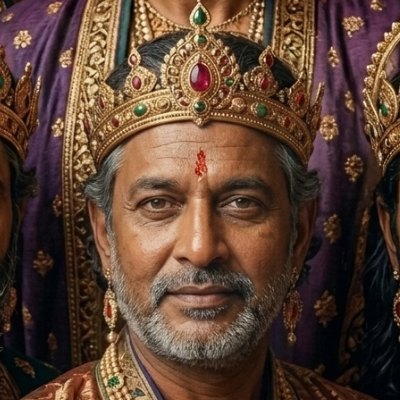
Romapada — King of Anga, Adoptive Father of Shanta
Romapada · Lomapada · Chitraratha · Dasharatha of Anga
Romapada, also known as Lomapada, was a king of the ancient eastern kingdom of Anga whose reign is remembered primarily for two episodes of lasting significance: the adoption of Princess Shanta from the Solar dynasty of Ayodhya, and the bringing of the sage Rishyashringa to his drought-stricken kingdom. Through the sage's presence, the rains were restored to Anga, and through Rishyashringa's subsequent journey to Ayodhya, the Putrakameshti sacrifice was performed that produced the four princes of Dasharatha — including Rama. Romapada thus stands at a pivotal narrative junction between the Anga dynasty and the central story of the Valmiki Ramayana. He appears in the Bhagavata Purana, the Vishnu Purana, the Matsya Purana, the Vayu Purana, the Harivamsha Purana, the Valmiki Ramayana, and the Mahabharata, though the texts differ on certain genealogical details concerning his parentage and the precise relationship between the names Citraratha, Satyaratha, Romapada, and Lomapada.
✦ The Names
The name Romapada is a compound of roma (body hair) and pada (foot), carrying the literal sense of one whose feet are hairy — a descriptive or perhaps totemic designation. Lomapada is its exact synonym, loma being an alternate Sanskrit word for body hair, and all Sanskrit lexicographers treat the two names as referring to the same individual. The name Chitraratha, meaning one who has a variegated or ornamented chariot, appears in certain textual traditions as either an alternate name for this king or as the name of the preceding generation. The designation Dasharatha of Anga distinguishes this king from the far more famous Dasharatha of Ayodhya and reflects the Matsya Purana and Vayu Purana's explicit use of Dasharatha as an alias for Lomapada in the Anga succession.
✦ Lineage
- Father: Dharmaratha in the Bhagavata Purana (9.23.7) and Vishnu Purana (4.18), which treat Citraratha and Romapada as the same person, son of Dharmaratha; the Matsya Purana (48.95) and Vayu Purana (99.103) place an additional generation between them, giving Satyaratha as the son of Citraratha and Lomapada as the son of Satyaratha — making Dharmaratha Romapada's grandfather in those texts
- Adoptive daughter: Shanta — a princess of the Solar dynasty given to Romapada by his close friend King Dasharatha of Ayodhya for adoption; subsequently given in marriage to the sage Rishyashringa
- Son: Chaturanga — attested in both the Bhagavata Purana (9.23.10) and the Harivamsha (31.47) as Romapada's son, born after Rishyashringa's intercession
✦ The Brahmin's Offence and the Drought
The Mahabharata and the Valmiki Ramayana both record that a severe drought afflicted Anga during Romapada's reign as a consequence of the king having offended a Brahmin. In the account preserved in the Vana Parva of the Mahabharata, Romapada had carelessly or negligently failed to honour a Brahmin who sought his assistance. As a result, the Brahmins of Anga withdrew from the kingdom, sacrificial rites could no longer be performed, and the rains ceased entirely. Romapada was told by his counsellors that the drought could only be ended by bringing into his kingdom a man of absolute chastity and purity.
✦ The Bringing of Rishyashringa
Learning of the sage Rishyashringa — the son of the sage Vibhandaka, born of a doe, raised in total forest isolation, and wholly ignorant of the existence of women — Romapada devised a plan to lure the young ascetic to Anga. He sent a group of courtesans, adorned and skilled in music and charm, into the forest during Vibhandaka's absence. Encountering these women for the first time, Rishyashringa was enchanted and followed them to Anga. The moment he entered the kingdom, rains fell and the drought ended. Romapada received the sage with great honour, constructed a new hermitage for him, and gave him his adopted daughter Shanta in marriage, thereby binding the sage permanently to his kingdom. This episode is narrated in detail in the Bala Kanda of the Valmiki Ramayana (Sargas 9–11) and corroborated in the Vana Parva of the Mahabharata (Chapters 110–113).
✦ Connection to Ayodhya and the Birth of Rama
Romapada's friendship with Dasharatha of Ayodhya — described in the Ramayana as a bond of childhood intimacy — had two consequences of epic significance. First, it was the basis on which Dasharatha offered his daughter Shanta to Romapada for adoption, given that Romapada was childless at that time. Second, when Dasharatha himself had no sons and sought a great sacrifice to obtain heirs, he sent his minister Sumantra to Anga to request Rishyashringa's assistance. Romapada consented and allowed Rishyashringa and Shanta to travel to Ayodhya. There, Rishyashringa performed the Putrakameshti sacrifice, from which the four princes of the Solar dynasty were born — Rama, Bharata, Lakshmana, and Shatrughna. Romapada's role in this chain of events, though indirect, was indispensable to the central narrative of the Valmiki Ramayana.
✦ Textual Variants and Inconsistencies
Several genuine inconsistencies appear across the primary sources. The most significant concerns the identity of Romapada's father. The Bhagavata Purana (9.23.7) and Vishnu Purana (4.18) treat Citraratha and Romapada as the same king — Citraratha being his given name and Romapada an epithet or alternate designation, with Dharmaratha as his father. The Matsya Purana (48.95) and Vayu Purana (99.103), however, insert an additional generation, giving the sequence as Dharmaratha → Citraratha → Satyaratha → Lomapada, making Romapada the great-grandson rather than the son of Dharmaratha. The Puranic Encyclopaedia's entry on Lomapada follows this fuller sequence. These two versions cannot be reconciled and represent a genuine divergence within the Puranic tradition.
A second inconsistency concerns the identity of Shanta. The Valmiki Ramayana in its earlier passages describes Shanta as Romapada's own daughter, without specifying adoption, while later passages in the same text and the Mahabharata clarify that she was the biological daughter of Dasharatha of Ayodhya given to Romapada for adoption. This difference between Ramayana recensions is well documented and unresolved.
A third point concerns the separate figure of Lomapada in the Yadava genealogies. The Bhagavata Purana (9.24), Brahmanda Purana, Vayu Purana, and Padma Purana all record a Lomapada as a son of Vidarbha in the Yadava line, with a distinct descendant sequence leading through Babhru toward the Chedi dynasty. Whether this Lomapada of the Yadava line is the same individual as the Anga king Romapada — reconciled through an adoption narrative not preserved in the primary Puranic texts — or a distinct figure who shares only a name, is not resolved by the texts themselves.
✦ Connection to the Wider Genealogy
Within the Anga dynastic succession, Romapada stands as the fifth or sixth king depending on which textual tradition is followed, descending from Anga → Para/Khalapana/Dadhivahana → Diviratha → Dharmaratha, and in the longer tradition also through Citraratha and Satyaratha. He is succeeded by Chaturanga, and the line continues through Prithulaksha, Champa, Haryanga, Bhadraratha, and the subsequent kings down to Adhiratha and Karna. Through the adoption of Shanta and her marriage to Rishyashringa, Romapada created a direct kinship link between the Anga dynasty of the Lunar line and the Ayodhya dynasty of the Solar line — a cross-dynastic bond unique in the Puranic genealogical record.
✦ References
- Bhagavata Purana, Canto 9, Chapter 23, verses 7–10: Treats Citraratha as Romapada, son of Dharmaratha; records the adoption of Shanta, the Rishyashringa episode, and Chaturanga as his son
- Vishnu Purana, Book 4, Chapter 18: Confirms Romapada as son of Dharmaratha; records the adoption of Shanta and the birth of Chaturanga
- Matsya Purana, Chapter 48, verse 95: Gives Lomapada (alias Dasharatha) as son of Satyaratha, inserting Citraratha and Satyaratha as intermediate generations between Dharmaratha and Lomapada
- Vayu Purana, Chapter 99, verse 103: Corroborates the Matsya Purana sequence; names Citraratha as an alternate name in this extended lineage
- Harivamsha Purana, Adi Parva, Chapter 31, verses 44–47: Names Citraratha as son of Dharmaratha and Lomapada as his alternate designation; records Chaturanga as his son through Rishyashringa's favour
- Valmiki Ramayana, Bala Kanda, Sargas 9–11: Primary narrative source for the drought, the luring of Rishyashringa, Shanta's marriage, and the connection to Dasharatha of Ayodhya
- Mahabharata, Vana Parva, Chapters 110–113: Corroborates the Rishyashringa episode; records the offence to the Brahmin, the drought, and Rishyashringa's arrival in Anga
- Wisdomlib — Lomapada definition entry: Secondary source compiling attestations from the Matsya Purana, Vayu Purana, Brahmanda Purana, and Padma Purana; records the extended Anga genealogy with Satyaratha as an intermediate generation and the separate Yadava-line Lomapada
- Puranic Encyclopaedia (Vettam Mani): Secondary source providing the full genealogical sequence from Anga to Lomapada as given in the longer textual tradition, and the narrative details of the Rishyashringa episode