
About
Chedi — Eponymous Founder of the Chedi Kingdom and the Chaidya Dynasty
Chedi · Chidi · Cedi · Cidi · Chaidya (as a derived clan name)
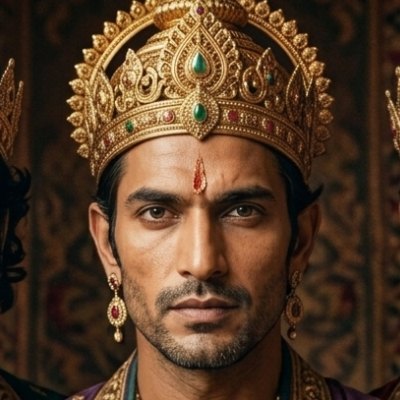
Chedi is a king of the Yadava lineage, descending through the Kroshtu branch of the Lunar Dynasty, and the eponymous founder of both the Chedi kingdom and the people known as the Chaidyas. He is recorded across the Vishnu Purana, the Harivamsha, and secondarily in the Bhagavata Purana tradition as a direct descendant of Vidarbha — the founder of the Vidarbha kingdom and himself a descendant of Shashabindu through Jyamagha. The Chedi kingdom that bears his name went on to become one of the most prominent political entities of the Mahabharata period, listed among the sixteen great mahajanapadas of ancient India. It is Chedi's most famous descendant, the king Shishupala, who gives the dynasty its most enduring narrative significance — as the sworn enemy of Krishna who was ultimately slain by the Sudarshana Chakra at the Rajasuya sacrifice of Yudhishthira. Chedi thus stands at the head of the one royal house within the broader Yadava confederation that developed into a direct and ultimately mortal antagonist of Krishna's own clan.
✦ The Name
The Sanskrit name Chedi, also written Chidi or Cedi, designates both the founding king and the kingdom and people that took his name — the Chaidyas, a standard vṛddhi derivation from Chedi meaning those who belong to or descend from Chedi. The Rigveda (VII.18.13) mentions a king named Kashu Chaidya, attesting the clan name's antiquity independently of the Puranic genealogies, though this early reference cannot be definitively connected to the same genealogical figure. The capital of the Chedi kingdom was named Suktimati — meaning oyster-shell — and its ruins have been variously identified by modern scholars with sites in Banda district of Uttar Pradesh and with Itaha near Rewa in Madhya Pradesh. The kingdom occupied the region of Bundelkhand, south of the river Yamuna along the river Ken.
✦ Lineage
- Remote ancestor: Vidarbha — son of Jyamagha and Shaivya, founder of the Vidarbha kingdom in the region corresponding to modern eastern Maharashtra; himself descended through Shashabindu and the early Kroshtu line of the Yadavamsha.
- Father (Vishnu Purana version): Kaishika — the second son of Vidarbha, from whom Chedi descends directly as his immediate son. This is the most compact and direct genealogical statement, placing Chedi two generations below Vidarbha.
- Father (Harivamsha version): A second Kaishika — a figure distinct from Vidarbha's son, reached through the line Lomapada (Romapada, Vidarbha's third son) — Babhru — Ahvriti — this second Kaishika — Chedi. In this version Chedi is five generations below Vidarbha through Romapada's sub-line, not two generations through Kaishika's direct line. The Harivamsha (Section 36) explicitly states that from this second Kaishika came Chedi, after whose name the kings of the Chaidya race pass.
- Descendants of note: The Chedi dynasty continued for many generations. By the Mahabharata period the most prominent kings of the line were Damaghosha, his son Shishupala — the last Chedi king of the heroic era — and after Shishupala's death at Krishna's hands, Dhrishtaketu, installed by Yudhishthira as Shishupala's successor.
✦ The Chedi Kingdom
The kingdom Chedi founded occupied a rich and strategically important territory in the central Gangetic plain. During its early period it fell under the suzerainty of the Paurava king Vasu Uparichara, who conquered it at the request of Indra and ruled it as a celebrated sovereign. Vasu Uparichara is described in the Mahabharata as a devotee of Vishnu and a great imperial figure; he placed his sons as governors across his extended territories, and his son Vrihadratha established the kingdom of Magadha, from whose line the famous emperor Jarasandha later descended. After Uparichara's time the Yadava line reasserted itself in Chedi, and the kingdom continued as a significant power in the region of Bundelkhand throughout the later Vedic and epic periods. In the period of Nala and Damayanti — narrated in the Mahabharata's Vana Parva — a Chedi king named Subahu or Suvahu is mentioned as a contemporary of Rama, indicating the dynasty's deep antiquity and continued political presence.
✦ The Most Famous Descendant: Shishupala
The culminating figure of the Chedi dynasty in Puranic and epic narrative is Shishupala, whose story is narrated in detail in the Sabha Parva of the Mahabharata and whose death is additionally treated as a major theological event in the Bhagavata Purana and the Vishnu Purana. Shishupala was the son of King Damaghosha of Chedi and his queen Shrutakirti — who was a sister of Vasudeva, the father of Krishna, making Shishupala and Krishna first cousins. He was born with three eyes and four arms, and a celestial voice foretold at his birth that his extra limbs would vanish at the touch of the person destined to slay him. When Krishna visited the Chedi court and placed the infant on his lap, the extra eye and arms disappeared at once, identifying Krishna as Shishupala's destined killer. At his mother's anguished plea, Krishna granted a boon to overlook a hundred offences by Shishupala before taking his life.
Shishupala grew into a powerful and proud king who allied himself with Jarasandha of Magadha and Kamsa of Mathura — both enemies of Krishna — and repeatedly antagonised Krishna through military provocations, including attacking Dwaraka during Krishna's absence, stealing a sacrificial horse from Vasudeva's Ashvamedha, and attempting to obtain Rukmini of Vidarbha as his own bride before Krishna abducted her. His enmity came to its culmination at the Rajasuya sacrifice of the Pandava king Yudhishthira. When the assembled elders, led by Bhishma, declared that Krishna should receive the agra-puja — the honour of first worship — Shishupala rose in furious protest and delivered more than a hundred public insults against Krishna, exhausting the limit of the granted boon. Krishna responded by releasing his Sudarshana Chakra, which severed Shishupala's head in the midst of the assembly. The texts note that Shishupala's soul, drawn into Krishna by the intensity of his constant — if hostile — preoccupation with the deity, attained liberation at the moment of death.
The Vishnu Purana identifies Shishupala as the third birth of the gatekeeper Jaya of Vaikuntha, who had been cursed to take three births as an enemy of Vishnu — having been born first as Hiranyakashipu, slain by Narasimha, and then as Ravana, slain by Rama. The Mahabharata period birth as Shishupala thus completes the cycle. After Shishupala's death, Yudhishthira installed his son Dhrishtaketu as king of Chedi. Dhrishtaketu subsequently fought on the Pandava side in the Kurukshetra War and was slain by Drona on the fourteenth day of battle.
✦ Textual Variants on the Genealogy
As noted above, the primary sources disagree on the exact genealogical path through which Chedi descends from Vidarbha. The Vishnu Purana (4.12) gives the direct sequence Vidarbha — Kaishika — Chedi. The Harivamsha (Section 36) gives the longer sequence Vidarbha — Lomapada — Babhru — Ahvriti — Kaishika (a second figure of this name) — Chedi, routing the Chedi eponym through Lomapada's (Romapada's) sub-line with a second Kaishika as the immediate father. The Bhagavata Purana (9.24.2) routes the Chedi eponym through Romapada — Babhru — Krti — Usika — Cedi, giving yet a third generational distance and omitting the intermediate Kaishika altogether. Several secondary sources — including the Wikipedia Yadava article and the Wisdomlib Chedi king entry — follow the Vishnu Purana version in describing Chedi as the son of Kaishika, grandson of Vidarbha. The Chedi kingdom article on Wikipedia, drawing on a different Puranic summary, identifies Chidi as the son of Vidarbha directly, collapsing the genealogy further. These discrepancies are characteristic of Puranic dynastic lists for this branch of the Yadava lineage and cannot be resolved by appeals to the primary texts alone.
✦ Connection to the Wider Genealogy
Chedi's founding of the kingdom that bears his name produced a royal house that remained politically active and dynastically significant from the early Vedic period through the Mahabharata era. The Chedi kingdom was the home of Uparichara Vasu, whose son Vrihadratha founded Magadha and whose granddaughter Satyavati — born of a fisherman woman — eventually became the wife of King Shantanu of the Kuru dynasty and the grandmother of Bhishma's half-brothers Chitrangada and Vichitravirya, entangling the Chedi line in the remote ancestry of the Pandavas and Kauravas as well. The Chedis are also the source of Nakula's wife Karenumati and of one of Bhima's wives. The dynasty is thus woven into the fabric of the Mahabharata's principal families through multiple threads, even as it stands as the political and religious opponent of Krishna's own Satvata clan.
✦ References
Primary Sources
- Vishnu Purana, Book 4, Chapter 12: The principal Puranic genealogical source giving Chedi as the direct son of Kaishika and grandson of Vidarbha; describes his descendants as the Chaidya kings.
- Harivamsha, Harivamsa Parva, Section 36: The primary source that explicitly names Chedi as the eponymous ancestor of the Chaidya race and gives his immediate father as a second Kaishika, reached through the Lomapada — Babhru — Ahvriti sub-line of Vidarbha's descendants.
- Bhagavata Purana, Ninth Canto, Chapter 24, verse 2: Routes the Chedi eponym through Romapada's line as Romapada — Babhru — Krti — Usika — Cedi, giving the derived clan name Chaidya for kings born from Cedi.
- Mahabharata, Sabha Parva: The primary narrative source for Shishupala's confrontation with Krishna at the Rajasuya sacrifice and his death at Krishna's hands; establishes Shishupala as king of the Chedi kingdom in the Mahabharata era.
- Mahabharata, Adi Parva, Chapter 63: Contains the story of Uparichara Vasu as king of Chedi and his sons, including Vrihadratha of Magadha.
- Rigveda, VII.18.13: The earliest textual attestation of the clan name Chaidya in reference to a king named Kashu, pre-dating the Puranic genealogical accounts.
Secondary and Reference Works
- Wikipedia, "Chedi Kingdom" article: Provides geographic identification of the kingdom with Bundelkhand in Madhya Pradesh; locates the capital Suktimati; summarises the careers of Uparichara Vasu, Damaghosha, Shishupala, and Dhrishtaketu as successive rulers.
- Wikipedia, "Yadava" article: States that according to the Puranas the Chedis were descendants of Chidi, son of Kaishika, grandson of Vidarbha, corroborating the Vishnu Purana version of the genealogy.
- Wikipedia, "Shishupala" article: Provides the full account of Shishupala's birth, his mother's relationship to Vasudeva, the boon of a hundred offences, and his death at the Rajasuya.
- Wisdomlib.org, "Chedi king: Significance and symbolism": Confirms the Puranic linkage of the Chedi royal line to Kaishika and notes Jarasandha and Shishupala as the most prominent title-holders.
- Harivamsam.arasan.info, Harivamsa Parva Section 36: Supplies the translated primary text of the Harivamsha's genealogical passage giving the Lomapada — Babhru — Ahvriti — Kaishika — Chedi sequence explicitly.
- Raychaudhuri, H. C., Political History of Ancient India (1923): Modern historical scholarship placing the location of Suktimati, capital of the Chedi kingdom, in the vicinity of Banda, Uttar Pradesh.