
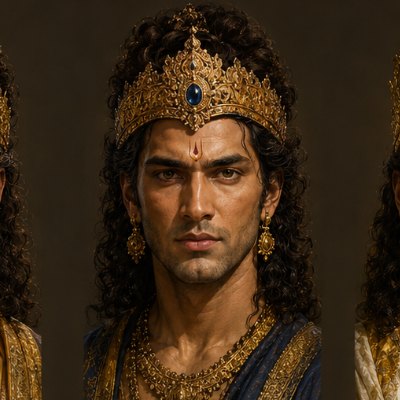
About
Devasravas — Prince of the Vrishni Clan and Husband of Kamsavati of the Kukura Line
Devasravas · Devashravas · Devasrava · Devashrava
Devasravas was a prince of the Vrishni sub-clan of the Yadava confederacy, the fifth and youngest of the sons of King Shurasena and Queen Marisha to participate in the systematic matrimonial alliance with the Kukura house, and a younger brother of Vasudeva — the father of Lord Krishna. As a brother of Vasudeva, Devasravas stood in the position of a paternal uncle to Lord Krishna. His marriage to Kamsavati, the fifth and youngest daughter of King Ugrasena of the Kukura sub-clan, is established by the sequential kramat alignment of Bhagavata Purana 9.24.25, which lists the five sons of Shurasena and the five daughters of Ugrasena in deliberate parallel order, placing Devasravas as the fifth-listed junior brother of Vasudeva against Kamsavati as the fifth daughter of Ugrasena. This union completed the full five-couple matrimonial grid connecting the Vrishni and Kukura houses. The primary sources assign him children through his marriage with Kamsavati, while the Vishnu Purana and the Harivamsha attribute additional sons to him through what those texts record as separate maternal branches. He is recorded in the Bhagavata Purana, the Vishnu Purana, and the Harivamsha.
✦ The Name
The name Devasravas is a Sanskrit compound of deva, meaning divine being or deity, and shravas, meaning fame, glory, or that which is heard. The compound may thus be understood to carry the sense of one whose fame is of divine quality or one celebrated in the manner of the gods. The spelling variants Devashravas, Devasrava, and Devashrava represent common transliteration alternatives for the same name arising from differing conventions for rendering Sanskrit consonant clusters and terminal forms in Roman script; they do not indicate distinct figures or separate epithets. No additional honorifics or titles for Devasravas the son of Shurasena are recorded in the primary sources consulted.
✦ Lineage
- Father: King Shurasena (also known as Sura) — patriarch of the Vrishni sub-clan of the Yadavas and father of Vasudeva and several younger sons; Devasravas is born into his line and carries the Vrishni lineage designation by birth.
- Mother: Queen Marisha — wife of Shurasena and mother of Devasravas and his brothers, recorded in the Bhagavata Purana and the Vishnu Purana as the queen of the Vrishni household.
- Elder Brother: Vasudeva (also known by his patronymic Anakadundubhi) — the foremost son of Shurasena, the father of Lord Krishna by his wife Devaki, and the most prominent figure of the Vrishni line in the Puranic tradition; the sibling through whom Devasravas's relationship to Krishna is established.
- Brothers: Devabhaga, Kanka, Anadhrishti, and Srinjaya — fellow sons of Shurasena and younger brothers of Vasudeva, each of whom likewise married a daughter of Ugrasena of the Kukura sub-clan as the first four pairings in the matrimonial grid that Devasravas's marriage completed.
- Wife: Kamsavati (also recorded as Kamsavatika in certain regional recensions, and referred to as Kankavati in some secondary sources) — the fifth and youngest daughter of King Ugrasena of the Kukura sub-clan and a sister of Kamsa, the tyrannical king of Mathura; her marriage to Devasravas formed the concluding pairing of the five-couple Kukura–Vrishni matrimonial grid.
- Son: Shatadhanu (also written as Satadhanu) — son of Devasravas and Kamsavati as recorded in the Bhagavata Purana; carries the Vrishni lineage designation inherited from his father. This figure is distinct from King Shatadhanu associated with the Syamantaka jewel episode in the Puranic narrative, who belongs to an entirely separate genealogical context.
- Son: Shatrughna — attributed to Devasravas in the Vishnu Purana; carries the Vrishni lineage designation. Distinct from Shatrughna the youngest brother of Lord Rama of the Ikshvaku solar dynasty of Ayodhya, with whom he shares only a name.
- Son: Ekalavya — attributed to Devasravas in the Vishnu Purana and the Harivamsha; recorded as having been abandoned in infancy and raised by the Nishada chief Hiranyadhanus; celebrated in the Mahabharata as an exceptional archer. The question of his maternal line and the textual divergence surrounding his parentage is addressed below.
✦ Marriage Alliance and Cross-Branch Significance
The marriage of Devasravas to Kamsavati completed the five-couple matrimonial grid through which the sons of Shurasena married the daughters of Ugrasena. The kramat sequential structure of Bhagavata Purana 9.24.25 aligns the five pairings in precise parallel order — Devabhaga with Kamsaa, Kanka with Kanka, Anadhrishti with Surabhu, Srinjaya with Rashtrapali, and Devasravas with Kamsavati — placing Devasravas and Kamsavati as the fifth and final pairing that closed the bilateral kinship network between the two houses. As the concluding link in this chain, Devasravas's node carries particular structural significance in the genealogical record as the point at which the systematic cross-clan alliance between the Vrishni and Kukura sub-clans was fully realised.
As a younger brother of Vasudeva and husband of a Kukura princess, Devasravas stood in the position of a paternal uncle to Lord Krishna. His son Shatadhanu, born of Kamsavati, was a first cousin of Krishna on the paternal side, carrying the Vrishni lineage designation through his father while holding through his mother a maternal connection to the Kukura royal house and, through his mother's brother Kamsa, a connection to the ruling line of Mathura.
✦ His Son Ekalavya
The Vishnu Purana and the Harivamsha record that Ekalavya was a son of Devasravas, abandoned in infancy and subsequently found and raised by Hiranyadhanus, the chief of the Nishada people — a forest-dwelling community. According to this Puranic tradition, Ekalavya's birth identity was that of a Vrishni prince, though his entire upbringing and social identity were formed among the Nishadas. The Mahabharata, which contains the most extended narrative of Ekalavya's life, does not assign him any Vrishni or Yadava parentage. In the Mahabharata account, Ekalavya is presented throughout as a Nishada prince who sought instruction from Drona — the celebrated preceptor of the Pandava and Kaurava princes — and upon being refused formal discipleship, trained himself before a clay image of Drona, attaining extraordinary skill in archery. When Drona subsequently demanded his right thumb as a teacher's fee, Ekalavya severed and presented it without hesitation. The two traditions — the Puranic birth parentage and the epic social identity — are not reconciled in the texts and represent genuinely distinct accounts of his origins. Both are preserved here as independent witnesses.
A further question arises regarding through which wife Shatrughna and Ekalavya were born to Devasravas. The data provided identifies Shatadhanu as the son born of Kamsavati, while describing Shatrughna and Ekalavya as born of alternative maternal branches. The primary texts do not explicitly name a second wife for Devasravas in the passages consulted for this profile, and the precise maternal line of Shatrughna and Ekalavya within the Vishnu Purana and Harivamsha account remains a matter requiring further textual verification against the original Sanskrit passages of those works.
✦ Textual Variants and Inconsistencies
Three distinct textual layers bear on the children attributed to Devasravas. The Bhagavata Purana at verse 9.24.28 records Shatadhanu as his son, presenting this as the primary genealogical attestation within that text. The Vishnu Purana at 4.14.5 and the Harivamsha at 1.34.18 attribute Shatrughna and Ekalavya to him as well, representing a supplementary Puranic tradition that extends his progeny beyond what the Bhagavata Purana records. The Mahabharata, as noted, presents Ekalavya's Nishada identity without reference to Vrishni parentage, constituting a third and non-reconciled tradition. Researchers should be aware that the assignment of three sons to Devasravas across these sources may reflect either the survival of different regional manuscript traditions or the compression of originally distinct genealogical branches under a single paternal node in the process of textual transmission.
✦ Connection to the Wider Genealogy
Devasravas belongs to the Vrishni branch of the Yadava confederacy through his father Shurasena. His elder brother Vasudeva fathered Lord Krishna by Devaki, a princess of the Bhoja sub-clan of the Yadavas. Through his marriage to Kamsavati the Kukura princess, Devasravas linked the Vrishni house to the Kukura royal line of Ugrasena as the final node in the matrimonial grid. His sons carry the Vrishni lineage designation forward through their father while remaining maternally connected — through Kamsavati — to the house of Mathura. The additional sons attributed to him by the Vishnu Purana and Harivamsha, if accepted, extend this branch further and introduce the singular genealogical case of Ekalavya, a Vrishni-born prince whose entire known life and identity unfolded within the Nishada community, placing him at one of the most unusual intersections of birth lineage and social identity in the Puranic and epic record.
✦ References
- Bhagavata Purana, Skandha 9, Chapter 24, verse 22: Establishes Devasravas as a son of Shurasena and Marisha within the Vrishni genealogical enumeration.
- Bhagavata Purana, Skandha 9, Chapter 24, verse 25: Records the kramat sequential alignment assigning Devasravas as the fifth Vrishni brother and establishing his marriage to Kamsavati the fifth daughter of Ugrasena.
- Bhagavata Purana, Skandha 9, Chapter 24, verse 28: Names Shatadhanu as the son born to Devasravas; primary Puranic witness for his offspring within this text.
- Vishnu Purana, Amsha 4, Chapter 14, verse 5: Attributes Shatrughna and Ekalavya to Devasravas and includes the detail of Ekalavya's abandonment and upbringing by the Nishada chief Hiranyadhanus; constitutes a supplementary Puranic tradition extending his recorded progeny.
- Harivamsha, Chapter 1, verse 34.18: Corroborating source for the attribution of Ekalavya to Devasravas and for the account of his Nishada upbringing; consistent with the Vishnu Purana tradition on this point.
- Mahabharata, Adi Parvan: Contains the principal narrative of Ekalavya as a Nishada prince and archer; does not assign him Vrishni or Yadava parentage, presenting a tradition independent of and irreconcilable with the Vishnu Purana and Harivamsha accounts.
- Wisdomlib, definition entries for Devashravas and Devashrava: Modern digital references consulted for Sanskrit etymology and name variant identification; do not constitute primary sources for genealogical claims.
- Ancientvoice, entry for Devasravas: Modern secondary reference consulted for corroborating identification within the Vrishni genealogical tradition; does not constitute a primary source for genealogical claims.