
About
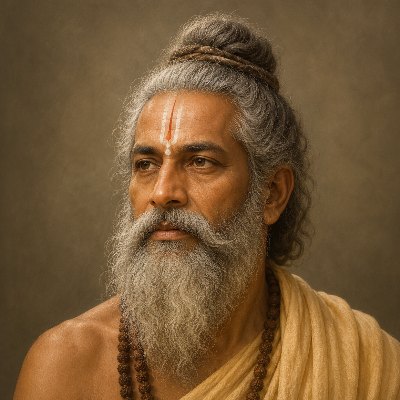
Bhavana Rishi — Divine Founder of Weaving in the Padmashali Community Tradition
Bhavana Rishi · Bhavanarayana · Padmabavacharya · Bhavana Maharishi
Bhavana Rishi is the founding ancestral figure of the Padmashali weaving community — a Telugu-speaking Hindu artisan caste concentrated in Andhra Pradesh, Telangana, Maharashtra, Karnataka, Tamil Nadu, and Kerala — venerated as the divine originator of the craft of weaving and the progenitor of the 101 gotras into which the community is organised. His legend is preserved in a body of Telugu-language caste-specific texts known variously as the Bhavana Rishi Puranam, the Markandeya Puranam (in the Padmashali community's usage), or the Padmasali Purana, and in the oral and painted performance tradition of the Kunapuli storyteller community of Telangana, whose members recite and display the narrative through large illustrated scroll paintings known as Bhavana Rishi Mahatmyan Patam. These scrolls are held in major museum collections including the British Museum, the Seattle Art Museum, the Jagdish and Kamla Mittal Museum, and the University of Michigan Museum of Art.
It must be stated clearly at the outset that Bhavana Rishi does not appear in any of the eighteen Mahapuranas, in the Ramayana, in the Mahabharata, or in any other text of the Sanskrit canonical Puranic or epic tradition. Scholarly study of the texts associated with his legend — notably the analysis published in the journal Artibus Asiae and the academic chapter study of the Padmasali Purana manuscripts — establishes that the Telugu-language texts narrating his story were composed in the middle of the sixteenth century CE and were commissioned by or written in the service of the Padmashali community's desire to establish a sacred genealogy. The Telugu literary scholar Subramanyam, who examined the manuscripts directly, described them as Puranam kani Puranam — literally the Purana that was not — noting that while they bear the name of the Markandeya Purana, they have no substantive textual relationship with the Sanskrit Mahapurana of that name. The claim that Bhavana Rishi appears in the Vishnu Purana or Vayu Purana, which circulates in some community publications, is not corroborated by those texts and does not withstand examination of the primary Sanskrit sources. This profile therefore treats Bhavana Rishi as a figure of caste and folk tradition rather than as a figure of the canonical Sanskrit Puranic genealogical record.
✦ The Name
The name Bhavana in Sanskrit means manifestation, creation, visualisation, or that which is brought into being through thought or will. The tradition that his name reflects his origin as a being brought into existence through the sacred visualisation of Markandeya's fire sacrifice — rather than through ordinary birth — is consistent with this etymology. He is also called Bhavanarayana, a compound combining his name with Narayana — an epithet of Vishnu — which appears in the Vaishnava strand of the tradition and reflects the prominent role of Vishnu in bestowing on him the lotus-stem thread from which the first cloth was woven. The form Padmabavacharya, meaning the teacher Bhavana of the Padma (lotus), is used in some community traditions and serves as an alternative epithet connecting him to the lotus with which he is consistently associated at birth.
✦ Textual Sources and Their Nature
The legend of Bhavana Rishi is preserved in three principal forms. The first is a Telugu-language text in dvipada verse style, composed in the mid-sixteenth century and commissioned by the Padmashali community, which bears the name Markandeya Puranam but contains content focused entirely on caste genealogy rather than on the cosmological, philosophical, and mythological themes of the Sanskrit Mahapurana. The second is a version composed by a Shaivite Telugu poet also dateable to the mid-sixteenth century, which gives a somewhat different theological inflection to the same events. The third is a handwritten compilation from 1942 to 1944 drawing on oral tradition. All three versions share the core narrative of Bhavana Rishi's miraculous birth, his weaving of the first cloth, his quest for the tiger skin, and his marriage and progeny.
The scroll-painting performance tradition associated with these texts is attested from at least 1625, when the oldest surviving scroll was painted. These scrolls, created by painter families in villages and temple towns of the Telangana region, were used by the Kunapuli — a bardic storyteller community whose origin myth is itself embedded within the Bhavana Rishi narrative — to perform the story before Padmashali households, particularly in connection with ritual and festive occasions.
✦ Genealogical Placement in the Community Tradition
Within the Padmashali community's own genealogical account, Bhavana Rishi is placed as a son of the sage Markandeya — the immortal Brahmarshi of the Bhrigu lineage — and is thereby positioned as a descendant of Bhrigu, Vidhata, Mrikandu, and Markandeya in that line. He is described as born not through natural parentage but from the sacrificial fire, making him an Ayoni Putra — one born without a human womb — analogous to other miraculous births found in the Puranic tradition. This genealogical placement situates the Padmashali community within the Bhargava gotra, and all Padmashalis are said to carry the gotra of Bhargava in addition to their individual family gotras as a consequence of this lineage claim.
It should be noted that this genealogical claim — that Bhavana Rishi is the son of Markandeya — does not appear in the canonical Puranic genealogy of the Markandeya line. The Sanskrit Mahapuranas record Markandeya's son as Vedasiras, born of his wife Murdhanya, and Vedasiras's sons through his wife Pivari as the community known as the Markandeyas. A faction within the Padmashali community itself has disputed the Bhavana Rishi narrative on these grounds, asserting instead that the Padmashalis are descendants of Vedasiras and Pivari, and that the Bhavana Rishi legend represents a later community construction rather than a Puranic fact. This internal disagreement within the community is itself a matter of documented record.
✦ The Legend: Birth from the Sacred Fire
According to the community tradition, humanity originally lacked clothing and lived covered only with leaves and animal skins. The gods, concerned for human welfare, approached the sage Markandeya and requested that he find a remedy. Markandeya performed a great Homa — a sacred fire sacrifice for the welfare of all the worlds — and from the sacrificial fire pit, a luminous divine being emerged holding a lotus flower. This being, born of the sacred fire rather than of a womb, was named Bhavana Rishi. In the Vaishnava strand of the tradition, Vishnu — the preserver deity, also known as Srimannarayana — drew from his own navel a long fibrous stem of the lotus and presented it to Bhavana Rishi as the raw material for weaving. Bhavana Rishi extracted thread-like fibres from the lotus stem and pioneered the technique of weaving, producing the world's first woven cloth.
✦ The Legend: The Offering to the Gods and Shiva's Refusal
Bhavana Rishi offered the woven garments to the Trimurti — Brahma, Vishnu, and Shiva — and to the assembled gods. In both the Vaishnava and Shaiva versions of the narrative, the other gods accepted and wore the new garments; but Shiva — or in the Shaiva version, Bhairava, the fierce manifestation of Shiva — refused. In the Shaiva version, Bhairava cursed the garments, declaring that they would wear out in six months. In the primary version of the narrative, Shiva demanded a tiger skin in place of woven cloth. This refusal set in motion the central episode of Bhavana Rishi's legend.
✦ The Legend: The Quest for the Tiger Skin
To fulfil Shiva's demand, Bhavana Rishi undertook a journey in search of a tiger. He encountered a princess named Bhadravati, daughter of Surya — the sun god — who was performing austerities with the desire of marrying Bhavana Rishi. She offered him a powerful tiger as her gift, on the condition that he accept her as his wife. He agreed and received the tiger.
Riding the tiger, Bhavana Rishi was confronted by a demonic enemy named Kaluva — or Kaluvasura or Kalavasenudu in variant tellings — a powerful Rakshasa who had stolen Bhavana's loom and was making cloth from jute for the demon world. Unable to defeat Kaluva alone, Bhavana Rishi called upon an army of tigers, known as the Pulisainyam. In one variant of the narrative, three figures — Adigadu, Padigadu, and Baladu — emerged from the sweat of Bhavana Rishi's exertion in battle; these three are regarded in the tradition as the founders of the Kunapuli bardic community. With their assistance, Bhavana Rishi defeated and killed Kaluva. In gratitude, he told the Kunapuli that they would henceforth earn their livelihood by performing the Bhavana Rishi story before weaving communities. This episode constitutes the community origin myth of the Kunapuli themselves, embedded within the broader Padmashali narrative.
Having defeated the demon, Bhavana Rishi proceeded to Shiva and presented the tiger skin, thereby fulfilling the deity's demand and securing the divine blessing of Shiva upon the craft of weaving. In one version, Shiva cast sacred ash upon the tiger, which separated its living form from its skin so that Shiva could receive the latter.
✦ Marriage, Progeny, and the 101 Gotras
After completing his mission, Bhavana Rishi returned to Bhadravati and married her, fulfilling the condition of their agreement. The tradition records that he also married a second wife named Prasannavati, who — like Bhadravati — is described as a daughter of Surya and his wife Chayadevi. From these two marriages were born 101 sons. One hundred of these sons became the founding patriarchs of the Padmashali weaving communities, each giving rise to one of the 101 gotras into which the Padmashali caste is organised. The remaining one son became the ancestor of the Pattusalias, the silk-weaving community. The 101 gotras of the Padmashali community are traced to these 101 sons and represent the primary genealogical structure of the caste.
✦ Internal Variant: The Shaiva and Vaishnava Traditions
The Padmashali community is itself divided into Shaiva and Vaishnava sub-groups, and the legend of Bhavana Rishi is inflected differently in each. In the Shaiva version, it is Shiva who commissions Markandeya to perform the sacrifice, and the narrative culminates in Bhairava's curse and Bhavana's quest for the tiger skin to satisfy Shiva. In the Vaishnava version, it is Vishnu who plays the central role — providing the lotus stem from his navel as the material for weaving and blessing the Padmashali community by name. The two versions share the core narrative structure but differ in their theological emphasis, with each strand grounding the community's identity in the patronage of its preferred deity.
✦ Ritual and Festival Traditions
The figure of Bhavana Rishi is honoured in specific ritual practices observed by Padmashali weaving families. At the festival of Makar Sankranti — the winter solstice harvest festival observed across India — weaving families traditionally worship a tightly wound ball of thread as a direct representation of Bhavana Rishi and the divine origin of their craft in the lotus-fibre thread given by Vishnu. The Kunapuli storytellers perform the full narrative of Bhavana Rishi before Padmashali households using the large illustrated scroll paintings, a tradition attested in scroll form from 1625 and maintained in some communities to the present, though the practice has declined significantly in recent decades.
✦ The Scroll Painting Tradition
The painted scrolls depicting the Bhavana Rishi legend — known as Bhavana Rishi Mahatmyan Patam — represent one of the most extensively documented traditions of South Indian narrative scroll painting. Produced by painter families living in villages and temple towns of Telangana, the scrolls are divided into horizontal registers, each depicting scenes from the narrative. They consistently begin with panels devoted to Ganesha and Vishnu, then establish the Markandeya and Mrikandu lineage, before moving into the specific story of Bhavana Rishi. The oldest surviving scroll is dated to 1625 and is held at the Jagdish and Kamla Mittal Museum. Significant examples are also held at the British Museum, the Seattle Art Museum, and the University of Michigan Museum of Art. The iconography of Bhavana Rishi riding the large tiger while confronting the demon Kaluvasenudu is among the most visually distinctive of the scroll's narrative episodes and has been widely reproduced in scholarly publications on South Indian folk art.
✦ References
- Primary and Community Sources:
- Bhavana Rishi Puranam / Markandeya Puranam (Telugu, mid-16th century CE), two versions: The principal textual sources for the Bhavana Rishi legend; one commissioned by the Padmashali community and one composed by a Shaivite Telugu poet; both composed in dvipada style and dateable to the middle of the sixteenth century; neither bears substantive relation to the Sanskrit Mahapurana of Markandeya.
- Bhavana Rishi Mahatmyan Patam scrolls (various dates, 1625–c.2000): The painted narrative scroll tradition of the Kunapuli community of Telangana; the oldest surviving scroll from 1625 is held at the Jagdish and Kamla Mittal Museum; examples at the British Museum (1996,0615,0.1), Seattle Art Museum, and University of Michigan Museum of Art.
- Secondary and Scholarly Sources:
- Project MUSE / Artibus Asiae: "Replication and Innovation in the Folk Narratives of Telangana: Scroll Paintings of the Padmasali Purana, 1625–2000": The principal scholarly analysis of the Padmasali Purana scroll tradition; establishes the narrative structure, variant versions, and origin of the Kunapuli performance tradition; analyses the relationship of the scrolls to the Sanskrit Markandeya Purana.
- Scribd academic chapter study of Padmasali Purana manuscripts (Chapter 2, "Markandeya Puranam and Padmasali Caste"): Examines all three versions of the caste-specific Markandeya Puranam; records Subramanyam's characterisation of the texts as Puranam kani Puranam; analyses how each version constructs caste genealogy differently while sharing the core narrative.
- Castes and Tribes of Southern India (Edgar Thurston and K. Rangachari): Contains an early ethnographic account of the Padmashali community's origin legend, including references to the Bhavana Rishi narrative.
- Alchetron / Bharatpedia entries on Padmashali: Community-perspective summaries of the Bhavana Rishi legend drawing on caste tradition sources.
- Padmashali.ca community website: Records the Padmashali community's own genealogical account, including the placement of Bhavana Rishi as son of Markandeya and the 101-gotra lineage structure.
- Internal dissent blog (padmashaali.blogspot.com): Documents the faction within the Padmashali community that disputes the Bhavana Rishi narrative and asserts Vedasiras and Pivari as the actual ancestors, based on the Sanskrit Mahapuranas.