
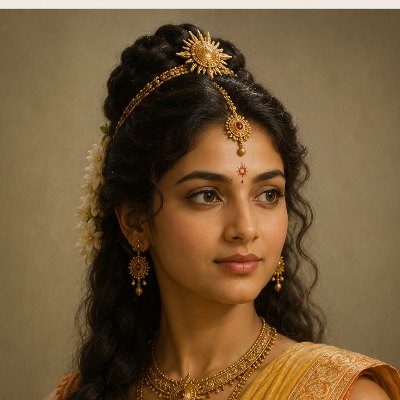
About
Bhadravati — Daughter of Surya in the Padmashali Community Tradition; and the Distinct Canonical Figure of Vishti-Bhadra
Bhadravati · Bhadravathi Devi · Vishti · Bhadra · Bhadra Vishti
This profile addresses two distinct figures who share a partial name and a common father — Surya, the sun god — but who belong to entirely different bodies of textual tradition. The first is Bhadravati, the daughter of Surya who appears in the Padmashali weaving community's caste-specific narrative tradition as the wife of Bhavana Rishi and the co-progenitor of the 101 founding clans of the Padmashali community. The second is Vishti, also called Bhadra or Bhadra Vishti, who is a genuine figure of the canonical Sanskrit Puranic tradition — specifically the Matsya Purana — as a daughter of Surya by his shadow-wife Chhaya, and who is closely associated with the inauspicious Vishti Karana period of the Hindu lunar calendar. These two figures are treated together here because the submitted details conflate them, but they must be clearly distinguished: Bhadravati of the Padmashali tradition does not appear in any of the eighteen Mahapuranas, while Vishti-Bhadra does. The two are not identified with each other in any primary canonical source.
✦ Part One: Vishti-Bhadra, Daughter of Surya and Chhaya — The Canonical Figure
Vishti, also known as Bhadra or Bhadra Vishti, is recorded in the Matsya Purana as a daughter of Surya — the sun god, one of the twelve Adityas and a principal deity of the Vedic and Puranic traditions — by his shadow-wife Chhaya. Chhaya was created by Surya's principal wife Sanjna — daughter of the divine architect Vishvakarma — as a substitute to remain with Surya while Sanjna herself withdrew to perform austerities in the form of a mare, unable to bear the intensity of Surya's radiance. Surya, unaware of the substitution, had children with Chhaya, among them Vishti.
✦ Lineage of Vishti-Bhadra
- Father: Surya, the sun god, son of Kashyapa and Aditi in the Puranic genealogy, and one of the twelve Adityas. He is the presiding deity of the solar sphere, patron of vision and cosmic order, and one of the most ancient deities of the Vedic tradition.
- Mother: Chhaya, meaning shadow, the substitute wife of Surya created by Sanjna. She is described in the Puranas as the shadow or earthly double of Sanjna.
- Full siblings (children of Chhaya and Surya): Shani — the deity of the planet Saturn, lord of karma and cosmic justice; Tapati — the goddess of the river Tapti, who married the king Samvarana and became the ancestress of the Kuru dynasty; and Savarni Manu — the future eighth Manu destined to preside over the next Manvantara.
- Half-siblings (children of Sanjna and Surya): Vaivasvata Manu — the seventh and current Manu, progenitor of the present human race; Yama — the god of death and cosmic justice; Yami — the goddess of the river Yamuna; the twin Ashvini Kumaras — the divine physicians of the gods; and Revanta — lord of horses. The relationship between Vishti-Bhadra and Yama is therefore that of half-siblings, not full siblings as the submitted notes state.
✦ Character and Cosmic Function of Vishti-Bhadra
The canonical tradition describes Vishti as a figure of fierce, destructive character. She is dark-complexioned, with long hair, large teeth, and a formidable appearance. From her birth she was associated with disruption — burning sacrificial grounds and obstructing auspicious ceremonies wherever she went. Surya, troubled by her temperament and unable to find her a suitable husband among the gods or the Asuras, appealed to Brahma. Brahma resolved the difficulty by assigning Vishti a specific cosmic function: she was to reside in the Vishti Karana — the seventh of the eleven Karanas of the Hindu lunar calendar, which recurs as an inauspicious period throughout each lunar month. During this period, which spans approximately half of a lunar day, she is understood to traverse the three worlds — the heavens, the earth, and the underworld — and her presence on earth is considered particularly malefic for the initiation of auspicious activities. The twelve names given to this Karana as personified by Bhadra include Dhanya, Dadhimukhi, Bhadra, Mahamari, Kharanana, Kaalratri, Maharudra, Vishti, Kulputrika, Bhairavi, Mahakali, and Asurakshayakari. Through this assignment, a fierce and unruly divine being was given a structured cosmic role within the calendar system, channelling her temperament into a function that serves to warn against inauspicious timing.
The claim in the submitted notes that Vishti-Bhadra married Kubera — the god of wealth and lord of the Yakshas — has not been found in any primary Puranic source consulted. The Matsya Purana's narrative of Vishti places her in the Vishti Karana of the calendar at Brahma's direction rather than in a marital relationship. This attribution is therefore omitted from this profile as unverified.
✦ Textual Sources for Vishti-Bhadra
The primary source for Vishti as a daughter of Surya and Chhaya is the Matsya Purana, which is the only Mahapurana to include her in its account of Chhaya's children. The Vishnu Purana, the Markandeya Purana, and the Vayu Purana record Chhaya's children as Shani, Savarni Manu, and Tapati, without naming Vishti. The Brahmanda Purana records Shani, Savarni Manu, and a daughter Tapati as Chhaya's children, again without Vishti. Her most extensive description as a mythological figure appears in the astrological and Panchanga literature — including the Muhurtha Chintamani and related classical texts of Jyotisha — where she is treated as the personification of the Vishti Karana.
✦ Part Two: Bhadravati of the Padmashali Tradition — A Community Narrative Figure
Bhadravati is a figure of the sixteenth-century Telugu caste-narrative tradition associated with the Padmashali weaving community, preserved in the Bhavana Rishi Puranam and the oral and painted scroll-performance tradition of the Kunapuli storytellers. She does not appear in any of the eighteen Mahapuranas or in the Itihasas. As established in the profile of Bhavana Rishi in this series, the texts in which she appears were composed in Telugu in the mid-sixteenth century and have no substantive textual relationship with the Sanskrit Markandeya Mahapurana, despite being called by that name within community tradition.
Within the community tradition, Bhadravati is described as a daughter of Surya and Chayadevi and the sister of Prasannavati, who also becomes a wife of Bhavana Rishi. She performs austerities at the Udayagiri mountains with the desire of marrying Bhavana Rishi. When Bhavana Rishi arrives on his quest for a tiger to satisfy Shiva's demand for a tiger skin, Bhadravati offers him a fierce tiger from her possession on the condition that he accept her in marriage. She and Bhavana ride the tiger together on the journey back, during which they confront and overcome demonic enemies. After the completion of Bhavana Rishi's mission to Shiva, he returns to Bhadravati, fulfils the marriage condition, and the union produces 101 sons — the founders of the 101 gotras of the Padmashali community. Bhadravati's role in the narrative is therefore that of the enabling figure who makes the completion of Bhavana Rishi's divine mission possible through her gift of the tiger and who becomes, through her progeny, the matriarch of the entire Padmashali lineage.
✦ The Relationship Between the Two Figures
The submitted notes propose that Bhadravati of the Padmashali tradition and Vishti-Bhadra of the Matsya Purana are the same figure appearing under different names in different textual streams — one canonical and fierce, the other community-specific and benevolent. This identification is not made in any primary Puranic source, nor in the scholarly studies of the Padmasali Purana examined for this series. The two figures share only the father Surya and a partial name. Their characters, narrative contexts, cosmic functions, and textual traditions are entirely distinct. The canonical Vishti-Bhadra is a figure of deliberate ferocity assigned to an inauspicious calendrical function; the community-traditional Bhadravati is a beneficent princess who enables the origin of weaving and the founding of a community lineage. Conflating them requires evidence that does not exist in the primary sources, and this profile does not do so.
✦ References
- Primary Sources for Vishti-Bhadra:
- Matsya Purana: The principal canonical source recording Vishti as a daughter of Surya and Chhaya; describes her dark complexion, fierce character, disruption of auspicious ceremonies, and Brahma's resolution of assigning her to the Vishti Karana of the lunar calendar.
- Vishnu Purana, Vayu Purana, Markandeya Purana, Brahmanda Purana: Record Chhaya's children as Shani, Savarni Manu, and Tapati without including Vishti; the textual variation across these Puranas on the children of Chhaya is noted here as an inconsistency.
- Muhurtha Chintamani and classical Jyotisha literature: The primary context in which Vishti-Bhadra is treated as an active figure; describes her twelve names, her movement through the three worlds, and the inauspiciousness of her terrestrial phase within the Vishti Karana.
- Primary Sources for Bhadravati (Padmashali tradition):
- Bhavana Rishi Puranam / Markandeya Puranam (Telugu, mid-16th century CE): The principal textual source for Bhadravati's narrative; records her austerities at Udayagiri, the tiger-gift bargain, the marriage to Bhavana Rishi, and the birth of 101 sons who became the founders of the Padmashali gotras.
- Bhavana Rishi Mahatmyan Patam scroll paintings (1625–c.2000): The performance tradition of the Kunapuli community; depicts Bhadravati's role in the narrative alongside Bhavana Rishi's battle with Kaluva and the journey to Shiva.
- Secondary Sources:
- Vedadhara, "Surya Bhagavan's Family": Records the canonical list of Surya's children from both Sanjna and Chhaya, including Vishti (Bhadra) as a child of Chhaya.
- Wikipedia, article on Chhaya: Summarises the variant accounts of Chhaya's children across the Vishnu, Matsya, Markandeya, and Brahmanda Puranas; notes that Vishti is recorded only in the Matsya Purana account.
- Project MUSE, "Replication and Innovation in the Folk Narratives of Telangana: Scroll Paintings of the Padmasali Purana, 1625–2000": The principal scholarly analysis of the Padmasali narrative tradition, in which Bhadravati's role is described.
- Indic-story.wixsite.com, "Bhadra: The Daughter of Suryanarayan": A summary of the Matsya Purana narrative of Vishti-Bhadra's birth, character, and Brahma's assignment of her to the Vishti Karana.