
About
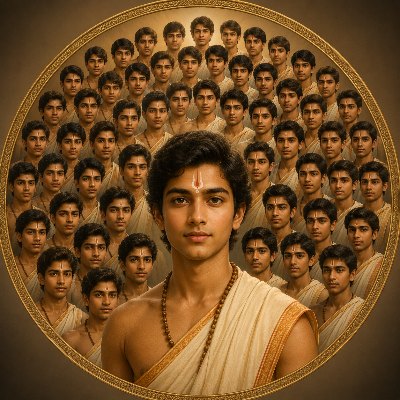
The One Hundred and One Sons of Bhavana Rishi — Founding Patriarchs of the Padmashali Community
Bhavana Rishi Santanulu · Padmashali Gotrakartalu · Padmasali Pitamahulu
The one hundred and one sons of Bhavana Rishi are the collective founding figures of the Padmashali weaving community in the tradition preserved by the sixteenth-century Telugu caste texts known as the Bhavana Rishi Puranam and the associated oral and painted scroll-performance tradition of the Kunapuli storytellers of Telangana. They are described as born to Bhavana Rishi — the divine founder of weaving who emerged from the sacrificial fire of the sage Markandeya — through his two wives Bhadravati and Prasannavati, both daughters of Surya, the sun god. In the community tradition, these 101 sons became the ancestors from whom all Padmashali families across India are descended and from whose lineages the 101 gotras of the community are derived. Of the 101, one hundred are regarded as the progenitors of the Padmashali cotton-weaving community, and the remaining one is the ancestor of the Pattusalias, the silk-weaving community.
No individual names are recorded for any of the 101 sons in any source consulted — neither in the Telugu caste texts, nor in the community publications, nor in the scholarly studies of the Padmasali Purana scroll tradition. They exist in the tradition as a named collective rather than as individually profiled figures. This profile therefore addresses them as a group, treating their collective identity, their narrative and genealogical function, the structure of the gotra tradition they are said to have founded, and the several significant inconsistencies and complications that attend the tradition's account of them.
As stated in the profiles of Bhavana Rishi, Bhadravati, and Prasannavati in this series, neither these sons nor their parents appear in any of the eighteen Mahapuranas or in the Sanskrit epic tradition. Their entire textual basis is the community-specific caste-narrative literature of the Padmashali tradition, which is not part of the canonical Hindu scriptural corpus.
✦ Parentage and Lineage
- Father: Bhavana Rishi, also known as Bhavanarayana, born from the sacrificial fire of the sage Markandeya's Homa for the welfare of all the worlds. He is the divine founder of weaving in the Padmashali community tradition, who wove the first cloth from lotus-stem fibres given by Vishnu and who obtained a tiger skin from Bhadravati to satisfy Shiva's demand.
- Mothers: Bhadravati and Prasannavati, both daughters of Surya, the sun god, and Chayadevi. Bhadravati is the narratively primary figure, who gave Bhavana Rishi a tiger in exchange for his acceptance of her in marriage; Prasannavati is her sister and co-wife. The tradition does not assign individual sons specifically to one mother or the other; all 101 are attributed jointly to both marriages.
- Paternal grandfather (in the community tradition): Markandeya, the immortal sage of the Bhrigu lineage, from whose sacrificial fire Bhavana Rishi was born. In the community tradition, Bhavana Rishi is described as an adopted son of Markandeya rather than a biological son in the usual sense, having emerged from the sage's fire ritual.
- Paternal great-grandfather (in the community tradition): Mrikandu, father of Markandeya, son of Vidhata and Niyati.
✦ The Founding Act: Weaving from the Lotus
According to the community tradition, following the marriage of Bhavana Rishi to Bhadravati and Prasannavati, the couple produced 101 sons. These sons took up the craft of weaving that their father had pioneered, using the fine fibres of the lotus stem as their primary material — inheriting directly the technique that Bhavana Rishi had received from Vishnu and first practised. By learning and practising this craft, the 101 sons became the first generation of human weavers, establishing the craft as both a sacred vocation and a hereditary occupation. In the Vaishnava strand of the tradition, Vishnu himself — pleased with the lotus cloth that Bhavana Rishi had woven — blessed the community by bestowing upon them the collective name Padmashali, meaning those who work with the lotus. This divine naming is understood within the community tradition as the moment of the community's formal inauguration as a distinct lineage.
✦ The Division: Cotton Weavers and Silk Weavers
The community tradition consistently records that of the 101 sons, 100 became the ancestors of the Padmashali cotton-weaving community and one became the ancestor of the Pattusalias — the silk-weaving community. The son who became the silk-weaver ancestor is not named in any source consulted, and no tradition specifies which of the 101 he was. This division reflects the historical reality of distinct weaving sub-communities within the broader Telugu weaver tradition and serves in the narrative to give both groups a common sacred origin while accounting for their different specialisations.
✦ The 101 Gotras and the Padmaksha Curse
The 101 sons are said to have established the 101 gotras — the patrilineal clan divisions — that structure Padmashali marriage regulations to the present day. These gotras are used to prevent marriages within the same clan, following the Brahminical pattern of gotra exogamy. The community tradition holds that from the time of these founding sons until the beginning of the Kali Yuga, the Padmashali community followed all the religious rites prescribed for Brahmins.
The community narrative records that the loss of this Brahminical status resulted from a specific transgression. A member of the community named Padmasaka refused to reveal to Ganesha — the elephant-headed son of Shiva and remover of obstacles, one of the most widely worshipped deities of the Hindu tradition — the virtues of a miraculous gem called the Padmaksha that Brahma had entrusted to the community. Angered by this refusal, Ganesha cursed the community to fall from its high status. This curse is the community tradition's explanation for why the descendants of the 101 founding sons — despite their claimed Brahminical origin — came to be classified in the social hierarchy below Brahmin rank and regarded in many contexts as a Vaishya or artisan community rather than as Brahmins.
A subsequent tradition records that a figure named Padmabavacharya, born in Srirama Agrahara, performed austerities that pleased Ganesha, partially mitigating the curse with the promise that after five thousand years of the Kali Yuga the community would regain its former status. Padmabavacharya is also credited in this tradition with reorganising the community's gotra structure and establishing four Mathas — monastic centres — with teachers for them. Some sources describe him as reorganising the gotras into 96 arranged in eight groups; others retain the number 101. This discrepancy across community sources — between 101 and 96 gotras — is unresolved within the tradition and reflects variant accounts of the later reorganisation rather than a disagreement about the original number of sons.
✦ The Gotras: Nature and Composition
A significant and honest complication in the tradition's genealogical claim is that the gotras actually observed and recorded among Padmashali families are not names derived from the 101 anonymous sons themselves. The Scribd document listing Padmashali surnames and their associated gotras records standard Brahminical rishi gotras — Vashishtha, Kashyapa, Bharadvaja, Agastya, and others — names shared with Brahmin communities across India. One community source notes that all Padmashalis carry the gotra Bhargava — from the lineage of Bhrigu — as a default lineage in addition to their individual family gotras, reflecting the community tradition's claim of descent from Bhrigu through Vidhata, Mrikandu, Markandeya, and Bhavana Rishi. Separately, the Wikipedia article on the Padmasali caste records the observation by Husan in 1920 that many illiterate members of the community were unaware that their caste had gotras at all, which indicates that the gotra system's actual penetration varied considerably across the community's geographic spread.
The relationship between the 101 founding sons and the specific gotras observed today is therefore one of symbolic ancestral correspondence rather than genealogical name-tracing: the sons are the mythological foundation of the gotra system's legitimacy, but the gotras themselves are drawn from the wider Brahminical rishi tradition rather than from the personal names of the sons.
✦ Inconsistencies and Internal Dispute
The number of sons varies across sources. Most community publications give 101; some give 100 (treating the silk-weaver ancestor as separate rather than inclusive); some give 96 as the number of gotras after Padmabavacharya's reorganisation. None of these variants provides individual names for any son. The tradition does not resolve this numerical inconsistency.
A significant faction within the Padmashali community, as documented in community blog discussions and as noted in the profile of Bhavana Rishi in this series, disputes the entire Bhavana Rishi narrative and therefore the existence of these 101 sons as legitimate ancestral figures. This faction holds that the Padmashalis are the historical descendants of Vedasiras and Pivari — whose sons are recorded in the Brahmanda Purana as the Markandeyas, masters of the Vedas — and that the Bhavana Rishi narrative, with its 101 sons, was a later constructed origin story rather than a record of actual lineage. This internal dispute is documented and is part of the honest record of this tradition.
✦ Scholarly Assessment
The Wikipedia article on the Padmasali caste notes that scholars including Evans-Pritchard assess the Padmasalis as being of Shudra origin and that the Brahminical origin claims — including the narrative of the 101 founding sons of Bhavana Rishi — represent a process of Sanskritisation through which a community of artisan weavers constructed a high-caste origin narrative to elevate their social status. This assessment is recorded here as part of the scholarly context of the tradition. The community itself vigorously disputes this characterisation, maintaining its Brahminical origin as a matter of both narrative and living practice.
✦ References
- Primary and Community Sources:
- Bhavana Rishi Puranam / Markandeya Puranam (Telugu, mid-16th century CE): The foundational caste-narrative text that introduces the 101 sons as the founding patriarchs of the Padmashali community; does not name them individually.
- Padmashali community publications (padmashali.ca, alchetron.com, ijrcs.org, markandeyatdr.blogspot.com, padmashaali.blogspot.com): Record the 101-son founding narrative, the Padmaksha curse, and the Padmabavacharya gotra reorganisation; sources vary between 101 and 96 for the gotra count after reorganisation.
- Scribd, Padmashali Caste Surnames and Gotras document: Lists over 330 Padmashali surnames and their associated gotras; demonstrates that the gotras are standard Brahminical rishi gotras rather than names derived from the individual 101 sons.
- Secondary and Scholarly Sources:
- Wikipedia, article on Padmasali (caste): Notes the 101-son narrative, the Padmaksha curse, the correspondence of the 101 sons with the 101 gotras, Husan's 1920 observation about gotra awareness, and the scholarly assessment of Shudra origin through Sanskritisation.
- Project MUSE, "Replication and Innovation in the Folk Narratives of Telangana: Scroll Paintings of the Padmasali Purana, 1625–2000": Discusses the concluding section of the Bhavana Rishi narrative in which Bhavana marries Bhadravati and the 101 sons are born; the primary scholarly source for the narrative tradition's structure.
- Scribd academic chapter, "Markandeya Puranam and Padmasali Caste" (Chapter 2): Analyses the construction of caste genealogy in the three versions of the Padmashali caste-Purana, including the role of the founding sons in establishing community legitimacy.