
About
Ekalavya — Prince of the Nishadas, Archer of Legendary Dedication
Eklavya · Naishadi · son of Devasravas · foster son of Hiranyadhanus · Nishada king
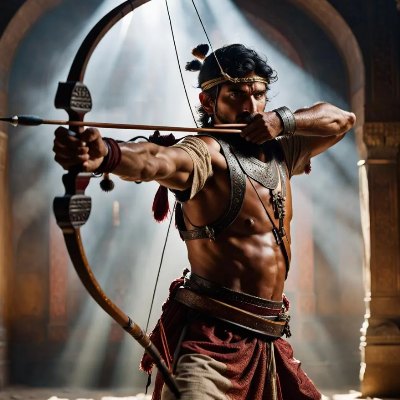
Ekalavya is one of the most memorable figures of the Mahabharata, celebrated across the tradition as an archer of supreme natural ability and as the embodiment of a disciple's unconditional devotion to his teacher. He is most widely known as the son of Hiranyadhanus, king of the Nishadas — a confederation of forest and hill tribes — in the primary narrative of the Mahabharata's Adi Parva. However, the Harivamsa, an appendix to the Mahabharata, supplies a distinct parentage, identifying his birth father as the Yadava prince Devasravas, a brother of Vasudeva, making Ekalavya a blood cousin of the deity Krishna. Abandoned in infancy and raised among the Nishadas, he presented himself to the royal preceptor Dronacharya seeking instruction in archery, was refused formal discipleship, and then taught himself through devoted practice before a clay image of Drona. When Drona subsequently demanded his right thumb as a teacher's fee, Ekalavya gave it without hesitation. His later career brought him into the orbit of the Magadha king Jarasandha, in whose service he acted, and he was ultimately killed by Krishna in battle. Ekalavya appears across the Mahabharata, the Harivamsa, the Bhagavata Purana, and the Vayu Purana, and has become in modern times a powerful symbol of marginalized communities' aspirations and the injustices they face.
✦ The Name
The name Ekalavya is a Sanskrit compound. One interpretation derives it from eka, meaning one or single, and lavya, connected to cutting or striking, yielding the sense of "one who can strike with a single (arrow)" — a name that directly evokes his unparalleled precision as an archer. The epithet Naishadi, meaning one belonging to or raised among the Nishadas, is applied to him in the Harivamsa specifically to distinguish his social upbringing from his birth lineage. The Harivamsa's use of this epithet is significant: it acknowledges that though he was Yadava by blood, he was Nishada by formation and identity.
✦ Lineage
- Birth father (Harivamsa account): Devasravas — a Yadava prince, son of Shurasena and full brother of Vasudeva, the father of Krishna. The Harivamsa, at chapter 34, verse 33 of the Harivamsa Parva, identifies Devasravas as Ekalavya's biological father, stating that the child was raised by Nishadas and therefore called Naishadi.
- Birth mother (Harivamsa and secondary accounts): Kamsavati — named in several secondary accounts as the wife of Devasravas and the mother of Ekalavya. This identification requires a textual caveat: the Bhagavata Purana (9.24.41) records that Devasrava married Kamsavati and by her begot sons named Suvira and Isuman, with no mention of Ekalavya. The relationship between these two sets of sons in the two texts is irreconcilable on the basis of available sources and constitutes a genuine textual inconsistency; see the section on variants below.
- Adoptive father: Hiranyadhanus — king of the Nishadas, the primary father figure in the Mahabharata's own narrative. The Adi Parva consistently introduces Ekalavya as the son of Hiranyadhanus, and it is as a Nishada prince that Ekalavya presents himself to Dronacharya. Hiranyadhanus served as a military commander under the Magadha king Jarasandha.
- Paternal grandfather (Harivamsa account): Shurasena — king of the Surasena realm and dynastic head of the Vrishni-Yadava line; father of Vasudeva, Devasravas, Devabhaga, and several other sons and daughters.
- Paternal uncle (Harivamsa account): Vasudeva — the most prominent son of Shurasena, husband of Devaki, and father of Krishna and Balarama. If the Harivamsa account is accepted, this relationship makes Ekalavya a first cousin of Krishna, Balarama, and Subhadra on the paternal side, and also a cousin of the Pandavas through Vasudeva's sister Kunti.
- Son: Ketuman — named in sources as Ekalavya's son; he is noted as having fought on the side of the Kauravas during the Kurukshetra War.
✦ Abandonment and Adoption
The Harivamsa records that Ekalavya was born to Devasravas but was separated from his birth family as an infant and was taken in and raised by Hiranyadhanus, the Nishada king. The text does not specify the circumstances of this separation with precision. Several secondary accounts, drawing on the Harivamsa tradition, record that inauspicious omens at the time of Ekalavya's birth led his parents to abandon him in the forest, where he was found and adopted by Hiranyadhanus. This detail is not directly verifiable from the primary texts in the sources available for this profile, and should be treated as part of the explanatory tradition that grew around the Harivamsa's brief statement rather than as a discrete primary text claim. The Mahabharata's own Adi Parva makes no mention of any Yadava birth lineage, presenting Hiranyadhanus simply and without qualification as Ekalavya's father.
✦ The Refusal by Dronacharya and the Clay Statue
The central narrative of the Mahabharata's Adi Parva, in the Sambhava Parva section, records that the young Ekalavya came to Dronacharya — the royal preceptor of the Kuru princes, a Brahmin master of the science of arms employed under the patronage of Hastinapura — and sought to be accepted as a pupil in archery. Dronacharya, aware both of Ekalavya's Nishada identity and of his own prior commitment to make Arjuna the foremost archer of the age, refused to accept him as a formal student. The epic presents Drona as being conscious of the rules of his role in the Kuru establishment rather than motivated by casual contempt alone, though the text also makes plain that Ekalavya's background was the reason for the refusal.
Ekalavya did not abandon his aspiration. He retreated to the forest, fashioned a clay image of Dronacharya, installed it as his symbolic guru, and practised archery before it with total dedication, treating the effigy as the living teacher. Through this disciplined self-training — conducted as an act of devotion rather than mere self-instruction — he developed an accuracy and speed in archery that came to surpass even the Kuru princes. The Adi Parva records the episode through which this was discovered: the Pandavas and Kauravas went on a hunting excursion, accompanied by a dog. The dog wandered into the part of the forest where Ekalavya practised; it began to bark at the dark, matted figure it encountered. In an instant Ekalavya shot seven arrows into the dog's open mouth, filling it completely without injuring the animal. The dog returned to the princes, who were astonished at this feat. Searching the forest, they found Ekalavya, who identified himself as a student of Drona.
✦ The Gurudakshina — The Severing of the Thumb
Arjuna brought the discovery to Dronacharya, reminding him of the promise he had made — that no student of his would surpass Arjuna in archery. The Adi Parva records Arjuna's distress at finding a Nishada prince who appeared to have exceeded him in skill. Drona then went to Ekalavya in the forest. Ekalavya received him with reverence, prostrating himself before the clay image. Drona asked for his gurudakshina — the customary fee rendered to a teacher — naming as his price Ekalavya's right thumb. Ekalavya, without hesitation or visible grief, drew his knife and severed his own right thumb, offering it to Drona. The Mahabharata records that after this, when Ekalavya resumed shooting, the speed and lightness of his draw had diminished. The Drona Parva of the Mahabharata later has Krishna remark, in a retrospective passage, that even without his right thumb Ekalavya was a formidable warrior and archer; had he retained it, he would have been effectively invincible for any mortal opponent.
✦ Later Career — Jarasandha, the Rajasuya, and Hostility to the Yadavas
The Sabha Parva of the Mahabharata records that Ekalavya became king of the Nishadas and was among those who attended Yudhishthira's Rajasuya sacrifice as one of the foremost kings of the age. His presence at this ceremony as a peer is significant, as the Sabha Parva identifies him as one of the leading monarchs present. The same book records that Sahadeva, the youngest Pandava, defeated Ekalavya during the southern digvijaya — the campaign of conquest that preceded the Rajasuya. The Mahabharata also records that the Nishada clan under Hiranyadhanus had been longstanding allies of Jarasandha, the king of Magadha and the dominant hostile power arrayed against Krishna and the Yadavas. Ekalavya's alignment with Jarasandha placed him structurally in opposition to Krishna and the Pandavas. The Bhagavata Purana and the Udyoga Parva of the Mahabharata both record that Ekalavya was killed by Krishna in battle, though the accounts of the precise occasion differ across texts and secondary traditions.
✦ Death
The Udyoga Parva of the Mahabharata contains a retrospective passage in which Krishna states that he personally killed Ekalavya, explaining that Ekalavya — had he not been slain — would have proved an insuperable opponent due to his combination of archery skill, unfailing resolution, and full command of weapons even after losing his thumb. The Drona Parva similarly records Krishna's acknowledgement that Ekalavya was slain for strategic reasons connected with the eventual balance of forces at Kurukshetra. The Bhagavata Purana states that Ekalavya was killed by Krishna while serving the Magadha king Jarasandha. Later traditions and secondary accounts associate his death specifically with the episode surrounding the abduction and elopement of Rukmini, during which he is said to have fought alongside Jarasandha and Shishupala against Krishna. None of these accounts agree precisely on circumstance, and the primary texts do not provide a detailed narrative of the death itself beyond Krishna's retrospective statements.
✦ Textual Variants and Inconsistencies
The accounts of Ekalavya's parentage across the primary texts are directly contradictory and cannot be reconciled.
Parentage — Mahabharata account: The Adi Parva of the Mahabharata introduces Ekalavya without qualification as the son of Hiranyadhanus, king of the Nishadas. This is the account given both in the episode of Ekalavya's own direct speech — where he identifies himself as Hiranyadhanus's son — and in the epic's framing narrative. The Mahabharata makes no mention of a Yadava birth father.
Parentage — Harivamsa account: The Harivamsa, in the Harivamsa Parva chapter 34 verse 33, gives a different account, stating that Ekalavya was the son of Devasravas — the Yadava prince, son of Shurasena, and brother of Vasudeva — who was brought up among the Nishadas and therefore called Naishadi. The Vayu Purana and Brahma Purana are also cited in secondary scholarship as supporting this variant parentage. Under this account, Hiranyadhanus is the adoptive father rather than the biological one.
A further complication: The Bhagavata Purana (9.24.41) records that Devasrava married Kamsavati and had two sons by her — Suvira and Isuman — with no mention of Ekalavya. This creates a three-way inconsistency: the Mahabharata gives Hiranyadhanus as Ekalavya's father; the Harivamsa gives Devasravas; and the Bhagavata Purana, while mentioning Devasrava and Kamsavati, assigns them entirely different sons. No harmonisation of these three accounts is possible on textual grounds alone.
The Adi Parva's cosmological framing: The Sambhava Parva section of the Adi Parva (chapter 67) lists Ekalavya among the kings born on earth as partial embodiments of the Asura class called Krodhavasa, the tribe of wrath-born beings. This cosmological framing — common in the Adi Parva for many major figures of the epic — coexists uneasily with both the Hiranyadhanus and the Devasravas parentage traditions, neither of which engages with the Krodhavasa identification.
✦ Connection to the Wider Genealogy
Under the Mahabharata's own account, Ekalavya belongs to the Nishada royal lineage through Hiranyadhanus and has no genealogical connection to the Yadava clan. Under the Harivamsa account, Ekalavya is a grandson of Shurasena, the Yadava king whose sons included Vasudeva (father of Krishna), Devabhaga (father of Chitraketu and Brhadbala), Devasravas (birth father of Ekalavya in this tradition), and several daughters including Kunti (mother of the Pandavas) and Shrutasravas (mother of Shishupala). This would make Ekalavya a first cousin of Krishna, Balarama, and Subhadra, and equally a first cousin of the five Pandavas through Kunti. In the same Harivamsa genealogical framework, the Bhagavata Purana's sons of Devasrava — Suvira and Isuman — would be Ekalavya's brothers, though that text does not acknowledge this. His son Ketuman fought at Kurukshetra on the Kaurava side, continuing the pattern of Ekalavya's line standing in opposition to the Pandava-Krishna alliance.
✦ Theological and Cultural Significance
Within the classical tradition, Ekalavya is invoked as an exemplar of the highest form of devotion to one's guru — a devotion so complete that it required no physical instruction, only the inner concentration that a mental image of the teacher could anchor. His willingness to give his right thumb as gurudakshina, freely and without coercion in any literal sense, is held up as the standard of a disciple's surrender to his teacher's will, even when that will appears to work against the disciple's own interests and excellence. At the same time, the episode sits in obvious tension with questions of fairness: Drona had not taught Ekalavya, yet claimed a teacher's fee and in doing so deliberately diminished him to protect Arjuna's supremacy. The Mahabharata does not resolve this tension editorially and leaves both readings available in the text. In modern Indian culture and political discourse, Ekalavya has become a central symbol for Dalit and Adivasi communities, representing both the aspiration of those excluded from formal educational institutions and the structural violence embedded in traditional hierarchies.
✦ References
- Mahabharata, Adi Parva, Sambhava Parva, Section CXXXIV (chapters 131–134 in various editions) — Primary source for the narrative of Ekalavya's approach to Dronacharya, his self-training before the clay image, the dog episode, and the giving of the thumb as gurudakshina. Identifies his father as Hiranyadhanus, king of the Nishadas.
- Mahabharata, Adi Parva, Sambhava Parva, Section LXVII — The cosmological genealogy section that lists Ekalavya among the kings born of the Asura class Krodhavasa, providing a transcendent framing of his origin distinct from either the Nishada or Yadava lineage accounts.
- Mahabharata, Sabha Parva, chapters 31 and 37–44 — Records Sahadeva's defeat of Ekalavya during the southern digvijaya campaign, and Ekalavya's subsequent presence at Yudhishthira's Rajasuya sacrifice as one of the foremost kings.
- Mahabharata, Udyoga Parva, chapter 48 — Contains Krishna's retrospective statement confirming that he killed Ekalavya and explaining his reasoning in terms of the military balance required for dharma's establishment.
- Mahabharata, Drona Parva, Ghatotkacha-badha Parva, Section CLXXXI — Further retrospective reference by Krishna to Ekalavya's death and the strategic necessity behind it, noting that even without his thumb Ekalavya was a warrior of fearsome ability.
- Harivamsa, Harivamsa Parva, chapter 34, verse 33 — The key primary source for the alternative parentage: identifies Ekalavya's birth father as Devasravas, the Yadava brother of Vasudeva, and explains his Nishada identity through upbringing rather than birth, applying to him the epithet Naishadi.
- Bhagavata Purana, Canto 9, Chapter 24 — Records that Devasrava married Kamsavati and had sons Suvira and Isuman, with no mention of Ekalavya; also, in its later cantos, records that Ekalavya served Jarasandha and was killed by Krishna.
- Vayu Purana and Brahma Purana — Cited in secondary scholarship as additional sources supporting the Harivamsa tradition that assigns Yadava birth parentage to Ekalavya; consulted here through secondary reference.
- Wikipedia, "Ekalavya" — Secondary reference used to confirm the range of primary sources and to verify the Bhagavata Purana's and Vayu Purana's support for the Harivamsa parentage tradition, and for confirming Ketuman as Ekalavya's son.
- Wisdomlib.org, "Ekalavya: Significance and symbolism" — Secondary reference consolidating Puranic and epic references to Ekalavya, confirming his role as Nishada king and his death at Krishna's hands.
- Sacred-texts.com, Mahabharata, Book 1, Section LXVII and Section CXXXIV — Used to verify the K.M. Ganguli translation of the relevant passages in the Adi Parva, including the Krodhavasa list and the Dronacharya episode.