
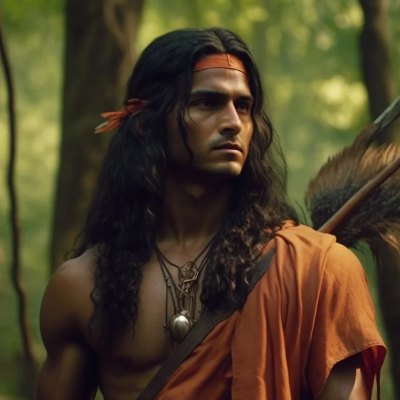
About
Ketuman — King of the Nishadas, Son of Ekalavya
Ketuman · Ketumana
Ketuman was a king of the Nishadas, a forest-dwelling tribal people of ancient India, and the son of Ekalavya — the celebrated archer of the Nishada clan who is remembered in the Mahabharata as one of the most gifted bowmen of his age. Ketuman succeeded his father as ruler of the Nishadas after Ekalavya was slain by Krishna, the Yadava prince and avatar of Vishnu, prior to the Kurukshetra War. Ketuman appears in the Mahabharata in two distinct contexts: as a warrior fighting on the Kaurava side during the eighteen-day battle of Kurukshetra, and as a Nishada leader who confronted Arjuna during the Ashvamedha Yagna conducted by King Yudhishthira after the war's conclusion. His profile is brief in the primary text, and the details given are sparse.
✦ The Name
The name Ketuman derives from the Sanskrit root ketu, meaning a banner, a sign, or a ray of light, combined with the suffix -man (or -vat in some formations), indicating one who possesses or embodies that quality. The name thus carries a connotation of one who bears a standard or signal — a fitting name for a king and warrior. No additional epithets for Ketuman are recorded in the available primary sources.
✦ Lineage
- Father: Ekalavya — prince and later king of the Nishadas, renowned in the Mahabharata as a self-taught archer of extraordinary skill who offered his right thumb as gurudakshina to Drona, the preceptor of the Pandavas and Kauravas, and who was subsequently slain by Krishna during the events leading up to the Kurukshetra War.
- Patrimony: The Nishada kingdom — a tribal forest realm whose precise geographical location is not fixed consistently across sources, but which is associated in the epics with the forested regions of the Indian subcontinent inhabited by the Nishada people.
No mother, siblings, spouse, or children of Ketuman are named in the primary sources consulted.
✦ Role in the Kurukshetra War
Ketuman fought on the side of the Kauravas — the faction led by Duryodhana, the eldest son of the blind king Dhritarashtra — during the eighteen-day war at Kurukshetra. This allegiance placed him in opposition to the Pandavas, the five sons of Pandu, who were the rightful claimants to the Kuru throne. The reason for the Nishada kingdom's alignment with the Kauravas is not elaborated upon in the surviving text; it may reflect political ties or enmity toward the Pandavas and their ally Krishna, who had killed Ekalavya. During the course of the battle, Ketuman was slain by Bhima, the second of the five Pandava brothers, who was celebrated throughout the epic as a warrior of immense physical strength. The specific circumstances and day of this encounter are not detailed in the sources available.
✦ Confrontation with Arjuna in the Ashvamedha Parva
Following the conclusion of the Kurukshetra War and the establishment of Yudhishthira — the eldest Pandava — as emperor, a great Ashvamedha Yagna (horse sacrifice) was conducted to consecrate his sovereignty over the earth. In accordance with the ritual, a consecrated horse was released to wander freely, followed by an armed escort. Any king or chieftain who challenged the horse's passage was required either to submit to Yudhishthira's overlordship or to fight the escort.
In the Ashvamedha Parva — the fourteenth book of the Mahabharata — the wandering horse entered the territory of the Nishadas, where the people, described as the followers or subjects of Ekalavya's son, attempted to seize it. This act of interception amounted to a direct challenge to Yudhishthira's imperial claim. Arjuna, the third Pandava and the foremost archer of his age, who was leading the escort, engaged the Nishadas in battle. After a fierce contest, Arjuna overcame them. The Nishadas subsequently acknowledged Yudhishthira's supremacy and rendered tribute.
It should be noted that the Ashvamedha Parva account refers to the Nishada forces in terms of their identity as Ekalavya's son's followers rather than naming Ketuman explicitly in all manuscript traditions. The identification of this leader as Ketuman rests on the narrative logic that he was the reigning Nishada king at that time, having inherited the throne after his father's death, though readers should be aware that the name Ketuman may not appear in every version of this passage.
✦ Textual Variants and Inconsistencies
The primary textual record for Ketuman is thin, and there are points of uncertainty worth noting. The Mahabharata's account of Ekalavya's lineage is itself not uniform across all recensions; some versions focus exclusively on Ekalavya without naming his descendants. The identification of the Nishada king who intercepted the Ashvamedha horse as Ketuman, son of Ekalavya, is consistent with the narrative continuity of the epic but is not always made explicit by name in every manuscript tradition. Additionally, the alignment of Ketuman with the Kauravas — despite the fact that it was Krishna, ally of the Pandavas, who killed his father — presents a straightforward logic of enmity, but the text does not explicitly state this as Ketuman's motivation.
✦ Connection to the Wider Genealogy
Ketuman belongs to the Nishada lineage, a line distinct from the principal Kshatriya dynasties of the Mahabharata such as the Kuru, Panchala, or Yadava clans. His grandfather's identity and the broader ancestral line of Ekalavya are themselves subjects of some variation in the text; Ekalavya is described in some accounts as the son of Hiranyadhanus, a Nishada chieftain. Through his father, Ketuman is thus connected to one of the most poignant sub-narratives of the Mahabharata — the story of a supremely gifted archer who was denied formal instruction by Drona on grounds of caste and birth, trained alone in the forest, and ultimately gave up his thumb at Drona's demand. Ketuman's own story — inheriting a diminished kingdom, fighting on the losing side at Kurukshetra, and eventually submitting to Pandava imperial authority during the Ashvamedha — traces the arc of his father's legacy to its conclusion within the epic's world.
✦ References
- Primary Sources
- Mahabharata, Adi Parva: Contains the primary account of Ekalavya, his training, his encounter with Drona, and the thumb sacrifice — establishing the paternal background from which Ketuman's identity derives.
- Mahabharata, Drona Parva: Contains references to Ekalavya's participation and death in the war, providing the context for Ketuman's succession as Nishada king.
- Mahabharata, Ashvamedha Parva (Book XIV): Records the episode in which the Nishadas under Ekalavya's son intercept the sacrificial horse of Yudhishthira and are subsequently defeated by Arjuna.
- Mahabharata, Karna Parva / Shalya Parva (Kurukshetra War books): General context for the Kaurava alliance forces among whom Ketuman is numbered, and for Bhima's role as the slayer of Kaurava-side kings during the battle.
- Secondary Sources
- Vettam Mani, Puranic Encyclopaedia (1975): Provides a consolidated reference entry on Ekalavya and notes on his lineage and descendants within the Mahabharata tradition.
- Alf Hiltebeitel, The Ritual of Battle: Krishna in the Mahabharata (1976): Provides scholarly context for Krishna's killing of Ekalavya and the political alignments of tribal kingdoms in the epic.