
About
Ekadashi — Divine Emanation of Vishnu and Slayer of the Demon Mura
Ekadashi Devi · Utpanna Ekadashi · Bhagavati Ekadashi · Harishakti
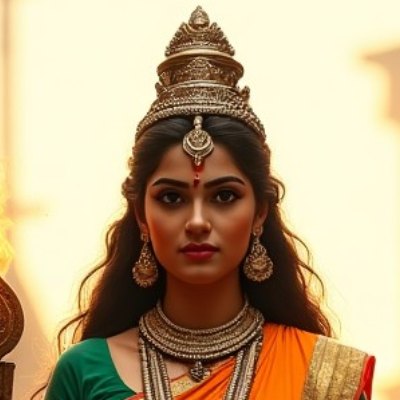
Ekadashi is a divine feminine being who originated directly from the body of Vishnu, the preserver among the Hindu triad of principal deities, during an era-defining battle in the Satya Yuga, the first of the four cosmic ages. She is not born of any parents in the usual sense but is an emanation of Vishnu's own divine radiance and inner power, which took a luminous, warrior form at the moment of crisis. Her sole primary narrative is found in the Padma Purana, Uttara Khanda, Chapter 38, one of the eighteen Mahapuranas, where her origin and her slaying of the demon Mura are described in full. She is the presiding deity of the Ekadashi observance — the fast kept on the eleventh lunar day of each fortnight — and her narrative constitutes the Puranic foundation for that widespread Vaishnava vow.
✦ The Name
The name Ekadashi is a Sanskrit ordinal formed from eka (one) and dasha (ten), meaning "the eleventh." It refers to the eleventh tithi (lunar day) of each fortnight in the Hindu calendar, of which there are twenty-four in a solar year. In the context of this deity, the name was conferred upon her by Vishnu himself at the conclusion of the episode narrated in the Padma Purana, because she arose on the eleventh day of the waning fortnight of the month of Margashirsha. The specific occasion of her first appearance is commemorated as Utpanna Ekadashi — "the Ekadashi that came into being" — with utpanna deriving from the Sanskrit root meaning "born" or "arisen." The epithet Bhagavati Ekadashi identifies her as a goddess endowed with divine majesty. The name Harishakti, meaning "the power of Hari" (Hari being a name of Vishnu), is used in some traditions to describe her essential nature as an energy-form of Vishnu rather than an independent deity.
✦ Lineage
- Origin: Ekadashi has no father or mother in the conventional sense. She emerged from the body of Vishnu — the supreme preserver deity and lord of Vaikuntha, husband of Lakshmi — as a luminous, fully armed feminine form constituted of his own divine energy.
- Nature of emanation: The Padma Purana describes her as the tejas (effulgence or inner radiance) of Vishnu made manifest, in some retellings further specified as his yoga maya — his creative and concealing power — taking a warrior form instinctively, without prior volition, at the moment of divine need.
No spouse, children, or further genealogical relationships are recorded for Ekadashi Devi in any primary source.
✦ The Rise of Mura and the War in Heaven
The narrative framework of the Padma Purana's thirty-eighth chapter of the Uttara Khanda is a dialogue: the god Shiva recounts to the sage Narada what Vishnu once told him concerning the origin of the Ekadashi vow. The account is thus framed as doubly reported speech, embedded within a broader instructional context about the meritorious Dvadashi and Ekadashi observances.
In the Satya Yuga, a demon named Mura arose whose ferocity exceeded that of his forebears. According to the Padma Purana (Uttara Khanda, Ch. 38), Mura was born in the lineage of Brahma, the creator deity among the Hindu triad, and was the son of a demon named Talajangha (also rendered Talajangh in some recensions). He established his dominion in the city of Chandravati, which served as his capital. Mura's power was extraordinary: he conquered all the principal devas in succession, seizing heaven itself. Indra, the king of the gods; Agni, the fire deity; Yama, the lord of death; Varuna, the deity of waters; and Vayu, the wind deity were all displaced from their celestial stations and rendered powerless. The devas, homeless and dispossessed, wandered in distress.
In their desperation the devas first approached Shiva, the destroyer among the three principal deities, at his abode. Shiva, recognising the situation as beyond his immediate intervention, directed them to seek refuge with Vishnu at Shvetadvipa, his luminous island-abode on the cosmic ocean of milk. Indra and the assembled gods presented their case to Vishnu, who agreed to confront Mura and moved with the devas against the demon's capital of Chandravati.
✦ The Battle Between Vishnu and Mura
The battle that ensued between Vishnu and Mura was of extraordinary duration. The Padma Purana states it lasted one thousand divine years — a span of cosmic time of a magnitude that underscores the exceptional power of the demon. Vishnu deployed his divine weapons, and while Mura's vast army was destroyed by them, Mura himself proved immune to any weapon Vishnu brought to bear. Neither the Sudarshana Chakra (Vishnu's discus) nor the Kaumodaki (his mace) could overcome the demon. As no conventional weapon prevailed, the conflict passed from armed engagement into direct physical contest — a form of wrestling known as malla yuddha.
After this protracted struggle, Vishnu — whose physical form, though divine, is described in the text as weary — withdrew from the battle. He retreated to Badarikashrama, the sacred hermitage in the Himalayas, and entered a deep cave there to rest. This cave is identified in later pilgrimage traditions as the Ekadashi Gufa (Ekadashi Cave) near present-day Badrinath. Vishnu fell into a profound sleep within the cave.
✦ The Birth of Ekadashi and the Slaying of Mura
Mura, pursuing Vishnu to the cave at Badarikashrama, found the god asleep and saw what he judged to be a supreme opportunity. He advanced to kill the defenceless deity. At this critical moment, before Mura could strike, a brilliant and fully formed feminine being emerged spontaneously from Vishnu's body. The Padma Purana describes her as radiant, armed, and possessed of extraordinary power — constituted from Vishnu's own divine luminosity.
This feminine being confronted Mura directly. She first destroyed his chariot, then systematically annihilated his remaining forces. Finally she slew Mura himself. The precise manner of the killing is described in popular retellings informed by the Purana as involving the demon being felled, with the maiden placing her foot upon his chest and severing his head, though the textual precision of this detail varies across recensions and popular summaries.
When Vishnu awoke he found the demon slain and the radiant maiden standing before him. Unaware of the source of the deed, he asked her who she was. She identified herself as his own effulgence — the luminosity of his being, emerged to protect him. Vishnu, greatly pleased, invited her to ask for a boon. Her request was not for power, wealth, or sovereignty, but for a spiritual boon on behalf of others: she asked that any person who fasted on the day of her arising should be freed from even the gravest sins and be granted the four aims of human life — dharma (righteous conduct), artha (prosperity), kama (desire), and moksha (liberation). Vishnu granted this in full, and further declared that she would henceforth be known as Ekadashi, because she had manifested on the eleventh day of the Krishna Paksha (waning fortnight) of the month of Margashirsha. This day became the festival of Utpanna Ekadashi, commemorating her birth.
✦ Textual Variants and Inconsistencies
Two variant traditions exist regarding the identity of Mura's father, which bear directly on the genealogical context of this narrative. The Padma Purana, Uttara Khanda, Chapter 38 names his father as Talajangha, described as a demon born in the lineage of Brahma. A separate version reported in some secondary and devotional sources — citing what appears to be a different recension or a variant retelling — names Mura's father as Nadijangha, also of Brahmic lineage. These two names are not reconciled within the available translations of the Padma Purana and represent a genuine intra-textual or inter-recension inconsistency.
There is also a discrepancy in the duration of the battle between Vishnu and Mura. The Padma Purana gives the figure as one thousand divine years. Several popular and devotional retellings, including those drawing on the same chapter, give the figure as ten thousand years. This appears to be an error in transmission or popularisation rather than a variant within the Purana text itself, but it is sufficiently widespread to note.
Some secondary sources cite the Skanda Purana as an additional source for Ekadashi Devi's narrative. However, a specific chapter or verse reference from the Skanda Purana that independently narrates the Mura episode has not been confirmed in the primary material consulted for this profile. Claims of Skanda Purana authorship for this story should be treated with caution until a precise verse reference is established.
A separate tradition, not part of the Padma Purana account, identifies Mura as a general in the army of Narakasura, the demon king of Pragjyotisha, who was slain by Krishna and Satyabhama in the Bhagavata Purana and the Harivamsa. In that entirely separate episode, a demon named Mura is among those killed by Krishna. These are two distinct narrative contexts involving a demon of the same name, and there is no textual basis in the Padma Purana for equating the Mura of the Ekadashi story with the Mura of the Narakasura cycle.
✦ Theological and Philosophical Significance
Ekadashi Devi's origin as an emanation of Vishnu's own body places her within a particular theology of divine power. She is not a goddess independent of Vishnu, nor is she his consort; she is constituted entirely of his own energy, a spontaneous protective manifestation arising from within him at the moment of existential threat. This positions her theologically as a shakti — a power-form — of Vishnu, analogous in structure (though not in narrative context) to the various shaktis described in Shakta and Tantric literature as inseparable from their corresponding male deities.
Her boon, freely chosen when any wish was available to her, is significant for understanding her theological role. She is not a warrior goddess seeking honour or dominion, but an intercessor whose entire purpose redirects toward the benefit of human beings engaged in devotional practice. The Ekadashi fast, which abstains from grains and certain other foods on the eleventh lunar day of each fortnight, is understood in Vaishnava tradition as the direct practical consequence of this boon, making Ekadashi Devi the presiding deity and spiritual authority behind one of the most widely observed fasting observances in Vaishnavism.
✦ Connection to the Wider Genealogy
Ekadashi Devi has no genealogical descent in the conventional sense, as she has no parents, no lineage, and no progeny recorded in any primary source. Her sole defined relationship is her origin within the body of Vishnu, the preserver deity, son of Brahma in some cosmological accounts, husband of Lakshmi (the goddess of fortune), and lord of the cosmic ocean of milk and of Vaikuntha, his transcendent abode. The demon she slays, Mura, is recorded in the Padma Purana as the son of Talajangha, himself a demon born within the lineage of Brahma, the creator deity of the Hindu triad. Through her function as the presiding deity of the Ekadashi vrata, Ekadashi Devi is genealogically connected — not by blood but by theological definition — to every aspect of the Vaishnava observance calendar and to the broader tradition of Vishnu worship across the eighteen Mahapuranas.
✦ References
- Primary Sources
- Padma Purana, Uttara Khanda, Chapter 38 — The sole Mahapurana chapter that gives the full foundational narrative of Ekadashi Devi's origin, her emergence from Vishnu's body, the circumstances and conduct of the battle with Mura, her slaying of the demon, her request for a boon on behalf of devotees, and Vishnu's conferral of her name. Trans. N. A. Deshpande (Motilal Banarsidass, 1951, Ancient Indian Tradition and Mythology series, vols. 39–48).
- Modern and Secondary Sources
- Wisdomlib.org, "The Origin of Ekadashi and the Killing of Demon Mura," Chapter 38 of the Padma Purana (Uttara Khanda), accessed 2026 — Provides the English translation of the primary chapter with Sanskrit apparatus notes and cross-references.
- Drikpanchang.com, "Utpanna Ekadashi Vrat Katha" — A devotional retelling of the Padma Purana narrative that preserves several narrative details including the cave location and the manner of Mura's death; used here to cross-check popular transmission of the story against the Purana text.
- Tirthayatra.org, "Ekadashi Gufa" — Contains a retelling that gives Mura's father as Nadijangha rather than Talajangha, documenting the variant naming tradition noted in the textual inconsistencies section above.
- Achalkrishnadas.com, "Utpanna Ekadashi: Significance and Observance" — Secondary summary referencing both the Padma Purana and Skanda Purana as sources; the Skanda Purana reference is noted but no specific chapter is confirmed.