
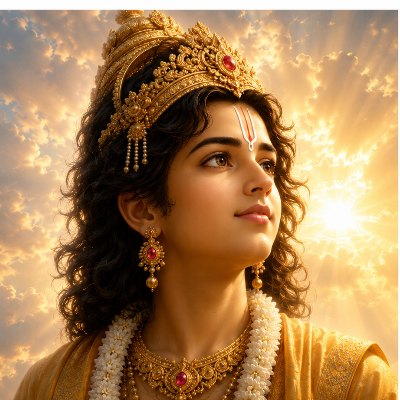
About
Utsaha — Divine Son of Vishnu and Lakshmi
Utsaha · Unmada (Garuda Purana variant) · Narayanatmaja
Utsaha is a divine being recorded in the genealogical sections of the Brahmanda Purana and the Vayu Purana as the second of two sons born to Vishnu — the preserver deity of the Hindu triad, also known as Narayana and Hari — and his consort Lakshmi, the goddess of fortune and prosperity, also called Sri. His brother in these texts is named Bala. The Garuda Purana, however, records the same genealogical position as belonging to a son named Unmada rather than Utsaha, constituting a significant inter-Puranic variant. Like his brother Bala, Utsaha appears solely in genealogical passages with no independent narrative, episode, or further lineage assigned to him in any primary source consulted.
✦ The Name
The name Utsaha derives from the Sanskrit prefix ut- (upward, forth) and the root sah (to endure, to prevail), giving the compound meaning of vigorous effort, enthusiasm, energy directed toward achievement, or the zeal that drives righteous action forward. In the dharmic literature, utsaha is frequently cited as one of the essential qualities required for the accomplishment of any great endeavour. Positioned alongside his brother Bala (strength), the pairing of the two names in the Brahmanda and Vayu Puranas suggests a complementary pair of divine principles: the physical power to act, and the energetic will that drives that action. The name Unmada, by which the Garuda Purana designates the same figure, carries an entirely different semantic range: it means intoxication, ecstasy, or a state of divine frenzy — sometimes used in a positive sense to denote the rapturous absorption of devotion, and sometimes in a neutral or negative sense to denote loss of rational control. That the Garuda Purana should use this word instead of Utsaha represents a substantive divergence, not merely a phonetic variant.
✦ Lineage
- Father: Vishnu (also known as Narayana, Hari, Janardana) — the preserver among the Hindu triad of principal deities, husband of Lakshmi, lord of Vaikuntha, whose cosmic function is the maintenance and protection of the universe across each cycle of creation.
- Mother: Lakshmi (also known as Sri, Bhargavi) — the goddess of wealth, fortune, and auspiciousness, consort of Vishnu. In the genealogical tradition of the Brahmanda, Vayu, and Garuda Puranas, Lakshmi is identified as the daughter of the sage Bhrigu — one of the seven great sages and a Prajapati — and his wife Khyati.
- Maternal grandparents: Bhrigu — the sage and Prajapati, son of Brahma the creator deity — and Khyati, his wife.
- Brother: Bala — the elder or co-born son of Vishnu and Lakshmi, named alongside Utsaha in the Brahmanda Purana and the Vayu Purana; named alongside Unmada in the Garuda Purana, where the second son's name differs from the Brahmanda-Vayu tradition.
- Maternal uncles: Dhata and Vidhata — twin divine brothers, also sons of Bhrigu and Khyati, who preside over the bestowal of good and ill fortune across the manvantaras.
- Maternal aunts by marriage: Ayati and Niyati — daughters of Svayambhuva Manu, the first Manu and progenitor of humanity, who became the wives of Dhata and Vidhata respectively.
✦ Textual Record and its Limits
Utsaha's presence in the primary sources is confined to a single genealogical statement preserved in two closely related texts. The Brahmanda Purana, Chapter 29 verses 1–3, records in a cosmogonical genealogical sequence that after Lakshmi obtained Narayana as her husband, she gave birth to two sons, Bala and Utsaha. The Vayu Purana preserves the same pairing. Both texts embed this statement within a broader account of the lineage of Bhrigu — the sage from whom Lakshmi descends in this tradition — covering the births of Dhata, Vidhata, their marriages to Ayati and Niyati, and the subsequent generations down to the sage Markandeya. Utsaha is named once and not mentioned again. No narrative role, cosmic function, iconographic description, or place of worship is assigned to him in any of these passages.
Some secondary sources characterise Utsaha as a deity who embodies the principle of vigorous cosmic effort and who, together with Bala, plays a role in sustaining the balance of creation through strength and enthusiasm. These characterisations are theological elaborations derived from the meaning of the names rather than from explicit statements in the primary texts. They are noted here but are not attributed to any specific verse or chapter of a Mahapurana.
✦ Textual Variants and Inconsistencies
The most significant textual issue surrounding Utsaha is his identification with or distinction from the figure named Unmada in the Garuda Purana. The Garuda Purana (1.5.9), in a genealogical passage parallel in structure to that of the Brahmanda and Vayu Puranas, names the two sons of Hari and Shri as Bala and Unmada. The Sanskrit compound balonmadau used in that verse unambiguously pairs Bala with Unmada. Whether Unmada and Utsaha represent the same divine being known by two different names across Puranic traditions, or whether they are distinct figures that later tradition has conflated into the same genealogical slot, cannot be determined from the available primary evidence. No text explicitly equates the two names or explains the discrepancy.
The divergence between the Brahmanda-Vayu tradition (Bala and Utsaha) and the Garuda tradition (Bala and Unmada) is the principal unresolved variant in the record of both Bala and Utsaha. It is worth noting that the Brahmanda Purana and the Vayu Purana are historically closely related texts — they share significant material and in medieval Indian literature were sometimes treated as variants of a single composition — while the Garuda Purana belongs to a distinct textual lineage. The divergence may therefore reflect the separate Puranic school traditions rather than a simple error of transmission.
✦ Connection to the Wider Genealogy
Through his father Vishnu, Utsaha belongs to the supreme tier of the Vaishnava cosmic hierarchy. Through his mother Lakshmi, he is a grandson of the sage Bhrigu — one of the Saptarshis (seven great sages) and a Prajapati, himself the son of Brahma the creator deity — placing Utsaha within the Bhrigu lineage that runs through much of the cosmogonical genealogy of the Puranas. His maternal uncles Dhata and Vidhata, who govern fate across the cosmic time-cycles, married Ayati and Niyati, daughters of Svayambhuva Manu. From these unions came Prana and Mrikandu; Mrikandu fathered the sage Markandeya, celebrated across multiple Puranas as the devotee who transcended death through his devotion to Shiva. Utsaha's fraternal pairing with Bala — strength and enthusiasm, or strength and divine ecstasy in the Garuda Purana variant — reflects a pattern in Puranic cosmogony whereby paired divine offspring embody complementary aspects of a single cosmic principle.
✦ References
- Primary Sources
- Brahmanda Purana, Chapter 29, verses 1–3 — The principal source naming Utsaha alongside Bala as the two sons of Narayana and Lakshmi, within a genealogical passage tracing the lineage of Bhrigu and establishing the wider cosmogonical family.
- Vayu Purana — Corroborates the Brahmanda Purana's pairing of Bala and Utsaha as the sons of Vishnu and Lakshmi; the Brahmanda and Vayu Puranas are closely related in their genealogical content and together form the primary textual basis for the Utsaha tradition.
- Garuda Purana, Canto 1, Chapter 5, verse 9 — The parallel genealogical passage naming the sons of Hari and Shri as Bala and Unmada rather than Bala and Utsaha, constituting the principal inter-Puranic variant relevant to this profile.
- Modern and Secondary Sources
- Hinduism Stack Exchange, "Who are the children of Vishnu and Lakshmi?" — Provides the transliterated Sanskrit verse from the Brahmanda Purana (Ch. 29) and a Vayu Purana excerpt, both naming Bala and Utsaha; used to establish the textual basis and chapter reference.
- Shrutaveda.wordpress.com, "Shri Garuda Puranam — 5" — Provides the transliterated Sanskrit and translation of Garuda Purana 1.5.9, documenting the Bala-Unmada pairing against which the Brahmanda-Vayu Utsaha tradition is assessed.
- Mystreal.com, "Goddess Lakshmi: The Divine Source of Wealth, Fortune and Prosperity" — Secondary source attributing to the Vayu Purana a theological characterisation of Bala and Utsaha as cosmic upholders of dharma and prosperity; noted here as a secondary interpretation derived from the names rather than from a specific verse.