
About
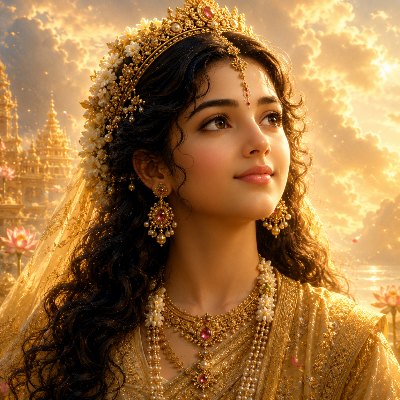
Amritavalli — Celestial Daughter of Vishnu and Lakshmi, Previous Birth of Devasena
Amritavalli · Amirtavalli · Narayanatmaja
Amritavalli is a divine goddess recognised in South Indian Hindu tradition, particularly within the Tamil recensions of the Skanda Purana and the Kanda Puranam — the fourteenth-century Tamil adaptation of the Skanda Purana composed by the poet Kacciyappar — as a daughter of Vishnu, the preserver deity, and his consort Lakshmi, the goddess of fortune. Together with her sister Sundaravalli, she performed intense austerities to win the war god Murugan (also known as Kartikeya, Subramanya, and Skanda — the son of Shiva and Parvati) as her husband. Murugan granted her a boon that she would be reborn in human form and wed him after his triumph over the demon Surapadman. In her subsequent earthly birth she was known as Devasena, or Devayanai, and married Murugan at Tirupparankundram. She is venerated in Murugan temples throughout Tamil Nadu principally as his consort rather than as an independently worshipped deity. This tradition of her origin as the daughter of Vishnu is specific to the Tamil scriptural tradition; she is not attested in this form in the standard Sanskrit Mahapuranas.
✦ The Name
The name Amritavalli is a Sanskrit compound of two elements: amrita (immortal nectar, the drink of the gods, and by extension anything that confers deathlessness or supreme bliss) and valli (creeper, a climbing plant — used in South Indian tradition both in its literal botanical sense and as a poetic term for a beautiful, graceful woman). The name therefore evokes the image of a divine creeper that is itself the essence of immortal sweetness. The Tamil form of the name, Amirtavalli, is phonologically equivalent. The epithet Narayanatmaja — meaning "born of Narayana," Narayana being a major name of Vishnu — is applied to her in the context of her divine parentage.
✦ Lineage
- Father: Vishnu (also Narayana, Hari) — the preserver deity of the Hindu triad, lord of Vaikuntha, husband of Lakshmi.
- Mother: Lakshmi (also Sri) — the goddess of wealth and auspiciousness, consort of Vishnu.
- Sister: Sundaravalli — the younger or co-born sister of Amritavalli, also a daughter of Vishnu and Lakshmi, who was reborn as the goddess Valli and married Murugan as his second consort.
- Husband (in reincarnation): Murugan (Kartikeya, Subramanya, Skanda) — the war deity and commander of the divine army, son of Shiva the destroyer and his consort Parvati; she married him as Devasena after his victory over Surapadman.
- Sister-wife: Valli — the incarnation of Sundaravalli, who married Murugan as his second consort; the two goddesses are venerated together flanking Murugan in his principal temples.
✦ Birth from Vishnu
The Tamil Skanda Purana tradition and the Kanda Puranam record that Amritavalli and her sister Sundaravalli were born from the body of Vishnu. Two variants of the manner of their birth circulate within this tradition and are not reconciled in the available sources. The first and more widely attested version holds that they arose from tears of divine joy shed by Vishnu during his incarnation as the dwarf-avatar Vamana, who then grew into the cosmic form of Trivikrama to measure the three worlds in three strides. The second version holds that they emerged from the light of one of Vishnu's eyes during his cosmic or meditative state. A third account found in secondary and devotional sources attributes their birth to Vishnu weeping with rapture while contemplating Shiva's Ananda Tandava (the cosmic dance of bliss); this version cannot be traced to a specific named chapter of a primary text and is noted here as a devotional elaboration.
✦ Penance and the Boon of Murugan
The Kanda Puranam and Tamil Skanda Purana manuscripts record that both sisters, upon meeting Murugan, were filled with intense devotion and desire to become his consorts. They sought their father Vishnu's counsel, and Vishnu directed them to undertake severe austerities at the sacred pond of Saravana Poigai — the same celestial pond associated with Murugan's birth — in order to secure their wish. They performed this penance with great fervour. Murugan appeared before them and acknowledged their devotion, but told them that he was then engaged in the cosmic battle against the demon Surapadman and could not take them as wives in their present celestial forms. He promised that he would wed them after they were reborn in human form and after his victory over Surapadman was complete.
Following this promise, Amritavalli, taking the form of a female child, went to Mount Meru and presented herself to Indra, king of the devas, declaring herself the daughter of Mahavishnu and requesting his guardianship. Indra received her with great joy and entrusted his white celestial elephant Airavata to raise her. Because she was nurtured by the elephant — rendered as yanai in Tamil — she came to be known as Deivanai (divine female) or Devayanai, which is rendered in Sanskrit as Devasena.
✦ Reincarnation as Devasena and Marriage to Murugan
As Devasena — the earthly and celestial form that Amritavalli assumed — she lived in the realm of Indra as his adopted daughter. After Murugan destroyed Surapadman and his demon forces, a grateful Indra offered Devasena to Murugan in marriage. The sacred wedding took place at Tirupparankundram, near Madurai in Tamil Nadu, which is regarded as one of the six principal abodes of Murugan (the Arupadaiveedu). This marriage is celebrated in the Tirupparankundram temple complex, which is held to be its site. After the marriage, the couple settled at the hills of Thiruttani, where the Thiruthani Murugan Temple stands. In the temples of Murugan throughout Tamil Nadu, Devasena stands on his left and Valli on his right.
✦ Textual Variants and Inconsistencies
The identity of Amritavalli as a daughter of Vishnu and previous birth of Devasena is specific to the Tamil scriptural tradition — principally the Tamil manuscripts of the Skanda Purana and the Kanda Puranam — and is explicitly described in those sources as an interpolation or regional elaboration not found in the standard Sanskrit recensions of the Skanda Purana. This is an important textual boundary: the tradition is well-attested and textually grounded, but its scope is Tamil and South Indian, not pan-Puranic.
In the Mahabharata (Vana Parva), Devasena is recorded as a daughter of Daksha Prajapati, the progenitor deity and son of Brahma. The Sanskrit Brahmanda Purana (IV.30.105) and the Matsya Purana (159.8) record her as a daughter of Indra and his wife Shachi, with no mention of adoption or of a previous birth as Amritavalli. The Kanda Puranam itself, in some passages, describes Devayanai simply as the daughter of Indra without reference to the adoption story. These three distinct genealogical traditions — daughter of Daksha (Mahabharata), daughter of Indra (Sanskrit Puranas), and previous-birth daughter of Vishnu adopted by Indra (Tamil Skanda Purana) — are not reconciled in any primary text and represent three fully independent accounts of the same goddess.
Regarding the relationship between the two wives of Murugan, the Skanda Purana tradition presents harmony between Devasena and Valli. The Paripatal, a work within the ancient Tamil Sangam corpus, presents a contradicting account in which conflict arises between Devayanai's royal soldiers and Valli's hunter tribe, with Valli's side prevailing. A folk tradition (ecal) records ongoing mistrust and quarrel between the co-wives. The Jayantipura Mahatmya offers yet another variant in which Murugan condemns Valli to be born on earth as punishment for her mockery of Devayanai, reversing the relationship of cause and effect from the Kanda Puranam version. These variants reflect the complex layering of Sanskrit, Tamil literary, and folk traditions around the same divine figures.
✦ Theological Significance
In South Indian theological interpretation, Amritavalli-Devasena is associated with Kriya Shakti — the power of action, ritual, and disciplined religious practice. Her path to Murugan is the orthodox path: penance, divine adoption into the celestial hierarchy, formal betrothal through Indra, and a Vedic wedding ceremony. She represents the soul that approaches the divine through established rites and structures. This is consistently contrasted in temple theology with the path of her sister Valli, who represents Ichha Shakti — the power of will, desire, and spontaneous devotional love. Together the two consorts are understood as embodying the two great paths by which the devotee may reach Murugan.
✦ Iconography and Worship
Amritavalli in her celestial form has no independent iconographic tradition in the primary sources. As Devasena, she is depicted flanking Murugan on his left in temple icons throughout Tamil Nadu and wherever Murugan worship is observed. She does not have temples dedicated solely to her; her veneration is always in the context of Murugan's worship. Festival processions of Murugan carry icons of him with both consorts. A fast observed on Tuesdays is specifically associated with the propitiation of Murugan's consort goddesses. The Tirupparankundram temple near Madurai holds particular significance for Devasena as the site of her marriage to Murugan and is one of the six canonical Arupadaiveedu shrines.
✦ Connection to the Wider Genealogy
Through her father Vishnu and mother Lakshmi, Amritavalli belongs to the supreme Vaishnava divine order. Through her marriage to Murugan — son of Shiva the destroyer and Parvati, herself a daughter of Himavan the mountain deity — she bridges the Vaishnava and Shaiva divine lineages, making Murugan simultaneously the son-in-law of Vishnu in the Tamil scriptural tradition. Her sister Sundaravalli, reborn as Valli, married Murugan as his second consort, making the two sisters co-wives within the same divine household. Murugan's mother Parvati and his brother Ganesha — the elephant-headed deity worshipped as remover of obstacles — are among the wider family connections established by this marriage. In the Valli courtship narrative, Ganesha assists Murugan by taking the form of an elephant to frighten Valli into his embrace, a role that places him also within the marriage narrative of the sisters' line.
✦ References
- Primary Sources
- Tamil manuscripts of the Skanda Purana (South Indian recensions) — The source that identifies Amritavalli and Sundaravalli as daughters of Vishnu in a previous birth and records them as the prior identities of Devasena and Valli; distinct from the standard Sanskrit Skanda Purana manuscripts which do not contain this account.
- Kanda Puranam — The fourteenth-century Tamil adaptation of the Skanda Purana by the poet Kacciyappar; narrates the full episode of the sisters' penance at Saravana Poigai, Murugan's boon, Amritavalli's self-presentation to Indra at Mount Meru, her upbringing by Airavata, and her eventual marriage to Murugan at Tirupparankundram.
- Mahabharata, Vana Parva — Records Devasena (the earthly identity of Amritavalli in the Tamil tradition) as the daughter of Daksha Prajapati; this is a distinct Sanskrit epic tradition not involving Amritavalli or the previous-birth narrative.
- Brahmanda Purana, IV.30.105 — Names Devasena as a daughter of Indra, married to Kumara (Kartikeya), with no reference to adoption or a previous identity as Amritavalli.
- Matsya Purana, 159.8 — Corroborates the Brahmanda Purana in recording Devasena as Indra's daughter given in marriage to Kartikeya.
- Paripatal (Tamil Sangam corpus) — The oldest Tamil literary attestation of Murugan's consort Devayanai; in this text the relationship between the two wives is one of conflict rather than harmony, providing an important counter-tradition to the Kanda Puranam narrative.
- Modern and Secondary Sources
- Wikipedia, "Devasena" — Provides a well-sourced overview of the multiple Puranic genealogies of Devasena (Daksha's daughter, Indra's daughter, Vishnu's daughter) with references to the relevant texts.
- Wisdomlib.org, "Devasena — definitions" — Compiles references from the Brahmanda Purana, Matsya Purana, Mahabharata, and Sanskrit lexicons, providing chapter-and-verse citations for Devasena's parentage across texts.
- Shanlax Journals, "Valli: A Venerated Folk Deity" — Academic paper documenting the South Indian manuscript tradition identifying Amritavalli and Sundaravalli as daughters of Vishnu and discussing the regional scope of this tradition.