
About
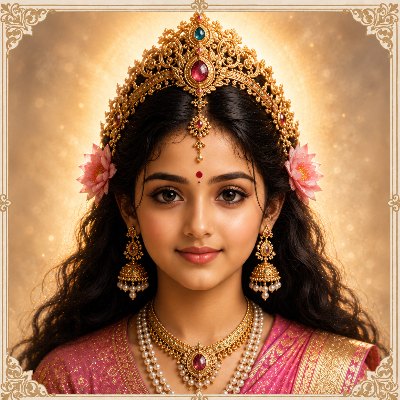
Sundaravalli — Celestial Daughter of Vishnu and Lakshmi, Previous Birth of Valli
Sundaravalli · Sundravalli · Narayanatmaja
Sundaravalli is a divine goddess recognised in South Indian Hindu tradition, principally through the Tamil manuscripts of the Skanda Purana and the Kanda Puranam — the fourteenth-century Tamil adaptation of the Skanda Purana by the poet Kacciyappar — as a daughter of Vishnu, the preserver deity, and his consort Lakshmi, the goddess of fortune. She is the sister of Amritavalli, with whom she undertook severe austerities to win the war god Murugan (Kartikeya, Subramanya, Skanda — son of Shiva and Parvati) as her husband. Murugan promised to marry her in her next earthly birth. In that birth she appeared as Valli, a huntress girl adopted by the tribal chieftain Nambirajan of the Kurava mountain community, and was eventually wooed and married by Murugan at Vallimalai. As Valli she is one of Murugan's two principal consorts, venerated throughout Tamil Nadu and wherever Murugan is worshipped. The tradition of her celestial identity as a daughter of Vishnu is specific to Tamil scriptural sources and is not present in the standard Sanskrit Mahapuranas.
✦ The Name
The name Sundaravalli is a Sanskrit compound of sundara (beautiful, lovely, pleasing) and valli (creeper; in South Indian poetic convention, a beautiful or graceful woman). The name thus means "the beautiful creeper" or "the one who is beautifully graceful as a creeper plant." In Tamil the name is phonologically equivalent and carries the same meaning. Her earthly name Valli is the Tamil word for a creeper or sweet potato plant; it is also the name of the hill and region (Vallimalai, in the Vellore district of Tamil Nadu) where she was found as a newborn and where her principal temple stands. The derivation of the earthly name thus works on two levels simultaneously: the botanical-topographic name of her birthplace, and the continuation of the creeper imagery from her celestial name.
✦ Lineage
- Father: Vishnu (Narayana, Hari) — the preserver deity of the Hindu triad, lord of Vaikuntha, husband of Lakshmi; father of Sundaravalli in the Tamil scriptural tradition.
- Mother: Lakshmi (Sri) — the goddess of fortune and auspiciousness, consort of Vishnu.
- Sister: Amritavalli — elder sister and co-born daughter of Vishnu and Lakshmi, who was reborn as Devasena and married Murugan as his first consort.
- Earthly foster-father (as Valli): Nambirajan (also Nambi, Nambi Raja) — chieftain of the Kurava mountain tribe at Vallimalai, who found Valli as an infant and raised her as his daughter.
- Earthly birth-father (in one variant): Sivamuni — an ascetic living on the slopes of Vallimalai who, in a moment of distraction from his austerities, cast a passionate glance at a passing doe, which became pregnant; the child born of that pregnancy was Valli. One sub-tradition identifies Sivamuni as Vishnu himself, reborn under a curse from the sage Kanva.
- Husband (in reincarnation): Murugan (Kartikeya, Subramanya) — the war deity and son of Shiva and Parvati; he wooed and married Valli at Vallimalai after a celebrated series of courtship encounters.
- Sister-wife: Devasena (Devayanai) — the incarnation of Amritavalli, Murugan's first consort, with whom Valli shares equal standing in temple iconography.
✦ Birth from Vishnu and Penance
The Tamil Skanda Purana manuscripts and the Kanda Puranam record that Sundaravalli and her sister Amritavalli arose from Vishnu's divine body — either from the tears of joy he shed during his Vamana-Trivikrama avatar, or from the light of one of his eyes in his cosmic meditative state. Both sisters desired Murugan as their husband. Together they performed severe austerities at Saravana Poigai, the sacred celestial pond, having been directed to do so by Vishnu. Murugan appeared before them and acknowledged their devotion, but explained that the battle against Surapadman was yet to be won. He promised to wed them in their next earthly births once that cosmic struggle was complete. Sundaravalli accepted this condition and prepared for her reincarnation.
✦ Reincarnation and the Birth of Valli
The birth of Valli on earth is recorded in the Kanda Puranam with a specific narrative. An ascetic named Sivamuni was performing austerities on the slopes of Vallimalai. During a momentary lapse in his concentration, he looked with desire upon a doe, and the doe became pregnant. She gave birth to a female child — that child was Sundaravalli, descended into earthly birth. The doe, unable to care for a human infant, left the child near a pond or in a pit among the tuber plants of the valli creeper. Nambirajan, the chieftain of the Kurava tribe who had long prayed for a daughter, came upon the infant in the tuber pit while digging for edible roots, and took her home. She was named Valli, after the creeper plants among which she was found and after the hill of her birth.
A variant account in the Kanda Puranam and related sources states more simply that Sundaravalli was born to Sivamuni and was left in the forest by her attendants after Indra's instructions were fulfilled, whereupon Nambirajan found and adopted her. The precise account of Sivamuni's identity also varies: one sub-tradition states that he was Vishnu himself in a temporary mortal birth, born under the curse of the sage Kanva who had been slighted when he visited Vishnu and Lakshmi's abode; another treats him simply as an unnamed or ordinary ascetic whose momentary passion caused the birth.
✦ The Courtship of Valli by Murugan
The courtship of Valli by Murugan is one of the most celebrated narrative cycles in Tamil Murugan devotion. Growing up as a huntress and the beloved daughter of Nambirajan, Valli harboured deep, secret devotion for Murugan from childhood, a consequence of the penance she had performed as Sundaravalli. When Murugan came to win her, he approached in disguise — first as a young hunter, then as an aged Shaiva mendicant — and engaged her in a series of encounters at the millet fields she guarded on the hillside. Valli resisted him repeatedly. In the most celebrated episode of this cycle, Murugan enlisted the help of his brother Ganesha — the elephant-headed deity, son of Shiva and Parvati — who took the form of a wild elephant and charged at Valli, terrifying her into throwing herself into the arms of the supposed old man. When the old man's true form was revealed, the union was accepted.
Nambirajan and his tribesmen, learning of Valli's absence with a stranger, came in pursuit with weapons. In the encounter that followed, the chieftain and his men were struck down. Valli, grieved by the sight of her fallen family, begged Murugan to revive them. Murugan instructed her to touch them herself; at her touch, all were restored to life. Recognising the deity before them, Nambirajan gave his blessing and celebrated the marriage. The site of this marriage is held to be Vallimalai, in the Vellore district of Tamil Nadu. After the wedding, Murugan and Valli settled at Thiruttani, where the Thiruthani Murugan Temple stands.
✦ Textual Variants and Inconsistencies
The identification of Valli as the reincarnation of Sundaravalli, daughter of Vishnu, is attested in the Tamil manuscripts of the Skanda Purana and the Kanda Puranam and is not found in the standard Sanskrit recensions of the Skanda Purana. It is specifically described in scholarly literature as an interpolation found in South Indian manuscript traditions of that text. Valli has an independent existence in the oldest Tamil literature without any Vaishnava parentage: the Thirumurugatrupadai from Sangam literature, one of the earliest Tamil texts, attests to Murugan's consort Devayanai without any mention of Valli's origin as Sundaravalli.
The manner of Valli's earthly birth varies across sources. The Kanda Puranam and related Tamil texts give the Sivamuni-and-doe account. Other sources describe her as found simply in a tuber pit with no human parentage specified. Sri Lankan traditions associated with the Kataragama temple give still further local variants of the wooing narrative, including an alternate ending in which Murugan remains at Kataragama with Valli rather than settling at Thiruttani.
The relationship between Valli and Devasena is presented differently across sources. The Kanda Puranam and Skanda Purana Tamil tradition describes the two consorts as harmonious sister-wives who flank Murugan together. The Paripatal, part of the ancient Tamil Sangam corpus, presents a contrary picture in which real conflict, including armed battle, breaks out between Devayanai's followers and Valli's hunter tribe. The Jayantipura Mahatmya provides a third account in which Valli's earthly birth is itself a punishment: Murugan condemns her to be born on earth for mocking her sister Devayanai — a version that inverts the motivation compared to the Kanda Puranam's positive penance-and-boon narrative. These three accounts are not reconcilable and reflect genuinely different layers of the tradition.
✦ Theological Significance
In South Indian Murugan theology, Sundaravalli-Valli embodies Ichha Shakti — the power of will, desire, and spontaneous devotional love. Her path to Murugan is not the path of ritual orthodoxy and formal arrangement but the path of ardent, personal, and even defiant longing that transcends social position and conventional expectation. She is the soul that reaches god through the fullness of love and surrender rather than through prescribed rites. This is consistently paired with and set against the path of her sister Devasena-Amritavalli, who represents disciplined ritual action. Together the two consorts are understood as completing Murugan and as embodying the twin energies through which the devotee may approach him: structured practice and passionate devotion.
✦ Iconography and Worship
Sundaravalli in her celestial form has no independent iconographic tradition in the primary texts. As Valli, she is depicted standing to Murugan's right in temple icons, with Devasena to his left. She typically holds a bow or is shown in the attire of a huntress in some regional depictions, reflecting her earthly life among the Kurava tribe. She is worshipped exclusively in the context of Murugan's temples and does not have independent shrines dedicated solely to her. The Vallimalai temple complex in the Vellore district, on the hill associated with her birth and marriage, is the most specific site of her veneration. Valli Kalyanam — the festival of her wedding to Murugan — is celebrated annually in Murugan temples on the Vaikasi Visakam day.
✦ Connection to the Wider Genealogy
Through her father Vishnu and mother Lakshmi, Sundaravalli belongs to the Vaishnava divine hierarchy. Through her marriage to Murugan — son of Shiva and Parvati — she connects the Vaishnava and Shaiva lineages, making Murugan the son-in-law of Vishnu in the Tamil tradition. Her sister Amritavalli, reborn as Devasena, is her co-wife in the divine household of Murugan. Murugan's brother Ganesha — who assists in the courtship of Valli — is thus her brother-in-law. Murugan's parents, Shiva the destroyer and Parvati, are her parents-in-law. Through her earthly foster-father Nambirajan, she is associated with the Kurava mountain tribe, whose descendants in Sri Lanka (the Vedda people of Kataragama) still observe traditions connected to her marriage to Murugan.
✦ References
- Primary Sources
- Tamil manuscripts of the Skanda Purana (South Indian recensions) — The source identifying Sundaravalli as a daughter of Vishnu in a previous birth and as the prior celestial identity of Valli; this narrative is specific to South Indian manuscript traditions and is not present in the standard Sanskrit recensions of the Skanda Purana.
- Kanda Puranam (Kacciyappar, 14th century CE) — The Tamil adaptation of the Skanda Purana that provides the most detailed narrative of Sundaravalli's penance, Murugan's promise, her birth as Valli from a doe on Vallimalai, the courtship episodes including Ganesha's role as elephant, and the marriage at Vallimalai.
- Thirumurugatrupadai (Sangam corpus, ancient Tamil literature) — The earliest Tamil literary attestation of Murugan's consort Devayanai; Valli as Sundaravalli's incarnation is not part of this text, providing evidence for the later origins of the Vaishnava parentage narrative.
- Paripatal (Sangam corpus) — Records conflict between Devayanai and Valli's adherents rather than the harmony depicted in the Kanda Puranam, providing an important alternate tradition.
- Jayantipura Mahatmya — Records a variant in which Valli's earthly birth is a punishment from Murugan for mocking her sister Devayanai, inverting the Kanda Puranam narrative of voluntary reincarnation through penance.
- Modern and Secondary Sources
- Wikipedia, "Valli" — Provides a well-sourced summary of the multiple birth variants, the Kanda Puranam narrative, the Sangam literary sources, and the Sri Lankan traditions.
- Handwiki, "Religion: Sundaravalli" — Documents the two birth variants (Vamana tears / eye-light) and the Kanda Puranam narrative with textual attribution.
- Shanlax Journals, "Valli: A Venerated Folk Deity" — Academic paper treating Valli's position across Sanskrit, Tamil literary, and folk traditions, with attention to the regional scope of the South Indian manuscript tradition.
- Grokipedia, "Valli" — Documents the doe-birth account in the Kanda Puranam, the role of Nambirajan, and the courtship narrative with detail on the disguise episodes and Ganesha's role.