
About
Bala — Danava Lord of Atala, Son of Maya
Bala · Maya-putra · Ataladhipati
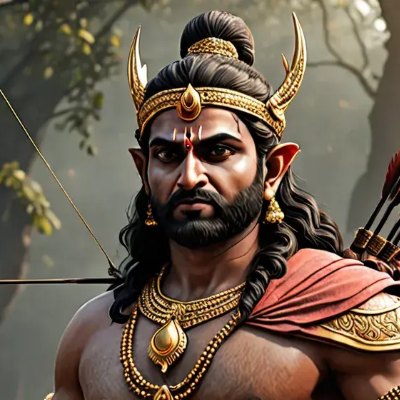
Bala is a Danava — a member of the race of supernatural beings descended from the sage Kashyapa and his wife Danu, a daughter of the Prajapati Daksha — who is identified in the Bhagavata Purana and the Devi Bhagavata Purana as the ruler of Atala, the uppermost of the seven subterranean worlds collectively known as Patala or bila-svarga. He is the son of Maya Danava, the celebrated divine architect and king of the Danavas, who is known across the Mahabharata, Ramayana, and multiple Puranas for building the illusory palace for the Pandavas, the three flying cities of Tripura for the sons of Tarakasura, and other architectural marvels. Bala's principal attribute is the creation of ninety-six varieties of mystic illusion, and his most distinctive act is the generation, through the mere act of yawning, of three categories of supernatural women who ensnare any male who enters his subterranean realm. He appears in two primary sources, both of which record him in the same cosmological context without giving him any further narrative role.
✦ The Name
The name Bala derives from the Sanskrit root bal, meaning strength, force, or power. As a proper name it is in common use throughout the Puranic corpus for both divine and demonic beings, and no etymology specific to this Danava figure is provided in either of the primary texts in which he appears. His patronymic Maya-putra — meaning "son of Maya" — distinguishes him within the Puranic literature from the numerous other figures who bear the name Bala, including the son of Vishnu and Lakshmi recorded in the Brahmanda and Vayu Puranas, and the demon general of that name who appears in other contexts. The descriptive epithet Ataladhipati, meaning "lord of Atala," is a functional identification rather than a textually attested proper epithet; it reflects his cosmological role as described in the Bhagavata Purana.
✦ Lineage
- Paternal grandfather: Kashyapa — one of the seven great sages (Saptarshis), son of Marichi, and grandson of Brahma the creator deity; the progenitor of the Danava race through his union with Danu.
- Paternal great-grandmother: Danu — a daughter of Daksha Prajapati, and one of the thirteen wives of Kashyapa; mother of the Danavas, from whom the entire race takes its name.
- Father: Maya (also Maya Danava, Mayasura) — the foremost architect among the Danavas and Daityas, credited in the Mahabharata with building the Mayasabha palace of illusions for the Pandava king Yudhishthira at Indraprastha, and with constructing the three flying cities of gold, silver, and iron known as Tripura for the Danava brothers Tarakaksha, Kamalaksha, and Vidyunmali — cities that were ultimately destroyed by Shiva. Maya is also identified in the Ramayana tradition as the father-in-law of Ravana, the Rakshasa king of Lanka. The Mahabharata (Adi Parva, Ch. 227) names the Danava Namuci as his brother.
- Mother: Not named in the primary sources that record Bala. In the Ramayana tradition, Maya's recorded wife and the mother of his other children is the Apsara Hema, a celestial dancer given to him by the gods during a visit to Svarga; the primary texts recording Bala do not connect him to this maternal lineage.
- Siblings (in other texts about Maya's family, not directly connected to Bala in the primary passages): Mayavi and Dundubhi — sons of Maya and Hema attested in the Ramayana, both killed by the Vanara king Vali; Mandodari — daughter of Maya and the wife of Ravana; Svayamprabha and Somaprabha — two daughters of Maya mentioned in the Kathasaritsagara, the latter married to Nalakubara the son of Vaishravana (Kubera).
✦ Atala and the Ninety-Six Mayas
The Bhagavata Purana (Skandha 5, Chapter 24, verse 16) introduces Bala in the context of Shuka's cosmological discourse to King Parikshit on the seven subterranean worlds. Atala is described as the first and topmost of these seven realms — Atala, Vitala, Sutala, Talatala, Rasatala, Mahatala, and Patala — each extending ten thousand yojanas below the preceding one. The subterranean worlds are collectively called bila-svarga (the imitation heavens of the netherworld) because they are described as even more opulent and pleasurable in their material appointments than Svarga, the celestial realm of the gods. Maya himself is credited elsewhere in this same cosmological passage with having built brilliantly decorated cities, mansions, gates, assembly halls, and temples throughout these regions.
Bala is the ruler of Atala. The Bhagavata Purana states that he created ninety-six varieties of maya — the word here denoting not philosophical illusion in the Vedantic sense but practical mystic powers, feats of magical deception, and supernatural techniques. The Devi Bhagavata Purana (Skandha 8, Chapter 19) corroborates this number exactly. Both texts note that of these ninety-six varieties, other practitioners of maya throughout the world may command one or two, but none can encompass all of them; the full mastery belongs only to Bala. The Bhagavata Purana's commentary tradition observed even in later Vaishnava interpretation that certain practitioners of yogic and magical powers in the human world derive their abilities from this reservoir of Bala's mystic tradition.
✦ The Three Classes of Women and the Snare of Atala
The most detailed episode assigned to Bala in both primary texts concerns the generation of three supernatural classes of women from his body by the act of yawning. Both the Bhagavata Purana and the Devi Bhagavata Purana record that when Bala yawned, three groups of women emerged from his mouth. These are identified by both texts with the same three terms. The first is the svairini — a woman who is self-determined in her choice of husband and marries within her own social or racial group. The second is the kamini — a woman driven by desire who takes husbands across any group or boundary. The third is the pumscali — a woman who moves from one husband to another, remaining with none. In the Bhagavata Purana's word-for-word Sanskrit commentary (atha-atale maya-putrah asuro balah nivasati), these three categories are given precise Sanskrit definitions.
These women inhabit Atala and constitute its characteristic danger. When any male being enters the subterranean realm of Atala, the women immediately take him captive and administer to him a drink prepared from a herb called hataka — described in the Sanskrit word-for-word of the Bhagavata Purana as an intoxicating substance. Under the influence of this drink the man acquires extraordinary sexual energy, believing himself more powerful than ten thousand elephants. Intoxicated by this false strength and the flattery of the women, who engage him in acts of sensual enjoyment, he loses all sense of his true identity and situation, imagines himself invincible, and in his delusion comes to regard himself as a god. The Bhagavata Purana presents this as the characteristic spiritual danger of Atala: not outright torment, as in the hells described elsewhere, but a sophisticated trap of pleasure and illusion that effaces higher awareness entirely. No account of escape from this realm or of any figure successfully traversing it is given in either text.
✦ Textual Variants and Inconsistencies
The two primary sources for Bala — the Bhagavata Purana (5.24.16) and the Devi Bhagavata Purana (8.19) — are in close agreement on all substantive details: his identity as Maya's son, his location in Atala, his ninety-six mayas, and his generation of the three women by yawning. There is no significant contradiction between them on these points.
A noteworthy ambiguity concerns the relationship between Bala the Danava of Atala and the broader family of Maya recorded in other texts. The Ramayana and the Kathasaritsagara record Maya's wife as the Apsara Hema and his children as Mayavi, Dundubhi, Mandodari, Svayamprabha, and Somaprabha. The Puranic Encyclopaedia of Vettam Mani, drawing on the Devi Bhagavata, notes Bala as an additional son of Maya. However, the primary Puranic passages recording Bala do not name his mother, do not situate him within Maya's other family relationships, and do not connect him to the Ramayana tradition of Maya's children. Whether Bala shares Hema as his mother or was born of a different union of Maya is not addressed in any primary source.
It should also be noted that Maya Danava is himself described inconsistently across texts as belonging to the Danavas (born of Danu) in some passages and to the Daityas (born of Diti, the other wife of Kashyapa) in others; the Ramayana (Uttara Kanda) calls him "Diti's son" in one verse and "that Danava" in another. This ambiguity in Maya's own classification carries through to Bala: in some secondary references he is called a Daitya's son and in others a Danava's son. The Bhagavata Purana verse (5.24.16) uses the compound maya-putrah asuro, meaning "the asura son of Maya," without specifying Danava or Daitya; the broader category asura encompasses both.
✦ Theological and Cosmological Significance
In the Bhagavata Purana's cosmological framework, Atala and its ruler Bala occupy a specific position in the mapping of consciousness onto the structure of the cosmos. Some later commentarial traditions associate Atala with the hip region in the subtle body, and with a state of consciousness described as "put" — a word associated with childlessness and with the fear and desperation that arise from attachment to material pleasure. Bala's realm in this reading is not a place of punishment but of captivation: the ninety-six mayas represent the full spectrum of material illusion, and the three women produced by his yawning are understood as the three modes of misdirected desire that bind a being to the material world. The number ninety-six carries no explanation in the text itself; it is simply presented as the complete and unsurpassable count of Bala's mystic repertoire.
Bala inherits from his father Maya a lineage entirely identified with the art of illusion and supernatural construction. Where Maya creates architectural illusions — cities, palaces, and flying dwellings that deceive both gods and humans — Bala creates experiential illusions: states of intoxication, false potency, and self-forgetfulness. Father and son together embody two faces of the same principle: the external maya of constructed appearances, and the internal maya of deluded consciousness.
✦ Connection to the Wider Genealogy
Through his father Maya, Bala descends from Kashyapa — one of the seven great sages, son of Marichi, and grandson of Brahma the creator — and through him from Danu, a daughter of Daksha Prajapati. Daksha is himself a son of Brahma in most Puranic genealogies, making Bala a fifth-generation descendant of the creator deity through the Danava line. His father Maya is the brother of the Danava Namuci (Mahabharata, Adi Parva, Ch. 227), making Namuci his paternal uncle. Through Maya's daughter Mandodari and her marriage to Ravana, Bala is connected by family to the Rakshasa royal house of Lanka: Ravana is his brother-in-law, and Ravana's sons Meghanada (Indrajit), Atikaya, and Akshayakumara are his nephews. Through Maya's sons Mayavi and Dundubhi, who were both killed by the Vanara king Vali, Bala is connected to the narrative world of the Ramayana, though he himself does not appear in that epic.
✦ References
- Primary Sources
- Bhagavata Purana, Skandha 5, Chapter 24, verse 16 — The principal primary source for Bala; names him as the asura son of Maya Danava, records his location in Atala, his creation of ninety-six varieties of mystic power, and the generation of the three classes of women by yawning, with the full account of the hataka drink and its effects on males who enter the realm. Sanskrit word-for-word analysis available at the Bhaktivedanta Vedabase (vedabase.io).
- Devi Bhagavata Purana, Skandha 8, Chapter 19 — Corroborating cosmological passage that records Bala as the haughty son of the Danava Maya residing in Atala, confirms the ninety-six mayas, and names the same three categories of women (Pumscali, Svairini, Kamini) generated by his yawning. Translation available at Wisdomlib.org.
- Mahabharata, Adi Parva, Chapter 227, verse 41 — Records Namuci the Danava as the brother of Maya; contributes to the fraternal lineage context within which Bala's paternal family is situated.
- Ramayana, Uttara Kanda — Records Maya's marriage to the Apsara Hema and his children Mayavi, Dundubhi, and Mandodari; contributes the maternal-lineage context for Maya's family, noting that Bala's mother is not named in the passages that record him.
- Kathasaritsagara, Madanamancukalambaka, 3rd Taranga — Names two daughters of Maya, Svayamprabha and Somaprabha, with Somaprabha married to Nalakubara, son of Vaishravana; contributes to the fuller sibling picture of Maya's family.
- Modern and Secondary Sources
- Vettam Mani, Puranic Encyclopaedia (Motilal Banarsidass, 1975), entry "Maya" — Explicitly cites the Devi Bhagavata Purana, Skandha 8 as the source for Bala as a son of Maya living in Atala; used here to confirm the Devi Bhagavata reference and the family placement.
- Wisdomlib.org, "On the narrative of Atala — Devi Bhagavata Purana, Chapter 19" — Provides the English translation of the Devi Bhagavata passage recording Bala and his attributes in Atala.
- Bhaktivedanta Vedabase (vedabase.io), "SB 5.24.16" — Provides the Sanskrit text, word-for-word analysis, and translation of the Bhagavata Purana's primary verse on Bala, including the grammatical parsing of maya-putrah asuro balah.
- Wisdomlib.org, "Danava Maya — significance and symbolism" — Secondary compilation confirming the Devi Bhagavata Purana's identification of Maya as the father of Bala and its cosmological context.