
About
Kakutstha — The Monarch of the Hump
Kakutstha · Puranjaya · Anenas · Kakutsthava · Kakutstha-kula
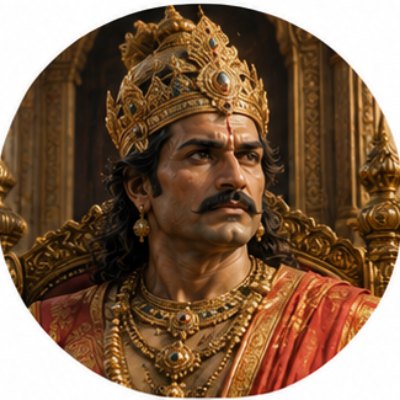
Kakutstha is a foundational emperor of the Solar Dynasty, the Surya Vansha, who ruled from Ayodhya as part of the early Ikshvaku lineage. His birth name was Puranjaya, meaning Conqueror of Cities, but the name Kakutstha — bestowed upon him by the gods in recognition of his role in a cosmic war between the Devas and the Asuras — became so dominant that it displaced his original name in the memory of the tradition and gave a permanent dynastic epithet to all his descendants. He is the son of King Vikukshi, also known by the name Shashada, who was himself a son of Ikshvaku, the founding patriarch of the Ayodhya royal house and eldest son of Vaivasvata Manu. The epithet Kakutstha, and its variant forms Kākutstha and Kakutsthava, passed down through the Solar line as a hereditary honorific, and Valmiki applies it with particular frequency to Rama, the seventh avatar of Vishnu and the hero of the Ramayana, who stands many generations after Kakutstha in the same descent. Kakutstha appears in the Vishnu Purana, the Bhagavata Purana, and the Valmiki Ramayana as a pivotal ancestral figure whose exploit on the divine battlefield defined the identity of the dynasty for all subsequent generations.
✦ The Name
The name Kakutstha is a compound of two Sanskrit elements: Kakud, meaning the hump of a bull, and Stha, meaning one who stands or is seated upon. The compound therefore denotes one who stands upon the hump of a bull, referring directly to the posture Puranjaya assumed when he rode the transformed Indra into battle. The name is not a birth name but an honorific conferred by the gods after the battle and subsequently adopted as the standard designation for the king in the textual tradition, his original name Puranjaya appearing primarily in those passages that narrate the episode itself or enumerate the alternative names. A third name, Anenas, appears in certain king-lists in connection with this figure, though the Puranas also record Anenas as the name of Kakutstha's son and successor, creating an ambiguity discussed further in the Variants section below. The dynastic epithet derived from his name — Kākutstha in its adjectival form — became a standard honorific applied to Solar Dynasty kings, most prominently to Rama throughout the Valmiki Ramayana.
In early Vedic literature, Puranjaya is also encountered as an epithet meaning conqueror of strongholds or fortified cities, carrying martial resonance appropriate to a Kshatriya king of the primordial era. The Rigveda uses Puranjaya as a descriptive epithet in hymns associated with Indra, which lends an additional layer of irony and theological symmetry to the Puranic narrative in which Puranjaya the mortal king rides Indra the god into battle.
✦ Lineage
- Grandfather: Ikshvaku — eldest son of Vaivasvata Manu, the seventh Manu and progenitor of the current human race, and founder of the royal house of Ayodhya, from whom the entire Solar Dynasty of the Puranic tradition descends.
- Father: Vikukshi, also known as Shashada — son of Ikshvaku, whose epithet Shashada, meaning rabbit-eater, was acquired when he consumed a hare from a ritual food offering during a hunting expedition, an act that led to his temporary banishment by his father on the counsel of the sage Vasishtha before he was eventually restored to the succession.
- Son and successor: Anenas — recorded in the Vishnu Purana and the Valmiki Ramayana as the son who followed Kakutstha on the throne of Ayodhya and through whom the dynastic line continued toward the later Solar kings.
No wife or wives of Kakutstha are named in the primary Puranic or epic sources consulted. The texts record only the patrilineal succession.
✦ The Deva-Asura War and the Exploit on the Hump
The defining episode of Kakutstha's life is narrated in the Bhagavata Purana at Canto 9, Chapter 6, and in the Vishnu Purana at Book 4, Chapter 2. In both accounts the narrative opens at a moment of catastrophic defeat for the Devas. The gods had been routed by the Asuras in one of the great recurring cosmic wars between the divine and demonic powers and had been driven from their celestial domains. In their distress, led by Indra, the king of the gods, the Devas descended to the mortal realm and approached King Puranjaya of Ayodhya, seeking his military assistance as their champion and vanguard commander.
Puranjaya agreed to fight for the gods but imposed a single non-negotiable condition: Indra himself must serve as his mount and carry him into the battlefield. The theological weight of this demand is considerable. Indra, the sovereign of heaven and the mightiest of the Devas, was being asked to assume the subordinate role of a vehicle beneath a mortal king. The texts record that the gods, being in no position to refuse, accepted the condition. Indra transformed himself using his divine power into the form of a colossal bull of brilliant white radiance. Puranjaya mounted the bull and took his seat upon its kakud — its prominent shoulder hump — and from that elevated position he entered the demonic ranks armed with his divine bow and the blessings of Vishnu, who is said in the Bhagavata Purana's account to have entered Puranjaya himself, lending the mortal king a portion of his own divine energy for the duration of the battle.
The battle that followed resulted in the complete destruction of the Asura armies. Puranjaya drove his arrows through the demon formations, slew the Asura forces including their principal commanders, and restored the heavenly realms to the Devas. In recognition of this feat, the gods conferred upon him the name Kakutstha — he who sat upon the hump — as a permanent honorific. The Vishnu Purana records that this name was thereafter borne not only by the king himself but became the ancestral epithet of all kings born in his line thereafter, who were collectively designated the Kakutsthas or Kakutsthava.
✦ Textual Variants and Inconsistencies
The principal inconsistency surrounding Kakutstha concerns the name Anenas and its assignment within the succession. The Vishnu Purana and the Valmiki Ramayana both record Anenas as the son and immediate successor of Kakutstha. However, certain king-list traditions and some manuscript variants of the Bhagavata Purana use Anenas as an alternate name for Kakutstha himself, treating it as one of the three names — Puranjaya, Kakutstha, Anenas — carried by the same individual. The Bhagavata Purana at Canto 9, Chapter 6 appears to present all three as names of a single king, whereas the Ramayana's genealogical recitation in the Bala Kanda treats Anenas as a distinct successor generation. This inconsistency is not resolved within the primary sources themselves and commentators have handled it differently across traditions.
A further variant concerns the son recorded as following Kakutstha in the Bhagavata Purana succession list, where the name Prithu appears in some recensions in the generational slot immediately after Kakutstha, rather than Anenas. This divergence from the Vishnu Purana and the Ramayana's placement of Anenas in that position has not been reconciled across the texts. Mainstream Puranic scholarship generally treats the Vishnu Purana and Valmiki Ramayana versions as the more consistently attested sequence for this portion of the Solar lineage.
✦ Theological and Philosophical Significance
The episode of Puranjaya-Kakutstha occupies a distinctive position in the Puranic theological framework because it stages a reversal of the expected cosmic hierarchy. In the standard ordering of the Puranic world, the Devas occupy a station above mortals and Indra as their king stands among the most powerful beings in creation. The episode in which the king of heaven voluntarily assumes the form of a beast of burden beneath a human monarch is therefore theologically striking and is treated in the Bhagavata Purana's account as made possible only by the presence of Vishnu within Puranjaya — the mortal king functioning as a vessel for divine energy rather than acting solely on his own power. This framing preserves the Vaishnava theological hierarchy even while the surface narrative elevates the human above the divine: the victory belongs ultimately to Vishnu acting through his human instrument.
The episode also functions as an origin myth for a dynastic identity. The naming of the king and, by extension, all his descendants as Kakutstha transforms a single military exploit into the founding charter of a heroic lineage designation. The name is not merely a personal epithet but a genealogical inheritance, ensuring that every king of the Solar line who bears it carries within his title a compressed memory of the cosmic battle and the mortal-divine alliance that won it.
✦ Connection to the Wider Genealogy
Kakutstha stands three generations from the founding patriarch of the Solar Dynasty. His grandfather Ikshvaku, eldest son of Vaivasvata Manu the seventh Manu, established the royal house of Ayodhya and initiated the principal Ikshvaku lineage. His father Vikukshi, known as Shashada, was among Ikshvaku's sons and continued the Ayodhya succession. Through Kakutstha's son Anenas the line descends through many generations of Solar kings, eventually reaching Trishanku, Harishchandra, Sagara, Bhagiratha, Dilipa, Raghu, Aja, Dasharatha, and finally Rama — the seventh avatar of Vishnu, whose identity as Kākutstha in the Ramayana represents the culmination of the dynastic epithet established by Kakutstha's exploit on the battlefield. The prophecy attributed to Anaranya, a later king of the same line who was slain by Ravana, that a descendant of his Solar lineage would destroy the demon king, is fulfilled by Rama — who, as a direct lineal descendant of Kakutstha, bears the ancestral name Kakutstha as his most frequently used epic patronymic.
✦ References
Primary Sources
- Bhagavata Purana, Canto 9, Chapter 6: The primary narrative source for the episode of Puranjaya riding Indra into battle, the bestowal of the name Kakutstha, and the Bhagavata's enumeration of his three names; also supplies the detail of Vishnu's energy entering Puranjaya for the duration of the battle.
- Vishnu Purana, Book 4, Chapter 2: Corroborates the battle narrative and records the genealogical statement that all kings of the Solar line descending from him bore the dynastic epithet Kakutsthava; provides the Anenas succession.
- Valmiki Ramayana, Bala Kanda, Sarga 70: Presents the formal genealogical recitation of Rama's lineage before his wedding, placing Kakutstha in the Solar succession between Vikukshi and Anenas, and establishing the ancestral basis for Rama's use of the Kakutstha epithet throughout the epic.
- Rigveda: Contains early Vedic usage of Puranjaya as an epithet meaning conqueror of strongholds, providing the name's Vedic background prior to its Puranic narrative application.
Secondary and Reference Sources
- Wisdomlib — definition entry for Kakutstha and Puranjaya: Aggregates cross-references across the Puranic corpus and identifies variant name assignments across different text traditions; useful for confirming the three-name identification and the Anenas ambiguity.
- V. S. Agrawala, Matsya Purana — A Study: Provides comparative analysis of Solar Dynasty king-lists across major Puranas, useful for contextualising the variant succession sequences around Kakutstha's position.
- F. E. Pargiter, Ancient Indian Historical Tradition (1922): Offers a systematic comparison of Puranic genealogies including the Ikshvaku line, noting the variant assignments of Anenas and the divergences between the Bhagavata and Vishnu Purana successions in this portion of the Solar lineage.