
About
Yakshas — Semi-Divine Nature Spirits of Wealth, Wilderness, and the Unseen World
Yaksha (singular) · Yakshas (plural) · Yakshinis / Yakshis (female) · Punyajanas · Paulastyas (in some Puranic classifications)
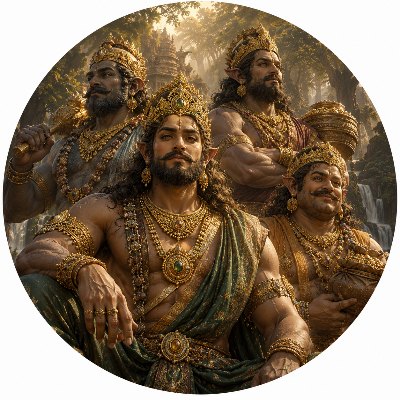
The Yakshas are a class of semi-divine beings appearing throughout the Mahabharata, the Ramayana, the eighteen Mahapuranas, and in a wide range of earlier Vedic and post-Vedic literature. They occupy an intermediate position in the cosmological hierarchy — more powerful than ordinary humans yet subordinate to the greater devas — and are primarily associated with the guardianship of natural treasures, forests, mountains, and hidden wealth. Their king and supreme lord is Kubera (also called Vaishravana or Dhanada), the god of wealth and lord of the northern quarter, who rules over them from his celestial city of Alaka on Mount Meru or, in some accounts, on Mount Kailasa. The Yakshas as a class are principally generated from the creative activity of Prajapati Kashyapa, one of the great progenitor sages, and from his wife Khasha (also spelled Kasha or Kashyapi in variant texts), though the precise genealogical account differs across sources. They figure in numerous narrative contexts — as guardians, as antagonists redeemed, as questioners of heroes, and as worshipped nature presences — and their cult had deep roots in pre-classical Indian popular religion before being absorbed into the Puranic synthesis.
✦ The Name
The word Yaksha derives from the Sanskrit root yaks, which carries the sense of swift movement, to move rapidly, or to appear suddenly, though some grammarians and etymologists in the tradition have also connected it to a root meaning to venerate or to worship. The ambiguity is itself significant: the Yakshas are beings who appear suddenly and unexpectedly, often in lonely natural places, and who are simultaneously objects of veneration. The feminine form Yakshini (or Yakshi) follows standard Sanskrit derivation. The epithet Punyajana, meaning people of merit or beings of good deed, is applied to them in some Puranic passages as a euphemistic or honorific designation, reflecting the tradition's tendency to use propitious names for powerful semi-divine beings. The alternative designation Paulastya, linking them to the sage Pulastya, appears in genealogical traditions that derive both the Yakshas and the Rakshasas from the lineage of Pulastya rather than from Kashyapa and Khasha, and is discussed further under the section on textual variants.
✦ Lineage
- Father (primary account): Kashyapa — one of the seven great progenitor sages (Saptarshis), son of the sage Marichi who was himself one of the mind-born sons of Brahma the creator. Kashyapa is the most prolific progenitor in the Puranic tradition, fathering the devas, asuras, nagas, and numerous other classes of beings through his many wives.
- Mother (primary account): Khasha (also written Kasha, Kashyapi, or Khasa in variant manuscripts) — one of the daughters of the progenitor Daksha and a wife of Kashyapa. The Vayu Purana and the Mahabharata's Adi Parva both identify Khasha as the mother of the Yakshas and the Rakshasas jointly, making these two classes of beings full siblings in this genealogical scheme.
- Sibling class (primary account): Rakshasas — the class of demon-beings also born from Khasha by Kashyapa, according to the principal Puranic genealogical accounts. The Yakshas and Rakshasas are therefore presented as cognate classes, sharing a single mother and a single father, though in character and function they diverge markedly.
- Alternative progenitors (variant account): In several passages of the Ramayana (Valmiki, Uttara Kanda) and in some Puranic genealogies, the Yakshas and Rakshasas are said to have sprung from Brahma himself in a moment of primordial creation, or to descend from the sage Pulastya through his grandson Vishravas. These accounts are treated under the Textual Variants section below.
- King / overlord: Kubera (Vaishravana, Dhanada, Vitteshvara) — son of the sage Vishravas and the Yaksha woman Ilavida (or Ilavila in some texts), and thus himself of partly Yaksha descent. Kubera is the lord of wealth, regent of the northern direction, and sovereign of all Yakshas. He rules from Alaka, a city of great splendour situated on or near Mount Meru.
- Notable individual Yakshas named in texts: Manibhadra and Purnabhadra (prominent Yaksha generals and attendants of Kubera, named in the Mahabharata); Sthunakarna (a Yaksha whose ear Shikhandi used for a temporary gender exchange, according to the Mahabharata's Udyoga Parva); the unnamed Yaksha who questions Yudhishthira at the forest lake (Mahabharata, Vana Parva, the Yaksha Prashna episode).
✦ Nature and Cosmic Function
In the Puranic worldview, the Yakshas serve primarily as guardians of wealth hidden in the earth — mineral deposits, buried treasure, the riches that lie beneath forests and mountains. They are associated with the principle of hidden or latent abundance: the wealth that exists but is not yet accessible to ordinary beings. This function places them in close relation to Kubera, who in Vedic literature is originally a lord of nocturnal darkness and hidden riches before becoming the fully anthropomorphised god of material wealth in the epics and Puranas. The Yakshas are not uniformly benevolent or malevolent in the texts. Some passages describe them as gentle beings who inhabit trees, groves, lakes, and crossroads and who can bestow blessings on those who propitiate them. Other passages describe them as capricious, frightening, and capable of causing illness, madness, or possession, particularly when they are angered or disturbed. This dual character — the Yaksha as both a benevolent guardian spirit and a potentially dangerous supernatural presence — is one of the most stable features of their portrayal across the entire textual tradition, from early Vedic references through the latest Puranic compilations.
The Yakshinis or Yakshis, the female counterparts of the Yakshas, have a particularly prominent role in popular and folk traditions. They are described as beautiful, powerful women associated with trees, fertility, and the abundance of nature. In later sculptural traditions they became a canonical artistic type — voluptuous female figures often shown in proximity to trees — and their imagery is among the oldest surviving examples of human sculptural representation in the Indian subcontinent.
✦ The Yaksha Prashna — The Forest Lake Episode
The single most celebrated episode involving a Yaksha in the Mahabharata occurs in the Vana Parva (the Book of the Forest), in the section known as the Yaksha Prashna or the Questions of the Yaksha. During the period of the Pandavas' forest exile, the five brothers follow a deer that has carried off the fire-sticks of a Brahmin into the forest. In the course of their search they come upon a lake, and when each of the four younger Pandavas — Nakula, Sahadeva, Arjuna, and Bhima — attempts to drink from it, they are struck down by an invisible power. When Yudhishthira, the eldest, arrives and attempts to drink, a great voice warns him that the lake belongs to a Yaksha and that he must first answer questions before drinking. Yudhishthira agrees. The Yaksha then poses a series of profound metaphysical, ethical, and cosmological questions — covering the nature of the self, the path to happiness, true wealth, the nature of a Brahmin, what is heavier than the earth, what is taller than the sky, and many others. Yudhishthira answers each question with wisdom and equanimity. Pleased, the Yaksha restores his brothers to life and reveals himself: the Yaksha is in fact Dharma, the god of righteousness and death, who is also Yudhishthira's divine father. This episode functions as one of the great tests of virtue in the entire epic narrative.
✦ The Sthunakarna Episode
In the Mahabharata's Udyoga Parva and in greater detail in the Adi Parva, the story is told of the Yaksha named Sthunakarna. Shikhandi, who was born female as Shikhandini and was reborn with a male form by the grace of a Yaksha, obtained his male gender temporarily through an exchange with Sthunakarna. The Yaksha, moved by Shikhandini's distress at having been born female despite being destined to be a warrior, agreed to lend his male characteristics to her, transforming her into Shikhandi, while he temporarily assumed a female form. When Kubera learned of this transaction, he was displeased and cursed Sthunakarna to remain in female form permanently, until the time of Shikhandi's death. Upon Shikhandi's death in the battle of Kurukshetra, Sthunakarna was restored to his original male form.
✦ The Curse of Nalakubara — Yakshas in the Bhagavata Purana
A well-known episode in the Bhagavata Purana (tenth skandha) involves Nalakubara and Manigriva, both sons of Kubera and therefore of Yaksha lineage. The two young men, intoxicated with pride and wine, were bathing in the Mandakini river with young women when the sage Narada came upon them. The women were shamed into dressing, but Nalakubara and Manigriva, in their drunken arrogance, did not cover themselves. Narada cursed them to become trees — specifically, the twin Arjuna trees (Terminalia arjuna) — until they would be liberated by contact with Krishna. The liberation came when the infant Krishna, tied to a mortar by his mother Yashoda as a punishment for mischief, dragged it between the twin trees and uprooted them, releasing Nalakubara and Manigriva from the curse.
✦ Textual Variants and Inconsistencies
The parentage and origin of the Yakshas is one of the more variable genealogical claims in the Puranic literature, and several distinct traditions must be honestly reported.
The Vayu Purana and the Mahabharata's Adi Parva both present Kashyapa and Khasha as the parents of the Yakshas and Rakshasas. This is the primary genealogical tradition underlying the lineage-tree placement of Yakshas under the Kashyapa-Khasha node. The Vishnu Purana similarly lists Khasha (or a cognate name) as a wife of Kashyapa from whom various classes of supernatural beings descend.
A second and significantly different tradition is found in the Valmiki Ramayana's Uttara Kanda and is echoed in parts of the Mahabharata. In this account, the Yakshas and Rakshasas did not descend from Kashyapa and Khasha but originated directly from Brahma the creator in a primordial episode. When Brahma created the primordial waters, beings arose from his activity and divided themselves, with some crying protect it (raksha) and others crying eat it (yaksha). Those who cried raksha became the Rakshasas; those who cried yaksha became the Yakshas. This cosmogonic origin story bypasses the Kashyapa-Khasha genealogy entirely and presents the two classes as originating from primordial speech acts.
A third tradition, found in Puranic genealogies of the lineage of Pulastya, states that the Yakshas and Rakshasas are Paulastyas — descendants of the sage Pulastya, one of Brahma's mind-born sons. In this scheme, Pulastya's grandson Vishravas fathered Kubera (king of the Yakshas) with the Yaksha woman Ilavida, and also fathered Ravana, Kumbhakarna, and Vibhishana with Kaikasi, linking the Yaksha and Rakshasa royal lines in a complex genealogical web. This tradition does not contradict the Kashyapa-Khasha tradition outright so much as it provides a separate, parallel genealogy for the leadership class of these beings, while the broader Kashyapa-Khasha tradition accounts for the class as a whole.
These three genealogical traditions cannot be harmonised without forcing the texts. Each belongs to a distinct compositional layer or textual strand, and a responsible genealogical reference should note all three rather than selecting one as authoritative.
✦ Theological and Philosophical Significance
The Yakshas occupy a complex theological position. On one hand, they are among the categories of being that receive popular worship — shrines to Yakshas and Yakshinis are attested in early Buddhist and Jain texts as well as in Hindu sources, indicating that Yaksha veneration was a pan-Indian popular religious phenomenon predating the consolidation of classical Brahmanical Hinduism. On the other hand, the Brahmanical textual tradition generally placed them below the devas in the cosmic hierarchy and sometimes deprecated their worship as belonging to a lower or less refined category of religious practice.
The philosophical significance of the Yaksha figure reaches its highest expression in the Kenopanishad (also known as the Talavakara Upanishad), where the supreme Brahman appears to the devas as a great Yaksha — an unknown, overwhelming, and unclassifiable presence — and none of the gods, not Agni, not Vayu, not even Indra, is able to comprehend it. Only the goddess Uma-Haimavati reveals to Indra that this Yaksha is Brahman itself. In this context the word Yaksha is used not in the sense of the class of nature spirits but in the sense of a numinous, mysterious entity — the utterly unknown — which is one of the oldest and most philosophically potent usages of the term in the Sanskrit tradition.
✦ Iconography and Worship
The earliest surviving sculptural representations of Yakshas and Yakshinis are large, massive, frontal figures dating to the third and second centuries BCE, found at sites such as Parkham and Patna. These early images project power and abundance through sheer physical size and solidity. The Yaksha male type in this early period is typically broad-shouldered, pot-bellied in token of prosperity, and simply dressed. The Yakshini type is voluptuous, associated with flowering trees, and frequently shown in a pose of tree-grasping (shalabhanjika) that connects her iconographically to fertility and vegetative abundance.
In the Puranic and Agamic traditions, Kubera as king of the Yakshas receives an established iconographic form: he is shown as a pot-bellied dwarf figure, richly ornamented, carrying a money-bag or a mongoose (which in some accounts spits jewels), and seated on a throne or vehicle. His retinue of Yakshas is depicted in attendant postures. Manibhadra, one of the most prominent individual Yakshas, had his own independent cult in parts of western India. Yaksha shrines associated with specific trees, groves, or water bodies continued as a living tradition alongside, and often integrated into, mainstream temple Hinduism.
✦ Connection to the Wider Genealogy
In the genealogical scheme underlying the lineage tree in which this profile appears, the Yakshas are placed under Kashyapa and Khasha. Kashyapa is a son of Marichi, who is a mind-born son of Brahma. Khasha is a daughter of Daksha, the great progenitor, who is himself in most accounts a son or grandson of Brahma. The Yakshas thus belong to the third or fourth generation from Brahma in the Kashyapa-Khasha line. Their sibling class in this genealogical framework, also born of Kashyapa and Khasha, are the Rakshasas, who are treated in a separate profile. The Yaksha king Kubera is himself of partly Yaksha descent through his mother Ilavida, a Yaksha woman who was a wife of the sage Vishravas, son of the sage Pulastya, son of Brahma. Kubera is thus related to the Yakshas as their lord while also being of a distinct genealogical line (the Pulastya line) from the Kashyapa-Khasha mass of Yaksha beings. Kubera is also the half-brother of Ravana, Kumbhakarna, and Vibhishana, the great Rakshasa princes of Lanka, through their shared father Vishravas, which creates a genealogical link between the Yaksha and Rakshasa royal families that the epics exploit extensively in their narrative treatments of the conflict between Ravana and Kubera for the ownership of Lanka.
✦ References
Primary Sources
- Mahabharata, Adi Parva (Book 1): Contains genealogical lists placing the Yakshas among the beings created by Kashyapa through his wives, including Khasha; also narrates the Sthunakarna-Shikhandi episode.
- Mahabharata, Vana Parva (Book 3), Yaksha Prashna section: The principal source for the encounter between Yudhishthira and the Yaksha at the forest lake, and the revelation that the Yaksha is Dharma.
- Mahabharata, Udyoga Parva (Book 5): Additional detail on the Sthunakarna-Shikhandi exchange and Kubera's curse.
- Valmiki Ramayana, Uttara Kanda (Book 7): Provides the alternative cosmogonic origin story in which Yakshas and Rakshasas arise from primordial beings responding to the waters of creation; also narrates the genealogy of Kubera and Vishravas.
- Vayu Purana: One of the principal Puranic sources for the Kashyapa-Khasha genealogy of the Yakshas and Rakshasas.
- Vishnu Purana: Contains genealogical accounts of Kashyapa's wives and the beings they produced, including the Yakshas.
- Bhagavata Purana, Skandha 10: The principal source for the Nalakubara-Manigriva episode and their liberation by Krishna.
- Kenopanishad (Talavakara Upanishad): The philosophically most significant use of the term Yaksha, where Brahman appears as an inexplicable Yaksha-presence to the devas, and only Uma reveals its identity to Indra.
- Atharvaveda: Contains early references to Yakshas as dangerous, disease-causing supernatural presences, attesting to the antiquity of the class in the Indian religious imagination.
Modern Reference Works
- Vettam Mani, Puranic Encyclopaedia (1975): Provides consolidated entries on the Yakshas, Kubera, Manibhadra, and Sthunakarna, with cross-references to relevant Puranic passages.
- A. K. Coomaraswamy, Yaksas (1928–1931): The foundational scholarly study of Yaksha iconography and cult in the Indian sculptural tradition, covering early archaeological evidence and the development of the Yakshini type.
- Wisdomlib (wisdomlib.org), Yaksha entries: Aggregates Puranic references to Yakshas across multiple texts with verse-level citations, useful for locating specific passages.