
About
Rakshasas — Demon-Beings of Night, Flesh, and Cosmic Opposition
Rakshasa (singular) · Rakshasas (plural) · Rakshasi / Rakshasi (female) · Nairrita · Kravyads (flesh-eaters, an epithet) · Paulastyas (in the Pulastya lineage tradition)
The Rakshasas are among the most extensively narrated classes of supernatural beings in the Hindu textual tradition. They appear throughout the Vedas, the Mahabharata, the Ramayana, the eighteen Mahapuranas, and numerous subsidiary texts, and their portrayal spans a wide range from fearsome cosmic antagonists to morally complex individuals capable of virtue, scholarship, and devotion. As a class, the Rakshasas are principally characterised as beings who oppose the rituals and moral order of the world (dharma), who consume human flesh, who are most powerful at night, and who act as the adversaries of sages, sacrificers, and gods. Their most celebrated members are the royal family of Lanka — Ravana the ten-headed demon-king, his brother Kumbhakarna, his half-brother Vibhishana, and his son Indrajit (Meghanada) — all of whom descend through the sage Vishravas and thus through Pulastya, one of Brahma's mind-born sons. The genealogical relationship of the Rakshasas to the Yakshas is a recurring theme in the texts: in the principal Puranic scheme they share a mother, Khasha, and a father, Kashyapa, but in other traditions they are presented as originating from Brahma directly, or from the lineage of Pulastya, or from a primordial act of speech. The Rakshasas function in the texts simultaneously as narrative antagonists, as theological symbols of the forces opposing cosmic order, and — in the cases of individuals such as Vibhishana and Maricha — as figures of genuine moral and spiritual depth.
✦ The Name
The word Rakshasa derives from the Sanskrit root raksh, meaning to protect or to guard. The name is thus etymologically identical in structure to the word for protector. The traditional explanation offered in the Valmiki Ramayana's Uttara Kanda accounts for this apparent paradox through a cosmogonic narrative: when Brahma created primordial waters, the beings that arose divided, with some calling out raksha (protect it) and others yaksha (devour it or wonder at it). Those who cried protect it became the Rakshasas, in the sense that they were charged with the guardianship of the waters — though in subsequent tradition the Rakshasas became the enemies of the sacred order they were nominally created to protect. This inverted guardianship — beings who were created as protectors but became destroyers — is one of the recurring ironies of Rakshasa mythology in the texts.
The epithet Nairrita (or Nairriti), meaning belonging to the south-west or children of Nirriti, connects the Rakshasas to Nirriti, the Vedic goddess of dissolution, decay, and misfortune, and to the south-western direction which she governs. This directional association marks the Rakshasas as beings of inauspicious, dissolving power. The term Kravyad, meaning flesh-eater or raw-meat-eater, is used as a descriptor of Rakshasas throughout Vedic and post-Vedic literature and emphasises their carnivorous and ritually impure nature.
✦ Lineage
- Father (principal Puranic account): Kashyapa — one of the seven great progenitor sages (Saptarshis), son of the sage Marichi who was a mind-born son of Brahma. Kashyapa is the progenitor of the devas, asuras, nagas, and numerous other classes of beings through his many wives.
- Mother (principal Puranic account): Khasha (also written Kasha, Kashyapi, or Khasa) — one of the daughters of the progenitor Daksha and a wife of Kashyapa. The Vayu Purana and Mahabharata's Adi Parva name Khasha as the mother of the Rakshasas and the Yakshas jointly, making them sibling classes.
- Sibling class: Yakshas — the class of semi-divine nature spirits and guardians of wealth, also born of Kashyapa and Khasha in the principal genealogical account. The Yakshas and Rakshasas are thus presented as full siblings in this scheme, though their natures and functions diverge sharply.
- Royal lineage of the Rakshasas (Pulastya line): The dominant Rakshasa royal family descends through a different genealogical channel: the sage Pulastya (a mind-born son of Brahma) fathered the sage Vishravas, who in turn fathered Kubera (by the Yaksha woman Ilavida) and the great Rakshasa princes Ravana, Kumbhakarna, and Vibhishana (by Kaikasi, a Rakshasa woman, daughter of Sumali). This makes the Rakshasa royal family Paulastyas — a designation that co-exists in the texts with the broader Kashyapa-Khasha genealogy for the Rakshasa class as a whole.
- Ravana: The ten-headed demon-king of Lanka, eldest son of Vishravas and Kaikasi, grandson of Sumali. The supreme antagonist of the Ramayana and the most elaborately characterised Rakshasa in all of Sanskrit literature. Also a great scholar of the Vedas, a devoted worshipper of Shiva, and a master of the Sama Veda according to various Puranic accounts.
- Kumbhakarna: Second son of Vishravas and Kaikasi, younger brother of Ravana. Famous for the boon of extended sleep granted (or accidentally induced) by Brahma, and for his immense physical size and strength. He is depicted in the Ramayana as personally opposed to Ravana's abduction of Sita yet loyal to his brother unto death.
- Vibhishana: Third son of Vishravas and Kaikasi, youngest of the three full brothers. Distinguished in the tradition for his righteousness: he opposed Ravana's course of action, defected to Rama's side, and was ultimately crowned king of Lanka by Rama after Ravana's death. He is said in some Puranas to be still living as one of the seven Chiranjivis (immortals).
- Indrajit (Meghanada): Son of Ravana and his wife Mandodari, a Rakshasa woman and daughter of the master architect Maya. Indrajit was the most powerful warrior in Lanka, who twice defeated Indra the king of the gods in battle — the second defeat earning him the name Indrajit, meaning conqueror of Indra. He possessed the Brahmastra and other supreme weapons. He was ultimately slain by Lakshmana, younger brother of Rama.
- Surpanakha: Sister of Ravana, Kumbhakarna, and Vibhishana, daughter of Vishravas and Kaikasi. Her encounter with Rama and Lakshmana in the Dandaka forest, and the mutilation of her nose and ears by Lakshmana, serves as the proximate cause of Ravana's abduction of Sita in the Ramayana narrative.
- Maricha: A Rakshasa who appears in both the Valmiki Ramayana and the Mahabharata. He is said to be the son of the Rakshasa Sunda and the Yaksha woman Tataka (Tadaka). He was reformed from his violent ways after being struck by Rama's arrow during a previous encounter, but was compelled by Ravana to assume the form of a golden deer to lure Rama away from Sita, and was killed by Rama in this deception.
✦ Nature and Cosmic Function
The Rakshasas in the textual tradition are defined most consistently by a cluster of characteristics: they are nocturnal, achieving greatest power at night and being weakened by daylight; they consume raw or impure flesh, including human flesh; they disrupt Vedic sacrifices and harass Brahmin sages performing austerities and rituals; they can assume many forms (the power of maya or illusion is frequently attributed to them); and they are extremely difficult to kill except by specific means or by beings of divine nature. These characteristics collectively mark them as the antithesis of the dharmic, sacrifice-centred world order that the texts endorse.
However, the Rakshasas of the epics and Puranas are not uniformly villainous. The texts preserve a consistent acknowledgement that Rakshasa status is not incompatible with learning, devotion, or righteousness. Ravana himself is depicted as a master Vedic scholar, a composer of hymns, a devotee who tore out his own heads as offerings to Shiva, and a ruler who maintained order in Lanka and ensured the welfare of his people. Vibhishana achieves the highest moral standing of any Rakshasa character, abandoning his brother's adharmic cause and ultimately receiving the sovereignty of Lanka from Rama himself. Maricha is shown as a Rakshasa who had genuinely renounced violence before being coerced back into Ravana's service. This moral complexity is one of the most distinctive features of Rakshasa characterisation in the Sanskrit literary tradition.
✦ The Vedic Rakshasas
In the Rigveda, the Atharvaveda, and the Yajurveda, the Rakshasas appear frequently as malevolent beings who must be warded off by ritual, by fire, by specific herbs, and by the power of sacred formulae. In this early Vedic layer, the Rakshasa is less a cosmologically defined class of being and more a category of dangerous supernatural presence — disease-causing, ritual-disrupting, and fundamentally hostile to the human community. The Atharvaveda contains numerous hymns directed against Rakshasas, Pisachas, and other categories of harmful beings, attesting to a deep anxiety about supernatural malevolence that predates the elaborate Puranic characterisations. In the Rigveda, the god Indra is celebrated in part for his destruction of the Rakshasas, and the god Agni — the sacred fire — is described as the great destroyer of Rakshasas, which explains why fire was understood as the primary ritual protection against them.
✦ The Rakshasas of the Ramayana
The Valmiki Ramayana is the principal literary monument of Rakshasa characterisation in Sanskrit literature. The central narrative — Ravana's abduction of Sita, wife of the prince Rama (an avatar of Vishnu), and Rama's subsequent war against Lanka — serves as the defining epic of Rakshasa identity in Hindu tradition. The Uttara Kanda of the Ramayana provides extensive genealogical and historical background on the Rakshasa royal family of Lanka, tracing the line from the progenitor Brahma through Pulastya and Vishravas to Sumali, the maternal grandfather of Ravana, and explaining how Lanka came to be a Rakshasa stronghold after Kubera, its original Yaksha king, was expelled by Ravana.
The Ramayana also introduces numerous Rakshasas who function as significant individual characters beyond the royal family: Jatayu, though a vulture rather than a Rakshasa, fights Ravana to defend Sita; Kabandha, a Rakshasa whose arms extend for leagues, is encountered by Rama and Lakshmana in the forest and directs them toward Sugriva after being slain; Shurpanakha's mutilation triggers the entire catastrophic sequence of events. The Rakshasa women of Lanka, the consorts of Ravana and the guardians of Sita during her imprisonment in the Ashoka grove, are presented with considerable psychological nuance — some threatening Sita with violence, others urging her to accommodate Ravana, and the noble Rakshasi Trijata defending Sita and prophesying Ravana's defeat.
✦ The Rakshasas of the Mahabharata
The Mahabharata features numerous Rakshasa characters and episodes independent of the Ramayana tradition. Hidimba and his sister Hidimbi are Rakshasas encountered by the Pandava brothers during their forest wanderings early in the epic. Hidimba attacks Bhima, is killed, and Bhima subsequently marries Hidimbi, who bears him the son Ghatotkacha — a being of mixed Pandava-Rakshasa heritage who plays a crucial role in the Kurukshetra war, sacrificing himself to consume the Vasavi Shakti weapon that Karna had preserved to use against Arjuna. Ghatotkacha is thus a figure of great genealogical and narrative importance, linking the Pandava lineage to the Rakshasa class.
The Rakshasa Baka, who terrorised the town of Ekachakra by demanding human sacrifices, was killed by Bhima in one of the Pandavas' earlier adventures. The Rakshasa Kirmira, brother of Baka, was also killed by Bhima in the forest during the Pandavas' exile. The Mahabharata's accounts of these Rakshasas present them primarily as monsters demanding human flesh, without the moral complexity of the Ramayana's principal Rakshasa characters.
✦ Textual Variants and Inconsistencies
As with the Yakshas, the parentage and origin of the Rakshasas is recorded inconsistently across the primary sources, and three distinct genealogical traditions require honest reporting.
The first tradition, found in the Vayu Purana, the Vishnu Purana, and the genealogical sections of the Mahabharata's Adi Parva, makes Kashyapa and Khasha the parents of both the Yakshas and the Rakshasas. In this scheme, the Rakshasas are one of the numerous classes of beings generated by Kashyapa through his many wives, and Khasha is identified as the wife who specifically produced the Rakshasas and Yakshas.
The second tradition, principally from the Valmiki Ramayana's Uttara Kanda, presents an entirely different cosmogonic origin. In this account, when Brahma created the primordial waters, the beings that arose to protect or consume the waters divided themselves into Rakshasas and Yakshas through their own spontaneous declaration — those who chose to protect (raksha) became Rakshasas, those who devoured (yaksha) became Yakshas. In this tradition, the primordial Rakshasas are Heti and Praheti, and it is Heti's line that eventually produces the great Rakshasa dynasties through a genealogy that reaches down to Sumali and his daughter Kaikasi, mother of Ravana.
The third tradition identifies the Rakshasas as Paulastyas, beings of the lineage of Pulastya. In this scheme, the royal line of the Rakshasas descends from Brahma through the mind-born sage Pulastya, then through the sage Vishravas, and finally to Ravana and his brothers through their mother Kaikasi. This lineage does not necessarily contradict the Kashyapa-Khasha origin of the broader Rakshasa class, since the Pulastya line accounts specifically for the ruling family rather than for all Rakshasas, but the texts do not explicitly harmonise these two traditions, leaving them in an unresolved tension.
The lineage tree in which this profile is embedded has placed the Yakshas and Rakshasas under the Kashyapa-Khasha node, and has placed Heti and his descendants, including the royal line of Lanka down to Ravana's children, in a separate branch. This reflects the textual reality that two parallel traditions — the Kashyapa-Khasha genealogy and the Heti-descent genealogy of the Ramayana — both exist in the primary sources and cannot be collapsed into each other without distorting one or both texts.
✦ Theological and Philosophical Significance
The Rakshasas function in the Hindu theological imagination primarily as the embodiments of adharma — the forces that oppose the righteous order of the cosmos. Their disruption of sacrifices in the Vedic literature directly threatens the cosmic maintenance function of the yajna; their abduction of Sita in the Ramayana represents the violation of the household order and the dharma of the wife; their carnivorous impurity stands in direct opposition to the ritual purity required of sacrificial priests and Brahmin sages. In this framework, the periodic descent of Vishnu as an avatar is understood partly as a response to the accumulation of Rakshasa power that threatens to overwhelm the dharmic order of the world, making the Rakshasas a structurally necessary element in the theology of divine intervention.
However, the tradition also preserves a counter-current of thought in which the Rakshasas who oppose the avatar and are slain by him are understood as receiving liberation (moksha) through that very death. The Bhagavata Purana develops this idea extensively: beings who are killed by Vishnu or by his avatar, regardless of whether they were devotees or enemies, are understood to receive liberation because the last thing they beheld was the divine form of the Lord. Under this theology, Ravana, Kumbhakarna, and Hiranyakashipu (a great demon of an earlier age) are paradoxically saved precisely through their destruction. Some Puranic texts go further and identify the great Rakshasas as having been sages or divine beings in previous lives who were cursed into Rakshasa form, so that their opposition to Vishnu's avatar is a necessary stage in a karmic arc that ends in liberation.
✦ Iconography
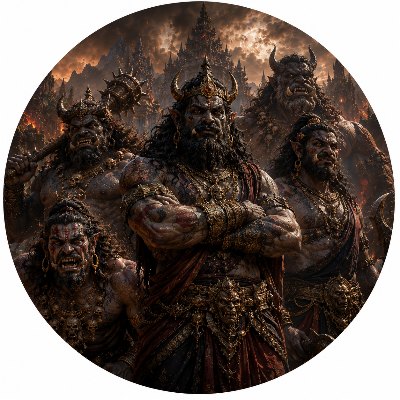
The Rakshasas have no single canonical iconographic form in the way that the major deities do, since as a class they are represented primarily through their individual members. Ravana's ten-headed form is his most distinctive iconographic attribute — he is shown with ten heads and twenty arms, carrying weapons and emblems of sovereignty, and is one of the most immediately recognisable figures in Indian visual culture. His ten heads are variously interpreted as representing his mastery of the four Vedas, the six schools of philosophy, and various forms of knowledge, or as symbols of his ten forms of passion and ego. Kumbhakarna is typically shown as a sleeping giant of immense size. Vibhishana, as the righteous Rakshasa, is sometimes depicted in the company of Rama and Hanuman, the monkey-general who served Rama, distinguished from demonic Rakshasa imagery by his benign posture and expression. Individual Rakshasas in narrative contexts are typically depicted with fanged teeth, wild hair, massive bodies, dark or reddish complexion, and fearsome expressions — conventions shared with Asura iconography and derived from the same underlying category of the terrifying supernatural opponent.
✦ Connection to the Wider Genealogy
In the genealogical scheme of the lineage tree in which this profile appears, the Rakshasas as a class descend from Kashyapa and Khasha, placing them in the same generational tier as the Yakshas — both classes are children of the same parents, making them sibling groups. The Yaksha king Kubera, lord of wealth and sovereign of the northern quarter, is the half-brother of Ravana, Kumbhakarna, and Vibhishana through their shared father, the sage Vishravas. This half-sibling relationship between the Yaksha sovereign and the Rakshasa royal family is narratively exploited in the Ramayana, where Ravana expels Kubera from Lanka — a city that was originally built by the divine architect Vishvakarman for Kubera — and seizes it as his own capital. This makes the Ramayana conflict, at one level, a family dispute between half-brothers of Yaksha and Rakshasa descent over a single great city.
The tree in which this profile appears has separately placed Heti — the first primordial Rakshasa named in the Ramayana's Uttara Kanda — and his descendants down to Ravana's children in a distinct branch from the Kashyapa-Khasha Rakshasa node. This is genealogically consistent with the textual evidence: Heti and his line represent the royal and named lineage of the Rakshasas as narrated in the Ramayana's own internal genealogy, while the Kashyapa-Khasha node represents the broader Puranic account of the origin of the Rakshasa class as a whole. Both branches are textually attested; both belong in a comprehensive genealogical reference.
✦ References
Primary Sources
- Rigveda: Contains the earliest references to Rakshasas as ritual-disrupting supernatural beings hostile to the gods and to the sacrificial order; Indra and Agni are praised for their destruction of Rakshasas.
- Atharvaveda: Contains extensive hymns directed against Rakshasas, Pisachas, and other supernatural threats, providing the most detailed Vedic picture of Rakshasa as a category of dangerous malevolent presence.
- Valmiki Ramayana (complete, all seven kandas): The primary narrative source for Rakshasa characterisation, genealogy, and mythology; the Uttara Kanda provides the most sustained genealogical account of the Rakshasa royal family and the cosmogonic origin story.
- Mahabharata, Adi Parva (Book 1): Contains genealogical passages identifying Khasha as the mother of the Rakshasas and Yakshas by Kashyapa; also includes the Hidimba and Hidimbi episode and the birth of Ghatotkacha.
- Mahabharata, Vana Parva (Book 3): Narrates the killing of Baka and Kirmira by Bhima, and contains numerous encounters between the Pandavas and Rakshasa beings during the forest exile.
- Vayu Purana: Principal Puranic source for the Kashyapa-Khasha genealogy of the Rakshasas; also contains cosmogonic accounts of the origin of the class.
- Vishnu Purana: Contains genealogical lists of Kashyapa's wives and the beings they produced, including the Rakshasas, and narrates episodes involving the Rakshasa royal family in the context of Vishnu's avatars.
- Bhagavata Purana: Extensively develops the theology of liberation through divine conflict, explaining how great Rakshasas (and Asuras) killed by Vishnu or his avatars receive moksha; contains the story of Prahlada and Hiranyakashipu as a paradigm of this doctrine.
- Brahmanda Purana: Contains genealogical lists relevant to the Rakshasa lineages and the descendants of Pulastya.
Modern Reference Works
- Vettam Mani, Puranic Encyclopaedia (1975): Provides consolidated entries on Ravana, Kumbhakarna, Vibhishana, Indrajit, Maricha, Ghatotkacha, and numerous other named Rakshasas, with cross-references to relevant Puranic and epic passages.
- Wendy Doniger O'Flaherty, The Origins of Evil in Hindu Mythology (1976): Provides sustained analysis of the theological function of Rakshasas and Asuras as embodiments of cosmic opposition and adharma in the Sanskrit tradition.
- Wisdomlib (wisdomlib.org), Rakshasa entries: Aggregates Puranic and epic references to Rakshasas across multiple texts with verse-level citations.