
About
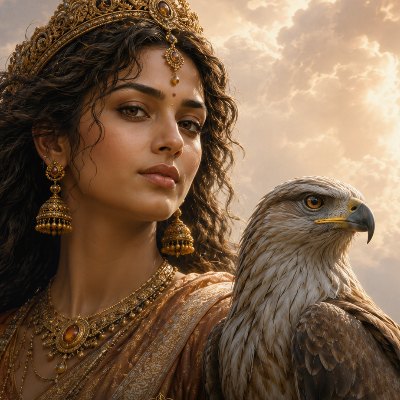
Bhasi — Daughter of Kashyapa and Tamra, Mother of Kites
Bhasi · Bhasa-matri · daughter of Tamra
Bhasi is a daughter of the primordial sage Kashyapa and his wife Tamra, and is identified in the Vishnu Purana and the Garuda Purana as the progenitrix of kites. Kashyapa, one of the seven great sages of the Saptarishi tradition and a Prajapati or progenitor-lord, fathered all principal orders of creation through his many wives, daughters of the progenitor Daksha. Tamra is the wife specifically associated in the Puranic genealogies with the origin of the major bird families, and her six daughters each head a distinct avian lineage or animal group. Bhasi's offspring — the kites, a family of medium-sized diurnal raptors — are among the most ecologically visible birds of prey on the Indian subcontinent, and their cosmogonic origin in the lineage of Kashyapa situates them within the sacred genealogical order of the Puranic world.
✦ The Name
The name Bhasi is the feminine form of Bhasa, a Sanskrit word denoting a kite or a class of kite-like birds of prey. The Bhasa appears in Sanskrit texts including the Mahabharata in lists of birds associated with forests, wilderness regions, and battlefield scenes, where kites and vultures are among the scavengers drawn to the aftermath of conflict. The Vishnu Purana and Garuda Purana are consistent and unambiguous in identifying Bhasi's offspring as kites specifically. The Padma Purana variant assigns a group called kurarangal to Bhasi, which may refer to a related category of medium-sized wading or shore birds; this variant is noted separately below. The name Bhasa is related to a Sanskrit root associated with shining or appearing, though whether this reflects a perceived quality of the kite's plumage or flight is not elaborated in the sources.
✦ Lineage
- Father: Kashyapa — one of the seven great sages (Saptarishis), a Prajapati or progenitor-lord, son of the sage Marichi who was himself born of Brahma; the foremost progenitor of all created beings in the Puranic system
- Mother: Tamra — a daughter of the progenitor Daksha given in marriage to Kashyapa; the wife through whom the principal bird families are descended in the Puranic system; her name means copper-coloured or dark red
- Siblings through Tamra (same mother and father): Shuki (mother of parrots, owls, and crows), Shyeni (mother of hawks), Gridhrika (mother of vultures), Sugrivi (mother of horses, camels, and asses), and Shuchi (mother of water-fowl)
- Offspring: Kites (Bhasa) — medium-sized diurnal raptors characterised by their forked tails, buoyant flight, and scavenging habits, who descend from Bhasi as their ancestral mother according to the Vishnu Purana and Garuda Purana
✦ The Kite in Sanskrit Literature and Tradition
The kite is one of the most commonly observed large birds of prey across the Indian subcontinent, and it appears frequently in Sanskrit epic and Puranic literature as a background presence in descriptions of forest, field, and battlefield. The Brahmin kite (Halastur indus) in particular, with its striking chestnut and white plumage, has long been associated in the popular tradition with Garuda — the divine eagle, vehicle of Vishnu — because of its physical resemblance to artistic depictions of that figure. However, Garuda himself is born not of Tamra but of Kashyapa's wife Vinata, and his lineage is entirely separate from the kite lineage headed by Bhasi. The kites descended from Bhasi are related to Garuda only through their shared father Kashyapa.
In the context of the battlefield descriptions that are a major feature of both the Mahabharata and the Ramayana, kites appear alongside vultures and crows as birds that gather in anticipation of or following carnage. This ecological role as battlefield scavengers gives the kite a place in the symbolic register of Sanskrit war literature alongside the vulture lineage of Gridhrika and, in a different register, the crow lineage of Shuki.
✦ Textual Variants
The Vishnu Purana and Garuda Purana agree precisely in assigning kites to Bhasi. The Padma Purana gives a different account of Tamra's daughters in which Shyeni (rather than Bhasi) is the mother of kites, and Bhasi is assigned a group called kurarangal — a term that may refer to certain wading or shore birds and whose precise identification is not settled in the secondary literature. The Agni Purana names Bhasi among Tamra's daughters but does not assign individual offspring to each daughter. These variant accounts are recorded here without harmonisation; the Vishnu Purana and Garuda Purana are treated as the primary record given their mutual consistency.
✦ Connection to the Wider Genealogy
Through her father Kashyapa, Bhasi is related to the full range of Kashyapa's progeny by other wives — the Adityas, Daityas, Danavas, Nagas, Garuda, the plant kingdom, and all other classes of created beings. Through her mother Tamra, she shares parentage with the five other daughters enumerated in Tamra's lineage. The kites descended from Bhasi thus stand within the Puranic cosmogonic system as creatures of divinely ordered genealogical origin, related through their grandmother Tamra and grandfather Kashyapa to the whole of created life.
✦ References
- Primary Sources
- Vishnu Purana, Book I, Chapter 21: Names Bhasi as a daughter of Tamra and Kashyapa and clearly identifies kites as her offspring in the enumeration of Tamra's progeny.
- Garuda Purana, Chapter VI (Dutt translation): Corroborates the Vishnu Purana precisely, assigning kites to Bhasi within the same six-daughter enumeration of Tamra's lineage.
- Padma Purana, Srishti-khanda, Chapter 6: Gives a variant in which Bhasi's offspring are identified as kurarangal rather than kites, and kites are instead assigned to Shyeni.
- Agni Purana, Chapter 19: Names Bhasi among Tamra's daughters without individually assigning offspring to each.
- Mahabharata, Vana Parva and Bhishma Parva (various passages): Mentions kite-class birds in descriptions of forest and battlefield settings; provides context for the kite's place in Sanskrit literature.
- Secondary Sources
- Mani, Vettam. Puranic Encyclopaedia. Motilal Banarsidass, 1975: Covers Tamra's daughters and the bird lineages of the Puranas, including the Bhasi entry.
- Monier-Williams, M. A Sanskrit-English Dictionary. Oxford, 1899: Defines Bhasa as a kite or kite-like bird with textual attestations from epic and Puranic sources.