
About
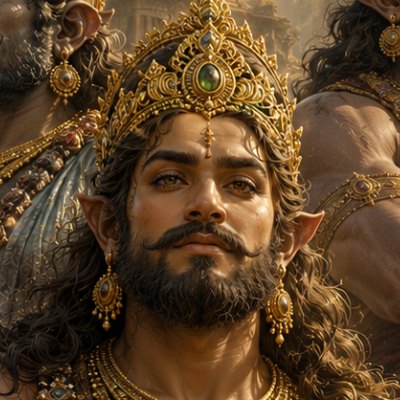
Suketu — Yaksha King and Father of Tataka
Suketu · father of Tataka · Yaksha king
Suketu is a Yaksha king who appears exclusively in the Bala Kanda of the Valmiki Ramayana, in the passage where the sage Vishvamitra narrates the origin of Tataka to the young prince Rama. His role in the text is entirely genealogical and contextual: he is the father of Tataka, and his act of austerity directed at Brahma is the event that results in Tataka's birth and in the extraordinary boon of strength that defines her subsequent career. Beyond this episode, Suketu is not attested as a significant or recurring figure in any of the principal primary sources of the Hindu tradition. The textual basis for his profile is therefore narrow, and this profile is proportionally brief in keeping with that limited evidence.
✦ The Name
The name Suketu is a Sanskrit compound formed from su (good, auspicious, excellent) and ketu (banner, sign, luminary, or mark of distinction). The compound thus carries the sense of one with an auspicious sign or one bearing an excellent standard — a name befitting a Yaksha king of high standing. It is a proper name and not an epithet derived from any narrative episode. The name does not appear in contexts beyond the Tataka episode of the Ramayana, and no etymology is offered within the text itself.
✦ Lineage
- Class: Yaksha — Suketu belongs to the class of semi-divine nature beings associated with the guardianship of forests, natural wealth, and the unseen world, who are principally under the sovereignty of Kubera, the lord of wealth and regent of the northern quarter.
- Daughter: Tataka — the only child of Suketu, born as a beautiful Yakshini through a boon granted by Brahma, and endowed at birth with the strength of a thousand elephants. Tataka later married the Rakshasa Sunda and was transformed into a Rakshasi by the curse of the sage Agastya, becoming the demoness of the Tatakavana who was ultimately killed by Rama.
- Grandchildren (through Tataka and Sunda): Maricha — the shape-shifting demon of the Ramayana's Aranya Kanda; and Subahu — the demon commander killed by Rama during the protection of Vishvamitra's sacrifice.
✦ The Austerity and Brahma's Boon
The Valmiki Ramayana records that Suketu was a great Yaksha who was without offspring and who undertook severe tapas — sustained ascetic austerity — directed at Brahma the creator, motivated by the desire for an heir. The text does not specify the form or duration of the austerities, only that they were of sufficient intensity and merit to draw Brahma's direct attention and response. Brahma, pleased with Suketu's penance, granted him a daughter. The text implies that Suketu had desired a son — as was the conventional expectation in the context of Vedic and epic literature, where a son was considered the primary vehicle of lineage continuation, ritual duty, and ancestral welfare — but Brahma chose to grant a daughter instead. To compensate for the absence of the male strength Suketu had perhaps hoped a son would bring, Brahma endowed this daughter with the physical might of a thousand elephants, a degree of strength exceptional even among supernatural beings.
This is the entirety of Suketu's direct narrative role. He does not appear again in the Ramayana after this backstory is provided by Vishvamitra, and his subsequent fate is not recorded in any primary source. Whether he witnessed the consequences of Tataka's transformation and career of destruction, or whether he had died or departed to another realm before those events, the text does not say.
✦ Connection to the Wider Genealogy
Suketu stands at the head of a short but genealogically significant lineage that bridges the Yaksha and Rakshasa classes in the Ramayana tradition. As a Yaksha king he belongs to the broader class of beings generated in the Puranic tradition from Kashyapa and Khasha and governed by Kubera. Through his daughter Tataka's marriage to Sunda the Rakshasa, and through Agastya's curse that transformed Tataka and her sons into Rakshasas, Suketu is the Yaksha progenitor from whom the demon Maricha — one of the most consequential supporting characters of the Ramayana — ultimately descends. Suketu thus sits at the genealogical boundary between the Yaksha and Rakshasa branches of the lineage tree, as the last purely Yaksha figure in a line that crosses into Rakshasa identity through his daughter.
✦ References
Primary Sources
- Valmiki Ramayana, Bala Kanda, Sargas 24–25: The sole primary source for Suketu. Vishvamitra's narration of Tataka's backstory to Rama contains the only recorded account of Suketu's identity, his austerity before Brahma, and the boon through which Tataka was born.
Modern Reference Works
- Vettam Mani, Puranic Encyclopaedia (1975): Brief entry on Suketu, identifying him as Tataka's father and a Yaksha, consistent with the Ramayana account and noting the absence of further textual attestation.
- Wisdomlib (wisdomlib.org), Tataka entry: The Suketu reference appears within the broader Tataka entry and corroborates the Bala Kanda account of his identity and the boon he received.