
About
Maricha — Shape-Shifting Rakshasa, the Golden Deer, and Reluctant Instrument of Ravana
Maricha · Marica · son of Sunda and Tataka · the golden deer (Kanchana Mriga)
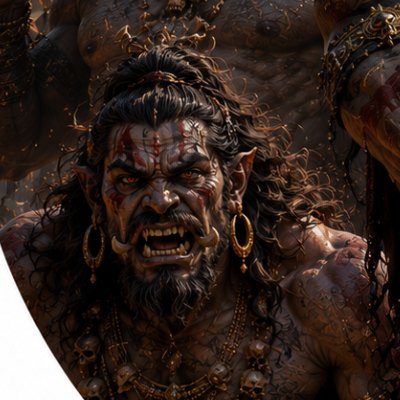
Maricha is a Rakshasa of considerable narrative importance in the Valmiki Ramayana, appearing in two distinct phases of the epic separated by years and by a profound personal transformation. He is the son of the Rakshasa Sunda and the Yakshini Tataka, who was cursed into Rakshasa form by the sage Agastya. In the Bala Kanda he is a demon commander who participates in the disruption of Vishvamitra's sacrificial rites alongside his mother Tataka and his brother Subahu, and who survives his encounter with the young Rama only because Rama chooses to spare his life. In the Aranya Kanda he reappears as a reformed ascetic living in voluntary solitude, only to be coerced by Ravana into assuming the form of a supernaturally beautiful golden deer — the celebrated Kanchana Mriga — whose enchanting appearance lures Rama away from Sita's side and enables Sita's abduction. Maricha's arc — from demon warrior to reluctant penitent to the unwilling instrument of a catastrophe he foresaw and dreaded — makes him one of the more psychologically complex subsidiary figures of the Ramayana. He appears also in references within the Mahabharata, where his Rakshasa identity and his connection to the Tataka lineage are corroborated.
✦ The Name
The name Maricha (also spelled Marica in transliteration) is a Sanskrit word meaning ray of light or a particle of light, and is also the name of one of the Saptarshis (the seven great sages) in some Puranic lists — though this Maricha the sage is an entirely distinct figure from Maricha the Rakshasa of the Ramayana. The use of a name associated with luminosity for a Rakshasa whose most celebrated act involves assuming a form of dazzling, deceptive beauty may be a deliberate irony in the text's composition, though the primary sources do not explicitly comment on this. The epithet Kanchana Mriga, meaning golden deer, refers specifically to the illusory form Maricha assumes at Ravana's command and is not a personal name but a descriptive designation for that episode.
✦ Lineage
- Father: Sunda — a Rakshasa, son of Jharjha (or Jambha in variant manuscripts), who was destroyed by the wrath of the sage Agastya after attacking his hermitage.
- Mother: Tataka — born a Yakshini, daughter of the Yaksha king Suketu, endowed by Brahma's boon with the strength of a thousand elephants, and transformed into a hideous Rakshasi by Agastya's curse following her husband Sunda's death. Tataka was subsequently killed by Rama in the Tatakavana.
- Brother: Subahu — a demon commander who fought alongside Tataka and Maricha in disrupting Vishvamitra's sacrificial rites and who was killed by Rama in that encounter, unlike Maricha who was spared.
- Mixed genealogical identity: Through his father Sunda, Maricha belongs to the Rakshasa class. Through his mother Tataka — who was born a Yakshini and only became a Rakshasi through curse — he carries Yaksha descent on the maternal side. His post-curse identity is firmly Rakshasa in all textual accounts.
✦ The Bala Kanda — First Encounter with Rama
Maricha's first appearance in the Ramayana occurs in the Bala Kanda, in the episode where the sage Vishvamitra brings the young princes Rama and Lakshmana to protect his sacrificial rites from demonic disruption. Tataka, Maricha, and Subahu had been routinely defiling these rites by raining blood, flesh, and bones upon the sacred fire at the critical moments of the ceremony. When Rama and Lakshmana took up their stations to guard the sacrifice, Maricha and Subahu arrived to repeat their disruption. Rama loosed a weapon — the Manavastra — at Maricha, which did not kill him but struck him with such force that it hurled him far out across the ocean, depositing him unharmed at a great distance. Subahu was killed by a different weapon. The Valmiki Ramayana's account makes explicit that Rama chose to spare Maricha's life at this point — the weapon used was selected deliberately to disable rather than destroy.
This act of mercy, or at minimum of intentional restraint, is significant for Maricha's subsequent characterisation. The experience of being struck by Rama's weapon — of feeling the overwhelming power of the prince's prowess — appears in the Aranya Kanda to have had a lasting effect on Maricha's understanding of who Rama was. When Ravana later comes to him with a plan, Maricha's dread of Rama is entirely grounded in personal, bodily experience.
✦ The Aranya Kanda — Reform, Coercion, and the Golden Deer
By the time of the Aranya Kanda, set years later during the Pandavas' forest exile — the Ramayana's Aranya Kanda, not the Mahabharata's — Maricha is living as a solitary ascetic in a hermitage in the forest, having apparently abandoned his former life of violence. Some later commentary traditions and regional retellings describe him as having undergone genuine spiritual transformation, presenting him as a penitent who had recognised the futility and wrongness of his earlier conduct. Whether this represents sincere reform or merely prudent withdrawal from a world in which Rama's power had become unmistakeable is a question the text leaves somewhat open.
Ravana, the ten-headed king of Lanka, came to Maricha seeking assistance in his plan to abduct Sita — the wife of Rama — as revenge for the mutilation of his sister Surpanakha by Lakshmana. Ravana's plan required a decoy: he needed Maricha to assume the form of a beautiful golden deer to draw Rama away from Sita's vicinity, creating an opportunity for the abduction. The Aranya Kanda of the Ramayana records Maricha's response in considerable detail. He argued strenuously against the plan, warning Ravana of Rama's extraordinary power, recounting his own experience of being struck by Rama's weapon in the Bala Kanda, and predicting with apparent certainty that the plan would lead to the destruction of Lanka and the entire Rakshasa race. He urged Ravana repeatedly to return Sita after she was taken, to make peace, to abandon a course of action he considered suicidal for all of them.
Ravana rejected all of Maricha's counsel and threatened him with immediate execution if he refused to cooperate. Maricha, faced with the choice between certain death at Ravana's hand and the possibility — however slim — of survival if he obeyed, chose to comply. His reasoning as the Ramayana presents it was stark: death at Rama's hand, which he considered the inevitable outcome of the plan, was preferable to death at Ravana's hand, because being killed by Rama carried a form of spiritual liberation whereas being killed by Ravana did not. This reasoning, which has attracted considerable attention in later theological commentary, aligns Maricha with the broader Bhagavata Puranic doctrine that death at the hands of a divine being or avatar confers moksha upon the slain.
Maricha accordingly assumed the form of a deer of spectacular beauty — golden-flanked, jewel-spotted, of a brilliance unlike any natural animal — and appeared near Rama's forest hermitage at Panchavati. Sita, captivated by the creature's beauty, asked Rama to capture it for her. Despite Lakshmana's warning that the deer was likely an illusion and possibly the Rakshasa Maricha — he knew of Maricha's ability to assume such forms — Rama went in pursuit of the deer, leaving Lakshmana to guard Sita. Maricha led Rama deep into the forest. When Rama finally shot the deer with an arrow, Maricha, at the moment of death, cried out in Rama's voice for Lakshmana and for Sita, mimicking Rama's voice as a final act of the deception. This cry lured Lakshmana away from Sita's side to search for his brother, leaving her unguarded. Ravana seized this moment to abduct Sita.
✦ Textual Variants and Additional Traditions
The core account of Maricha's role in both the Bala Kanda and the Aranya Kanda is stable across the principal manuscripts of the Valmiki Ramayana. Regional and later retellings of the Ramayana — including the Adhyatma Ramayana and various vernacular versions — preserve the golden deer episode as a fixed narrative element, with minor variation in framing and emphasis.
Some later commentary and Puranic traditions describe Maricha in his pre-Rakshasa existence as a sage or a divine being who was cursed into Rakshasa form — a convention in the tradition of presenting major Rakshasa figures as beings undergoing karmic purgation rather than as inherently demonic entities. The Valmiki Ramayana itself does not state this: it identifies him straightforwardly as the son of Sunda and Tataka, both Rakshasas by the time of his birth. The sage-cursed-into-demon tradition for Maricha appears to be a later elaboration.
✦ Theological Significance
Maricha is one of several Rakshasa figures in the Ramayana who embodies the theological principle that death inflicted by an avatar of Vishnu — here Rama — constitutes liberation rather than mere destruction. His explicit articulation of this reasoning in the Aranya Kanda, when he chooses participation in Ravana's plan precisely because it guarantees his death at Rama's hands, makes him the clearest exposition of this doctrine in the Ramayana text. Later Vaishnava commentators drew on this passage extensively in developing the theology of the salvific nature of divine contact, even in the form of conflict and death. Maricha's foreknowledge of his own fate, his helplessness to prevent it, and his final act of crying out in Rama's voice all contribute to his unusual standing as a Rakshasa character whose moral and theological dimensions the text treats with evident care.
✦ Connection to the Wider Genealogy
In the genealogical tree in which this profile appears, Maricha stands as the child of Sunda (Rakshasa, son of Jharjha) and Tataka (Yakshini by birth, Rakshasi by curse, daughter of the Yaksha king Suketu). He is thus of mixed Yaksha-Rakshasa descent, though his functional identity in the texts is entirely Rakshasa. His brother Subahu shares this parentage. Maricha has no children recorded in any primary source, and his line ends with him. His significance to the wider genealogy is not propagative but narrative: he is the pivot-point of the Aranya Kanda's central episode, the agent whose participation in Ravana's plan sets the Ramayana's war in motion.
✦ References
Primary Sources
- Valmiki Ramayana, Bala Kanda, Sargas 24–30: Establishes Maricha's parentage through Vishvamitra's narration and records his first encounter with Rama during the protection of Vishvamitra's sacrifice, including the use of the Manavastra to hurl him away rather than kill him.
- Valmiki Ramayana, Aranya Kanda, Sargas 35–44: The principal source for Maricha's role as the golden deer — his meeting with Ravana, his lengthy warnings against the plan, his coerced compliance, his assumption of the golden deer form, his pursuit and death at Rama's hand, and his final cry in Rama's voice.
- Mahabharata, Adi Parva: Contains references corroborating Maricha's identity as a Rakshasa of notable power and his connection to the Tataka lineage.
Modern Reference Works
- Vettam Mani, Puranic Encyclopaedia (1975): Entry on Maricha with cross-references to both the Bala Kanda and Aranya Kanda episodes, and notes on later commentary traditions regarding his status as a reformed or formerly divine being.
- Wisdomlib (wisdomlib.org), Maricha entry: Aggregates textual references to Maricha across Ramayana manuscripts and secondary Sanskrit literature with verse-level citations.