
About
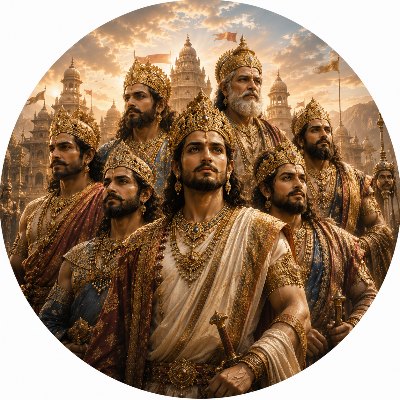
Prashruta to Takshaka — Seven Kings of the Ikshvaku Solar Dynasty, Descendants of Maru
Prashruta · Sandhi · Amarshana · Mahasvan · Vishvasahva · Prasenajit · Takshaka
This profile covers seven successive kings of the Ikshvaku Solar Dynasty who reigned between Prashruta — the son of Maru, the immortal yoga master of Kalagrama — and Takshaka, the human Ikshvaku king of Kosala who is the father of Brihadbala. These seven kings are recorded in the Bhagavata Purana's ninth skandha, chapter twelve, verses seven and eight, as an unbroken patrilineal chain linking the era of the extraordinary king Maru to the era of Brihadbala, who died in the Kurukshetra war. No independent narrative episodes are recorded for any of these seven kings in the primary sources consulted; they are known solely through their positions in the dynastic succession. Their profile is necessarily brief and honest about this limited textual basis, as the Bhagavata Purana itself notes that its genealogical lists record only the most significant kings, with many intermediate rulers left unnamed.
✦ Dynastic Context
These seven kings form the final segment of the Ikshvaku succession between Maru — whose yogic immortality makes him the dynasty's cosmic guardian — and Brihadbala, the last great warrior-king of the line. The Bhagavata Purana frames this entire portion of the succession as belonging to the era immediately preceding the Mahabharata war: Brihadbala, a contemporary of the Pandavas, fought on the Kaurava side and was slain by Abhimanyu on the thirteenth day of the Kurukshetra battle. The seven kings in this profile are thus his immediate ancestors, the mortal Ikshvaku rulers who bridged the age of Maru's departure from ordinary royal life and the age of the great war.
✦ The Succession: King by King
- Prashruta: Son of Maru — the immortal Ikshvaku king who resides still in the village of Kalagrama through the power of yoga and who will revive the Solar Dynasty at the close of the Kali Yuga. Prashruta is named in the Bhagavata Purana as Pra-Sushruta, a prefixed form of the name Sushruta, which in Sanskrit means well-heard or of good repute. Some extended secondary genealogical lists interpolate an additional king named Susandhi between Prashruta and Sandhi, but the Bhagavata Purana's ninth skandha gives Prashruta's son directly as Sandhi. No narrative episode is recorded for Prashruta beyond his position as the link between the extraordinary Maru and the resumption of ordinary royal succession.
- Sandhi: Son of Prashruta. His name in Sanskrit means junction, alliance, or bond — a term of wide application in grammar, diplomacy, and cosmology. No narrative episode is recorded for Sandhi in the primary sources consulted.
- Amarshana: Son of Sandhi. The name derives from the Sanskrit root amarsha, meaning impatience, indignation, or inability to endure — a name with martial connotations. The Bhavishya Purana's Pratisarga Parva, which preserves a parallel Ikshvaku succession list, notes of Amarshana only that he ruled like his father, which is the sole characterisation available for him across the sources consulted. No other narrative detail is recorded.
- Mahasvan: Son of Amarshana. The name compounds maha, meaning great, with svan, meaning sound or resonance — thus the one of great sound or great voice, a name perhaps reflecting the epic tradition's association of sovereignty with proclamation and command. No narrative episode is recorded for Mahasvan in the primary sources consulted.
- Vishvasahva: Son of Mahasvan. The Bhagavata Purana renders this name as Vishvasahva; some variant Puranic lists and secondary compilations give it as Vishvasaha or Vishvasahva. The name compounds vishva, meaning all or universal, with sahva or saha, meaning bearing, enduring, or companion — thus the all-bearing, the one who sustains all, or the universal companion. No narrative episode is recorded for Vishvasahva in the primary sources consulted.
- Prasenajit: Son of Vishvasahva. He is the penultimate king in this group, the father of Takshaka and the grandfather of Brihadbala. His name combines prasena, referring to a battle array or a form of military deployment, with jit, meaning conqueror — thus the conqueror of battle arrays or victor in war. This Prasenajit is a human Ikshvaku king of Kosala and is entirely distinct from the later Prasenajit who appears in the post-Brihadbala Kali Yuga succession list of the same Bhagavata Purana chapter, as well as from the famous Kosala king Prasenajit who appears in Buddhist texts as a contemporary of the historical Buddha. The shared name across these distinct figures has the potential to cause confusion in secondary literature, and care must be taken to identify which Prasenajit is being referenced in any given context. No narrative episode is recorded for this Ikshvaku Prasenajit in the primary sources consulted.
- Takshaka: Son of Prasenajit and father of Brihadbala. He is the final king in this group and the immediate father of the warrior-king Brihadbala. As noted in the profile of Brihadbala, this Takshaka is a human Ikshvaku king of Kosala — a mortal ruler occupying a fixed position in the documented human succession from Kusha to Brihadbala — and is entirely distinct from the Naga king Takshaka, the serpent ruler who kills the Pandava king Parikshit and who belongs to the race of serpents descended from the sage Kashyapa and Kadru. The shared name between these two figures has been a source of confusion in secondary literature and popular tradition; the Bhagavata Purana's genealogical text is unambiguous in treating this Takshaka as a human Ikshvaku king. No narrative episode is recorded for this Ikshvaku Takshaka in the primary sources consulted beyond his position as Prasenajit's son and Brihadbala's father.
✦ The Critical Distinction: Ikshvaku Takshaka and Naga Takshaka
The name Takshaka is shared by two entirely separate figures in the Puranic corpus and the Mahabharata, and the distinction between them is fundamental to reading the Ikshvaku genealogy correctly. The Naga king Takshaka is the serpent ruler who bites and kills Parikshit — the grandson of Arjuna — as narrated in the Bhagavata Purana's ninth and tenth skandhas and in the Adi Parva of the Mahabharata. He is a serpent being, a member of the Naga race descended from the sage Kashyapa and Kadru, and he has a son named Ashvasena who harboured a personal vendetta against Arjuna arising from the Khandava forest burning. The Naga Takshaka has no connection whatsoever to the Ikshvaku royal lineage.
The Ikshvaku king Takshaka, by contrast, is a human ruler of Kosala, son of the human king Prasenajit, who occupies his position in the Bhagavata Purana's direct genealogical chain from Kusha to Brihadbala. The two Takshakas lived in entirely different realms, belonged to entirely different species of being in the Puranic cosmos, and are connected only by the accident of a shared name. Some popular and secondary sources have conflated the two, suggesting that Brihadbala was the son of the Naga Takshaka; the primary textual evidence of the Bhagavata Purana does not support this identification.
✦ Textual Variants
The Bhagavata Purana's ninth skandha, chapter twelve, verses seven and eight, gives the succession in this group as Prashruta, Sandhi, Amarshana, Mahasvan, Vishvasahva, Prasenajit, Takshaka — seven kings in a clean, unbroken chain. Some extended secondary genealogical lists, drawing from cross-Puranic traditions or from texts such as the Bhavishya Purana's Pratisarga Parva, interpolate an additional king — named Susandhi or Sugandhi — between Prashruta and Sandhi, which would expand the group to eight kings. This interpolation does not appear in the Bhagavata Purana's own text at this point and is treated here as a variant tradition rather than the primary account.
The name Vishvasahva appears as Vishvasaha in some secondary compilations. The name Prashruta appears as Prasushruta or Sushruta in different Puranic lists. These represent the ordinary pattern of minor name-variation across the Puranic manuscript traditions for the intermediate kings of this dynasty.
✦ Connection to the Wider Genealogy
These seven kings form the concluding segment of the post-Kusha Ikshvaku chain before the Mahabharata era. Above them stands Maru — the immortal yoga master, son of Shighra and living guardian of the Solar Dynasty's cosmic continuity. Above Maru rises the entire sequence from Kusha, son of Rama, through Atithi, the thirteen unnamed kings, Hiranyanabha the yoga preceptor, and the five kings from Pushya to Shighra. Below Takshaka stands Brihadbala — his son — the last great warrior-king of the Solar Dynasty, who fought for Duryodhana at Kurukshetra and was slain by Abhimanyu within the Padmavyuha on the thirteenth day of the war. With Brihadbala's death the dynasty's heroic age effectively ends, and the Bhagavata Purana then traces the much longer list of future Kali Yuga kings from Brihadbala's son Brihadrana through to Sumitra, the last ruler before the dynasty's final extinction.
✦ References
- Bhagavata Purana, Skandha IX, Chapter 12, Verses 7–8: Primary source. The definitive genealogical text for this group. Verse 7 gives the chain Prashruta (Pra-Sushruta), Sandhi, Amarshana, Mahasvan, Vishvasahva; verse 8 continues with Prasenajit, Takshaka, and Brihadbala, identifying Brihadbala as the one killed by Abhimanyu. These two verses constitute the complete primary textual basis for the seven kings in this profile.
- Vishnu Purana, IV.4 and IV.22: Primary source. Contains the Ikshvaku succession list including this segment; provides corroborating genealogical data and is one of the three principal Puranic sources for the post-Kusha Ikshvaku king list alongside the Bhagavata Purana and the Vayu Purana.
- Vayu Purana, 88 and 99: Primary source. Preserves a parallel Ikshvaku succession list broadly consistent with the Bhagavata Purana at this segment.
- Brahmanda Purana, III.63 and III.74: Primary source. Further Puranic corroboration of the Ikshvaku succession including the kings in this group.
- Bhavishya Purana, Pratisarga Parva: Primary source. A parallel Ikshvaku king list that notes of Amarshana only that he ruled like his father, providing the sole surviving characterisation for that king; also interpolates an additional king Susandhi between Prashruta and Sandhi, representing a textual variant from the Bhagavata Purana account.
- G.V. Tagare, Bhagavata Purana translation (1950): Modern reference. The translated verses IX.12.7–8 were directly consulted to verify the precise names and sequence of kings in this group and to confirm the statement that Brihadbala was killed by Abhimanyu.
- Cologne Digital Sanskrit Dictionaries — Monier-Williams: Modern reference. Consulted for the etymology and meaning of the individual names Prashruta, Sandhi, Amarshana, Mahasvan, Vishvasahva, Prasenajit, and Takshaka.